
Discover how to get a scholarship to study in the USA in 2026. Explore eligibility criteria, fully funded scholarships, required documents, and application tips.
Studying in the United States is a dream for many international students who want to receive a quality education, gain international experience, and build successful careers. However, the cost of studying abroad can be expensive. Tuition fees, accommodation, food, transportation, health insurance, and other living expenses can create financial challenges for students and their families.
Fortunately, several scholarship opportunities are available for eligible international students who want to pursue higher education in the United States. These scholarships may be offered by universities, educational foundations, government programs, and private organizations. Depending on the scholarship, students may receive financial assistance for tuition fees, living expenses, books, and other educational costs.
If you are planning to study in the USA in 2026, understanding the scholarship application process can help you prepare effectively. This guide explains how to find scholarships, check eligibility, prepare the necessary documents, and improve your chances of receiving financial assistance.
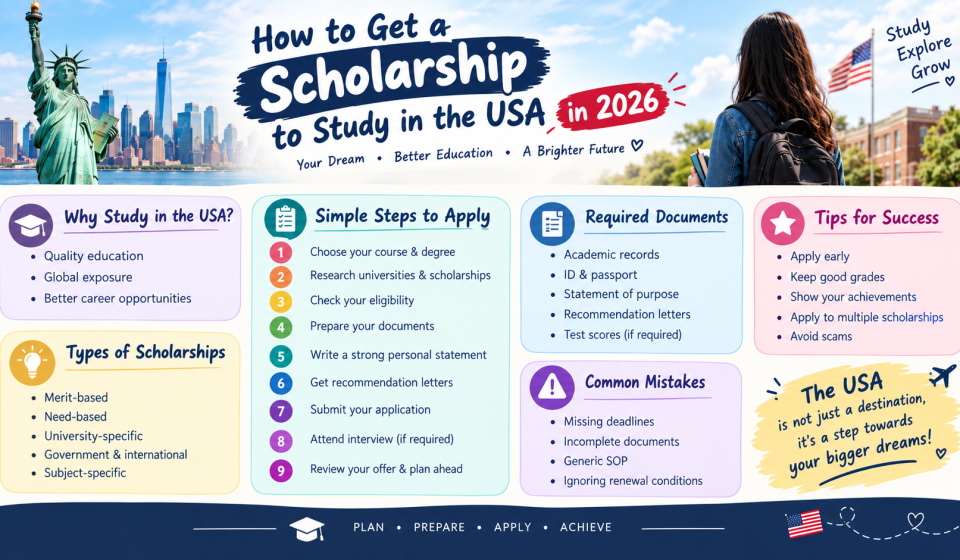
Why Study in the USA in 2026?
The United States is a popular destination for international students because of its educational opportunities, research facilities, and diverse academic programs. Students can choose from undergraduate degrees, master’s programs, doctoral studies, and specialized professional courses.
Here are some important benefits of studying in the USA:
- Quality education: Many American universities provide recognized qualifications and comprehensive academic programs.
- Career opportunities: Students can develop professional skills through academic projects, research, and eligible practical training.
- Research facilities: Universities may provide access to laboratories, advanced technology, and research opportunities.
- International exposure: Students can interact with people from different cultures and backgrounds.
- Flexible education system: Many institutions offer a wide range of subjects, majors, and elective courses.
- Professional development: Students can improve their communication, problem-solving, and critical-thinking skills.
Although studying in the USA offers several advantages, students should carefully consider university fees, scholarship availability, living expenses, and admission requirements before making a decision.
What Is a Scholarship for Studying in the USA?
A scholarship is financial assistance provided to students to support their education. Unlike a conventional education loan, a scholarship generally does not need to be repaid, provided the student follows the award’s conditions.
Scholarships can cover different educational expenses. Some provide a fixed amount of money, while others cover a percentage of tuition fees. Certain competitive programs provide funding for several major expenses, including accommodation and living costs.
For example, a university may award a scholarship to a student who demonstrates excellent academic performance. Another program may provide financial support to students who meet specific financial-need requirements.
Scholarship eligibility and benefits vary by institution and program. Therefore, students should carefully review the conditions before applying.
Types of Scholarships Available to Study in the USA
Understanding the different types of scholarships can help you identify opportunities that match your qualifications and financial needs.
1. Merit-Based Scholarships
Merit-based scholarships are awarded to students based on academic achievements, exceptional talents, leadership, or other accomplishments.
Universities may consider previous grades, examination results, extracurricular activities, competitions, research, and community involvement.
These scholarships are suitable for students who can demonstrate strong academic performance or outstanding abilities.
2. Need-Based Scholarships
Need-based scholarships provide financial assistance to students who meet specific financial requirements.
Applicants may need to provide information about family income, household finances, or other financial circumstances.
However, eligibility varies between institutions, and not all need-based scholarships are available to international students.
3. University-Specific Scholarships
Many American universities offer scholarships to attract talented students from different countries.
These scholarships may be available to undergraduate, postgraduate, and doctoral students. Some are awarded automatically during the admission process, while others require a separate application.
Students should compare scholarship amounts, eligibility criteria, deadlines, and renewal conditions before selecting a university.
4. Government and International Scholarships
Certain governments and international organizations support students who want to pursue education or research abroad.
For example, the Fulbright Foreign Student Program provides opportunities for eligible international students to pursue graduate study or research in the United States.
The benefits, application process, and eligibility requirements depend on the applicant’s country and the specific program.
5. Subject-Specific Scholarships
Some scholarships are designed for students studying particular subjects, including engineering, computer science, business, science, public policy, and the arts.
These awards may be offered by universities, professional associations, foundations, and research organizations.
Students should search for opportunities related to their intended degree and career goals.
How to Get a Scholarship to Study in the USA in 2026
Getting a scholarship requires careful planning, research, and preparation. Follow these steps to make the application process easier.
Step 1: Choose Your Course and Degree Level
Begin by deciding what you want to study in the United States.
You may want to pursue an undergraduate degree, a master’s degree, a doctoral program, or a specialized academic course.
Your degree level is important because scholarship eligibility varies. Some programs are exclusively for graduate students, while others accept undergraduate applicants.
Prepare a list of courses that match your educational background, interests, and long-term career goals.
Step 2: Research Universities and Scholarship Opportunities
After selecting your preferred courses, identify universities that offer suitable programs.
Research their admission requirements, tuition fees, financial aid options, and scholarship opportunities.
For each scholarship, check:
- Eligibility requirements.
- Academic qualifications.
- Available funding and covered expenses.
- Application deadlines.
- Required documents.
- Whether a separate scholarship application is necessary.
- Conditions for renewing the scholarship.
Start researching early because some universities have application deadlines several months before the academic year begins.
Step 3: Check Your Eligibility
Before applying, make sure you meet the scholarship requirements.
Common eligibility factors include academic qualifications, citizenship, intended course, financial circumstances, English-language proficiency, and previous educational experience.
Some institutions may require IELTS, TOEFL, or another accepted English-language qualification. Others may accept alternative evidence of English proficiency.
Certain programs may also require standardized examination scores, research experience, professional experience, or specific academic achievements.
Remember that meeting a university’s admission requirements does not automatically make you eligible for every scholarship.
Step 4: Prepare Your Academic Documents
Academic records are an important part of many scholarship applications.
Depending on your course and the scholarship, you may need:
- Class 10 and Class 12 mark sheets.
- College transcripts or university mark sheets.
- Degree certificates, if applicable.
- Academic certificates and awards.
- English-language test results, if required.
- Standardized examination scores, if required.
Keep digital copies of your documents organized and ensure that the information is accurate.
Some institutions may require official transcripts, certified copies, or translated documents. Follow the instructions provided by each institution.
Step 5: Write a Strong Personal Statement
A personal statement or statement of purpose explains your educational background, academic interests, achievements, and future plans.
A strong statement should answer three important questions:
- Why do you want to study in the USA?
- Why have you selected this particular course or university?
- How will the scholarship help you achieve your educational and career goals?
For example, a computer science student could discuss an interest in software development, artificial intelligence, cybersecurity, or technological research.
Avoid writing generic statements that could apply to any applicant. Instead, explain your own experiences, achievements, interests, and ambitions honestly.
Always follow the required word limit and application instructions.
Step 6: Obtain Recommendation Letters
Some scholarship programs require recommendation letters from teachers, professors, academic advisers, or professional supervisors.
Choose recommenders who understand your academic abilities, work ethic, achievements, and potential.
Give them enough time to prepare the letters. You can also provide information about your chosen course, scholarship requirements, and career goals.
Ensure that the recommendation letters meet the institution’s submission requirements.
Step 7: Submit Your Application Before the Deadline
Complete the application form carefully and submit all required documents before the official deadline.
Some universities automatically consider eligible students for scholarships when they apply for admission. Others require a separate application or additional essays.
Maintain a record of your applications, deadlines, required documents, and submission status.
If you are applying for the 2026–2027 academic year, check whether applications are still open. Some deadlines may already have passed by October 2026.
Students planning to begin their studies in a later academic term should research upcoming application cycles and prepare their documents in advance.
Step 8: Prepare for Scholarship Interviews
Some competitive scholarship programs require an interview.
You may be asked about your academic achievements, career goals, leadership experience, chosen course, and reasons for applying.
Prepare clear and honest answers that demonstrate your motivation and understanding of the program.
Practise common interview questions with a teacher, friend, or mentor. Research the scholarship’s objectives and be prepared to explain how you intend to use the educational opportunity.
Step 9: Review Your Scholarship Offer
If you receive a scholarship offer, read the terms carefully before accepting it.
Confirm the following details:
- Total scholarship amount.
- Tuition fees covered.
- Whether accommodation and living expenses are included.
- Scholarship duration.
- Academic performance requirements.
- Renewal conditions.
- Additional responsibilities.
Compare the scholarship with the university’s total estimated cost of attendance. Even a substantial scholarship may leave you responsible for certain expenses.
Once your admission and funding arrangements are confirmed, follow the university’s instructions for international student documentation and the appropriate student visa process.
Popular Scholarship Opportunities for International Students
Students planning to study in the United States can investigate several types of established funding opportunities.
1. Fulbright Foreign Student Program
The Fulbright Foreign Student Program supports eligible international students pursuing graduate study or research in the United States.
Program benefits, eligibility requirements, and application procedures vary by country.
Indian applicants should check the requirements for their country and intended program before applying.
2. University Scholarships
Many American universities provide financial assistance to eligible international students.
Scholarships may be awarded based on academic performance, financial need, leadership, or other achievements.
Some universities offer partial tuition assistance, while others provide more substantial funding packages.
Students should check the scholarship opportunities available at each institution because eligibility and award amounts differ.
3. Graduate Assistantships and Fellowships
Graduate students may find assistantships, fellowships, or research funding through universities and academic departments.
Depending on the position, funding may include a stipend, tuition assistance, or other educational benefits.
These opportunities are particularly relevant to students pursuing research-focused master’s or doctoral programs.
However, funding is not guaranteed, and students must meet the requirements of the relevant department or program.
4. Subject-Specific Funding Programs
Students studying subjects such as engineering, science, business, technology, or public policy may find funding opportunities related to their academic interests.
Some awards support research, innovation, academic excellence, or professional development.
Students should look for opportunities that match their intended course and career objectives.
Documents Required for a USA Scholarship Application
The documents required depend on the scholarship provider and university. However, many applications request some of the following:
- Academic transcripts: Records of your previous education.
- Educational certificates: Proof of completed qualifications.
- Passport: Valid identification and travel documentation when required.
- Statement of purpose: An explanation of your educational objectives.
- Recommendation letters: References from appropriate academic or professional contacts.
- English-language test results: IELTS, TOEFL, or accepted alternatives, if required.
- Resume or CV: A summary of your education, experience, skills, and achievements.
- Financial documents: Evidence of financial circumstances when required.
- Portfolio or research proposal: Documents required for certain courses or scholarship programs.
Prepare these documents in advance and check the application instructions carefully. Missing documents or incorrect information can delay your application or affect your eligibility.
Tips to Increase Your Chances of Getting a Scholarship
Scholarships can be competitive, but a well-prepared application can help you demonstrate your qualifications effectively.
Apply Early
Starting early gives you enough time to research opportunities, prepare documents, and meet deadlines.
Maintain Good Academic Performance
Strong grades may help you qualify for merit-based scholarships. Focus on improving your academic performance and maintaining accurate academic records.
Highlight Your Achievements
Include relevant projects, competitions, leadership activities, volunteering, research, or work experience in your application.
Apply for Multiple Scholarships
Do not depend on a single scholarship. Identify several suitable opportunities and apply to those for which you meet the eligibility requirements.
Customize Your Application
Adapt your personal statement to the university and scholarship. Explain why your background, interests, and goals make you a suitable candidate.
Read the Requirements Carefully
Check whether the scholarship accepts international students and whether it applies to your degree level and intended course.
Avoid Scholarship Scams
Be cautious of organizations that guarantee scholarships in exchange for suspicious upfront payments or request unnecessary sensitive financial information.
Verify the legitimacy of every opportunity before sharing documents or making payments.
Common Mistakes to Avoid When Applying for Scholarships
Students sometimes miss valuable opportunities because they overlook important application details.
Avoid these common mistakes:
- Applying without checking eligibility requirements.
- Missing application deadlines.
- Submitting incomplete documents.
- Using the same generic personal statement for every application.
- Assuming every scholarship covers tuition and living expenses.
- Ignoring scholarship renewal conditions.
- Depending on unverified scholarship advertisements.
- Paying suspicious fees to organizations promising guaranteed awards.
Careful research, accurate documentation, and proper planning can help you avoid these problems.
source
https://sl1nk.com/k3y5t9w
https://sl1nk.com/evm2pyz
Conclusion
Getting a scholarship to study in the USA in 2026 is possible for eligible international students, but the process requires research, preparation, and realistic financial planning.
Scholarships are available through universities, international exchange programs, educational foundations, and other funding providers. Each opportunity has different eligibility requirements, application procedures, deadlines, and financial benefits.
Start by selecting a suitable course, researching universities, checking scholarship requirements, and preparing your academic documents. Write a strong personal statement, request recommendation letters when necessary, and submit complete applications before the deadlines.
Most importantly, calculate the total cost of studying in the United States and understand exactly what your scholarship covers before accepting an offer.
With careful planning, a well-prepared application, and persistence, you can take meaningful steps toward achieving your goal of studying in the United States.
Frequently Asked Questions (FAQs)
1. Can Indian students get scholarships to study in the USA in 2026?
Yes. Indian students may qualify for university scholarships, international scholarship programs, fellowships, and other funding opportunities. Eligibility depends on the course, degree level, scholarship provider, and individual qualifications.
2. Can I get a 100% scholarship to study in the USA?
Yes, some universities and scholarship programs offer full-tuition awards or broader financial support. However, these scholarships can be competitive, and coverage varies. Always check whether living expenses, insurance, and travel costs are included.
3. What percentage is required to get a scholarship in the USA?
There is no single percentage requirement for all scholarships. Each university or organization establishes its own academic criteria. Some scholarships prioritize grades, while others also consider financial need, leadership, research, or other achievements.
4. Do I need IELTS or TOEFL to get a scholarship in the USA?
Not always. Some universities and scholarship programs require IELTS, TOEFL, or another English-language proficiency test, while others accept alternative evidence or grant exemptions. Check the requirements of your chosen institution.
5. When should I apply for a USA scholarship in 2026?
Apply according to the scholarship’s official deadline. For the 2026–2027 academic year, some deadlines may already have passed. Students planning to begin in a later term or academic year should research upcoming application cycles early.
6. Which scholarship is best for Indian students who want to study in the USA?
There is no single best scholarship for everyone. The right option depends on your degree level, academic record, field of study, financial circumstances, and career goals. Students should compare university awards, international scholarship programs, and graduate funding opportunities.
7. Can I study in the USA without paying tuition fees?
Some scholarships and university funding packages cover full tuition fees. However, students should check whether they must pay other expenses, such as accommodation, food, health insurance, and transportation.
8. Is it safe to apply for scholarships online?
Applying through legitimate scholarship programs and university application systems is generally safe. Avoid guaranteed-scholarship promises, suspicious payment requests, and organizations that request sensitive financial information without a legitimate reason.
9. Can international students work while studying in the USA?
Certain international students may be permitted to work under specific immigration rules and authorization requirements. Employment options and restrictions depend on visa status and individual circumstances. Students should understand the applicable rules before accepting employment.
10. How can I improve my chances of receiving a scholarship?
Maintain good academic performance, prepare a strong personal statement, highlight relevant achievements, obtain recommendation letters when required, and apply to multiple suitable scholarships. Most importantly, follow the instructions and submit complete applications before the deadlines.