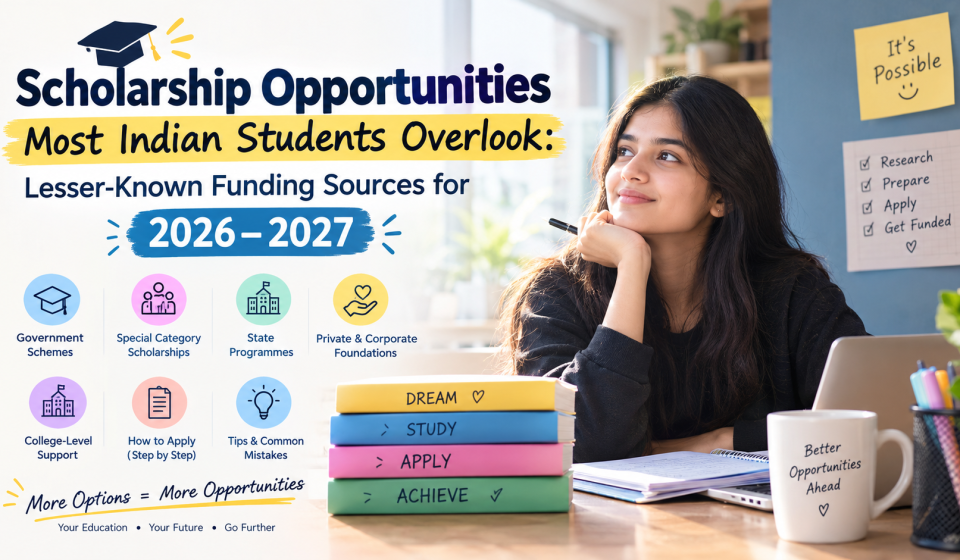
Scholarship Opportunities Most Indian Students Overlook: Lesser-Known Funding Sources for 2026–2027

Discover lesser-known scholarships for Indian students in 2026–2027, including eligibility criteria, government schemes, private funding, and application tips.
Higher education in India can be expensive, with students paying tuition fees, accommodation costs, transportation expenses, and the cost of books and digital learning resources. While many students know about popular government scholarships, several lesser-known funding opportunities remain overlooked.
Scholarships are not limited to academic toppers. Depending on the programme, financial assistance may be available to girls pursuing technical education, students with disabilities, postgraduate learners, students from eligible low-income families, and children of workers in specified industries.
For the 2026–2027 academic year, understanding these opportunities can help students identify financial support suited to their educational needs. This guide explores lesser-known scholarships, where to find them, and how to prepare a successful application.
Why Do Students Miss Scholarship Opportunities?
Many students rely on a single scholarship website or assume they cannot qualify because their marks are average. Others overlook scholarships designed for particular courses, family circumstances, or educational backgrounds.
Another common mistake is missing deadlines or failing to prepare the required documents.
Students can improve their chances by researching government schemes, checking university announcements, and exploring verified private foundations. The key is to find opportunities that match their eligibility rather than applying randomly.
AICTE Pragati Scholarship for Girl Students
The AICTE Pragati Scholarship supports eligible girls pursuing approved technical education programmes. It is worth exploring for students who may not realise that dedicated financial assistance exists for technical diploma and degree courses.
Who Can Apply?
Eligible girls enrolled in qualifying technical diploma or degree programmes may apply, subject to the scheme’s admission, income, and institutional requirements.
Applicants should verify the current rules before submitting their applications.
Where to apply: Visit the National Scholarship Portal to check the scheme details and application dates for 2026–2027.
AICTE Saksham Scholarship for Students with Disabilities
Students with disabilities pursuing eligible technical education may find financial assistance through the AICTE Saksham Scholarship.
This programme is particularly relevant to students who need support to continue their technical studies but may not know about specialised scholarship schemes.
Important Eligibility Considerations
Applicants should check the applicable disability requirements, family income criteria, course eligibility, and institutional conditions. Supporting documents may also be required.
Where to apply: Search for the AICTE Saksham Scholarship on the National Scholarship Portal and review its current guidelines.
AICTE Swanath Scholarship
The AICTE Swanath Scholarship is intended for eligible technical students belonging to specified categories facing particular family circumstances.
Depending on the applicable guidelines, these categories may include eligible orphans, students whose parents died due to COVID-19, and wards of eligible armed forces or central paramilitary personnel martyred in action.
Why Is This Scholarship Worth Exploring?
Students who satisfy these specific conditions may qualify even if they have never previously considered a specialised technical scholarship.
Applicants should confirm their eligibility category, admission requirements, family income conditions, and documentation requirements.
Where to apply: Visit the National Scholarship Portal and search for the AICTE Swanath Scholarship.
PM-USP Central Sector Scheme of Scholarship
The PM-USP Central Sector Scheme of Scholarship for College and University Students is another opportunity worth investigating.
The scheme supports eligible students pursuing higher education, subject to prescribed academic performance, family income, and other requirements.
What Should Students Check?
Students should confirm whether they qualify for a fresh application or a renewal. They should also review the academic requirements and verify that their institution and course satisfy the scheme’s rules.
For 2026–2027, the National Scholarship Portal lists renewal applications with a deadline of 31 October 2026. Fresh applicants should check the applicable announcement separately.
Where to check: Visit the National Scholarship Portal for official eligibility information and application updates.
National Scholarship for Postgraduate Studies
Students planning to pursue postgraduate education should investigate scholarships beyond undergraduate funding.
The University Grants Commission (UGC) lists the National Scholarship for Postgraduate Studies among its scholarship programmes. According to the UGC’s published scheme information, eligible students entering the first year of a recognised postgraduate degree through regular, full-time study may qualify, subject to the scheme’s conditions.
Who Should Explore It?
- Students entering an eligible postgraduate degree.
- Applicants who meet the prescribed admission and age requirements.
- Students enrolled in recognised institutions and qualifying programmes.
Where to check: Visit the UGC Student Corner or the National Scholarship Portal to review the latest details.
Scholarships for Students with Disabilities
Students with disabilities should explore opportunities beyond technical education-specific schemes.
The National Scholarship Portal lists programmes such as the Post-Matric Scholarship for Students with Disabilities and the Scholarship for Top Class Education for Students with Disabilities.
These schemes have different eligibility conditions and may support students at different educational levels.
How to Find the Right Scheme
Check the disability documentation requirements, income limits, eligible courses, and institutional conditions. Students should also determine whether their chosen programme accepts fresh applications for the current academic year.
Where to apply: Search for disability-related scholarships on the National Scholarship Portal.
Financial Assistance for Children of Eligible Workers
Some students may qualify for educational assistance because their parents work in particular industries.
For example, the National Scholarship Portal lists financial assistance schemes for eligible children of workers in beedi, cine, and specified mine-related industries.
These opportunities can be missed because students may not realise that a parent’s occupation could affect their eligibility.
What Should Applicants Verify?
Students should check whether their parent’s employment falls within the scheme’s definitions, whether their educational level qualifies, and which employment or income documents are required.
Where to check: Visit the National Scholarship Portal and search for the applicable workers’ children education assistance scheme.
State Government Scholarships and Fee Assistance
National scholarships are only one part of India’s education funding system. State governments also offer various scholarships, fee concessions, and educational assistance programmes.
These opportunities may depend on a student’s state of residence, family income, academic background, category, course, or institution.
How to Discover State Scholarships
- Visit your state’s official education or scholarship portal.
- Check domicile and residency requirements.
- Confirm whether your course and college qualify.
- Review application deadlines and document requirements.
- Contact your college scholarship office for additional guidance.
Students in Gujarat and other states should investigate relevant state schemes rather than relying exclusively on central government programmes.
Private Foundations and Corporate Scholarships
Private foundations, charitable trusts, and companies also provide educational funding to eligible students.
Some programmes focus on financial need, while others support academic achievement, women in education, or students pursuing specific professional courses. Corporate social responsibility initiatives may also fund scholarships.
How to Find Reliable Opportunities
Students can research established foundations, visit official company websites, and ask their colleges about verified scholarship partnerships.
Before applying, confirm the organisation’s identity, eligibility criteria, award conditions, and deadline.
Avoid suspicious providers promising guaranteed scholarships in exchange for registration fees. Never share passwords or OTPs with unknown individuals.
College-Level Scholarships and Fee Concessions
A student’s college or university may be an overlooked source of financial assistance.
Some institutions offer merit-based scholarships, need-based support, fee concessions, emergency assistance, or awards funded by alumni and charitable donors.
Questions to Ask Your College
- Are merit-based fee concessions available?
- Can students from low-income families receive assistance?
- Are there scholarships funded by alumni?
- Does the institution offer emergency financial support?
- Are any department-specific scholarships available?
Contact the college administration or scholarship coordinator to obtain the latest information.
Even when a student does not qualify for a national scholarship, institutional assistance may provide another way to reduce educational expenses.
How to Apply for Scholarships in 2026–2027
Finding an opportunity is only the first step. Students must also complete the application accurately and meet all deadlines.
Step 1: Check Your Eligibility
Review your course, year of study, academic results, family income, state of residence, and other relevant circumstances.
Step 2: Prepare Your Documents
Depending on the scheme, applicants may need academic marksheets, identity proof, an income certificate, admission documents, bank details, domicile proof, or relevant category and disability certificates.
Follow the official checklist because requirements differ between scholarships.
Step 3: Track Deadlines
Check the opening date, final submission date, and institute-verification deadline. Fresh and renewal applications may follow different schedules.
Step 4: Submit and Track Your Application
Enter accurate information, upload readable documents, and save your application number. Check the status regularly and respond promptly if corrections are requested.
Common Scholarship Application Mistakes to Avoid
Students should avoid applying without checking eligibility, relying on outdated information, submitting incomplete documents, and overlooking college-level assistance.
They should also use official application portals and verify private scholarship providers before sharing personal information.
Careful preparation can prevent avoidable errors and make the application process smoother.
Source
https://l1nq.com/4f678q9
https://sl1nk.com/ty16jby
Conclusion
Lesser-known scholarship opportunities can help Indian students reduce the financial burden of higher education during 2026–2027. Options worth exploring include AICTE scholarships, postgraduate funding, disability-related assistance, educational support for eligible workers’ children, state government programmes, private foundations, and college-level fee concessions.
The best approach is to identify schemes that match your circumstances, check the latest official guidelines, prepare the necessary documents, and submit applications before the deadlines.
Not every scholarship is suitable for every student, and meeting the eligibility criteria does not guarantee selection. However, researching a wider range of funding sources can help students discover opportunities they might otherwise miss.
Frequently Asked Questions (FAQs)
1. Which lesser-known scholarships can Indian students explore in 2026–2027?
Students can investigate AICTE Pragati, Saksham and Swanath scholarships, the PM-USP Central Sector Scheme, UGC postgraduate scholarships, disability-related schemes, workers’ children education assistance, and state or institutional funding.
2. Can students with average marks receive scholarships?
Yes. Some scholarships consider financial need, disability, family circumstances, or other eligibility factors. However, each programme has its own academic and selection requirements.
3. Where can I find government scholarships in India?
The National Scholarship Portal is a useful starting point. Students should also check official state government websites, UGC scholarship information, and their college’s scholarship office.
4. Can students apply for multiple scholarships?
Possibly. The National Scholarship Portal states that, from academic year 2026–2027, students may apply for one merit-based scheme and one or more welfare-based schemes, subject to eligibility. Students must also check the rules of each individual programme.
5. Are scholarships available for BCA and B.Voc students?
Potentially. Eligibility depends on the scholarship’s course classification, institutional requirements, and other conditions. Students should confirm that their specific course and college qualify.
6. Are private scholarships trustworthy?
Many established organisations offer legitimate scholarships. Verify the provider’s identity and official application process, and avoid suspicious payment requests or guaranteed-award promises.
7. When should I apply for a 2026–2027 scholarship?
Start researching early and check each scheme’s official dates. Fresh applications, renewals, and institute verification may have different deadlines.