
Learn how to build a job-ready skill portfolio before graduation with practical projects, essential skills, internships, certifications, and career tips to prepare for your first job.
College is an important stage in a student’s journey toward a successful career. It provides academic knowledge, opportunities to explore interests, and a foundation for professional development. However, in today’s competitive job market, a degree alone may not always be enough to demonstrate that a candidate is ready for the workplace. Employers also look for practical skills, problem-solving abilities, communication, and the ability to apply knowledge to real-world situations.
A job-ready skill portfolio helps students demonstrate these abilities. It brings together projects, technical skills, certifications, internships, and achievements in one organized place. Instead of simply listing skills on a resume, students can show examples of what they have learned and accomplished.
The good news is that students do not need years of experience or expensive courses to create a portfolio. By starting early, practicing regularly, and documenting their progress, they can build a strong professional profile before graduation.
What Is a Job-Ready Skill Portfolio?
A job-ready skill portfolio is a collection of work samples and achievements that demonstrates a student’s knowledge, abilities, and professional potential. Unlike a traditional resume, which summarizes qualifications and experience, a portfolio provides evidence of those qualifications.
For example, an IT student might showcase websites, Python applications, database projects, and GitHub repositories. A business student could include spreadsheet reports, marketing plans, presentations, and business case studies. Similarly, a design student might display branding concepts, illustrations, and user interface designs.
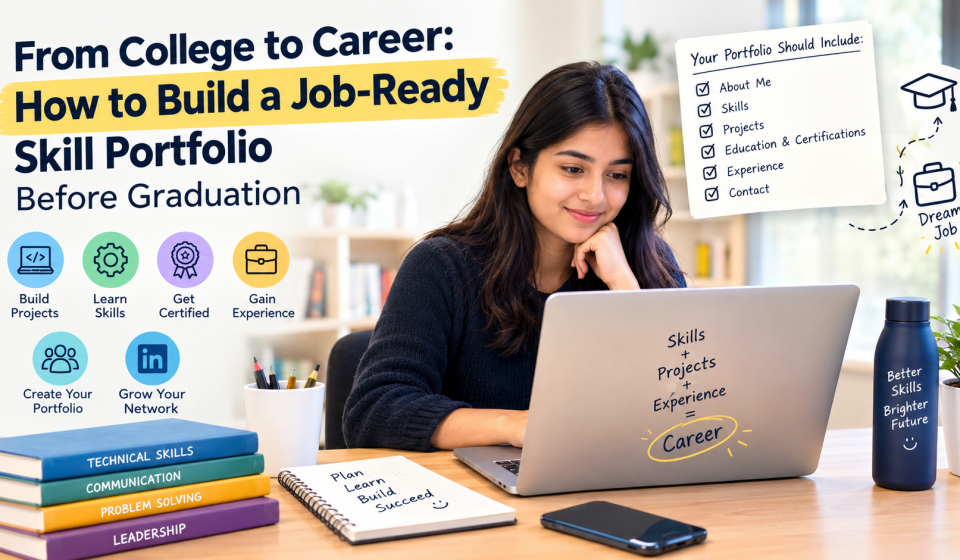
A professional portfolio may include a personal introduction, technical and transferable skills, academic projects, internships, certifications, achievements, and contact information.
The main purpose is to help employers understand what a candidate can do and whether their abilities match the requirements of a particular position.
Why Should Students Build a Portfolio Before Graduation?
Starting early gives students more time to explore career opportunities, develop relevant skills, and improve their work before applying for jobs.
First, a portfolio demonstrates practical knowledge. Projects show how students apply classroom learning to solve problems or create useful results.
Second, it can strengthen internship and entry-level job applications. Recruiters can review examples of a student’s abilities, even when the candidate has limited professional experience.
Third, building a portfolio develops confidence. Students become more comfortable explaining their work, discussing challenges, and describing what they learned.
Finally, a portfolio encourages continuous learning. As students complete new projects and explore different tools, they can identify their strengths and discover which career paths interest them most.
A portfolio does not guarantee employment, but it can help candidates present their qualifications more effectively.
Step 1: Identify Your Career Goals
Before building a portfolio, identify the career areas you want to explore. You do not need to decide your entire future immediately, but choosing one or two possible career directions will help you focus your efforts.
Start by considering your interests, existing strengths, and the type of work you would enjoy. Then review job descriptions for internships and entry-level positions to understand which skills employers commonly request.
For example, IT students might explore frontend development, Python programming, database management, software testing, or data analysis. Business students could focus on digital marketing, financial reporting, customer coordination, or business analysis.
Prepare a list of the skills you already possess and those you need to develop. Use this list to create a realistic learning plan and select projects relevant to your preferred career.
Step 2: Develop Technical and Professional Skills
Employers value candidates who combine technical knowledge with communication, teamwork, and problem-solving abilities.
Technical skills depend on the chosen profession. Technology students may benefit from learning HTML, CSS, JavaScript, Python, SQL, Git, and GitHub. Business students may focus on Microsoft Excel, presentation design, research, reporting, and customer relationship management tools.
Alongside these skills, students should develop transferable abilities such as communication, time management, critical thinking, adaptability, teamwork, and professional writing.
These abilities can be practiced through college assignments, group projects, presentations, volunteering, and internships.
Instead of simply listing a skill in your portfolio, provide examples of how you used it. For instance, a group project can demonstrate collaboration, while a completed application can demonstrate technical knowledge and problem-solving.
Step 3: Build Practical Projects
Projects are among the most valuable parts of a student portfolio because they demonstrate how knowledge can be applied in practice.
Choose projects that match your career interests and are appropriate for your current skill level.
IT students can create a personal portfolio website, contact book application, basic calculator, library management system, or expense tracker. Business students can prepare expense analysis reports, spreadsheet dashboards, marketing campaigns, or customer feedback studies. Design students can develop branding concepts, social media graphics, website mockups, and user interface designs.
For every project, explain its purpose, the tools used, the process followed, and the final outcome. Include screenshots, working demonstrations, or links to the project whenever possible.
Start with manageable projects and improve them gradually. Three well-developed projects that you understand completely are often more useful than ten unfinished projects.
The University of California, Davis, provides career guidance on selecting relevant portfolio materials and presenting work professionally.
Step 4: Create a Professional Online Portfolio
An online portfolio allows recruiters and employers to review your work conveniently. You can build a personal website or use a platform that suits your profession.
A professional portfolio should contain a few essential sections.
About Me: Introduce yourself, your educational background, your interests, and your career goals.
Skills: List the tools, technologies, and professional abilities you can demonstrate confidently.
Projects: Present your strongest work with short descriptions, screenshots, and relevant links.
Education and Certifications: Include your degree, relevant courses, training, and certifications.
Experience: Describe internships, volunteering, freelance assignments, or other relevant responsibilities.
Contact Information: Provide a professional email address and links to appropriate professional profiles.
Keep the design simple, readable, mobile-friendly, and easy to navigate. Avoid unnecessary animations or complicated layouts that distract visitors from your work.
If you are not ready to build a website, start with an organized digital document or professional profile. You can develop a website later as your skills improve.
Step 5: Use GitHub and LinkedIn Effectively
Students interested in technology can use GitHub to organize and showcase programming projects. Each project can have its own repository containing code and a README file that explains its purpose, features, tools, and setup instructions.
GitHub’s official documentation explains how to present your profile and highlight your work:
https://docs.github.com/en/account-and-profile/concepts/personal-profile
You can also learn how to create a profile README:
LinkedIn is another useful platform for presenting education, skills, projects, and professional interests. Students can explore career resources and learn how to build a professional profile through LinkedIn for Students:
Use these platforms to showcase genuine work and connect with relevant professional communities. Never copy another person’s project and claim it as your own. If you use a tutorial or collaborate with others, acknowledge the source and explain your contribution honestly.
Step 6: Gain Experience Through Internships
Internships help students understand workplace expectations and apply their knowledge to practical tasks. They also provide opportunities to develop communication, teamwork, time management, and professional responsibility.
Students can find opportunities through college placement cells, company career pages, reputable internship platforms, faculty recommendations, and professional networks.
However, you do not need to wait for an internship to begin building experience. College projects, independent assignments, volunteering, and student activities can also demonstrate useful abilities.
When documenting an experience, explain what you contributed and what you learned. For example, instead of writing only that you worked on website development, mention which pages you created, which technologies you used, and what problem you helped solve.
Always protect confidential company information and obtain permission before publishing work created for an employer or client.
Step 7: Add Relevant Certifications
Certifications can demonstrate that you have completed structured learning in a particular subject. Consider courses related to your career goals, such as programming fundamentals, databases, Excel, digital marketing, communication, or project management.
Before enrolling, review the course syllabus, the provider’s credibility, the learning outcomes, and the relevance to your target jobs. Many useful learning resources are available free of charge, so expensive courses are not always necessary.
Most importantly, apply what you learn. Completing a small project after a course can help you understand the subject better and provide practical evidence of your abilities.
Remember that certifications should support your portfolio rather than replace practical projects and experience.
Step 8: Prepare to Explain Your Work in Interviews
A portfolio becomes more valuable when you can explain it confidently. Interviewers may ask why you selected a project, which tools you used, what challenges you encountered, and what you would improve.
Prepare a short explanation of each major project covering five points:
- Objective: What problem were you trying to solve?
- Tools: Which technologies or resources did you use?
- Process: How did you complete the work?
- Challenges: What difficulties did you face, and how did you address them?
- Learning: What did you learn, and what would you improve next time?
Practice explaining your projects in simple language instead of memorizing complicated answers. Be honest about your contribution and acknowledge areas where you still need to improve.
Entry-level candidates are not expected to know everything. Showing curiosity, responsibility, and a willingness to learn can help create a positive impression.
Step 9: Follow a Simple Portfolio-Building Plan
A practical timeline can help students balance portfolio development with college responsibilities.
Month 1: Planning and Learning
Choose a career direction, review job descriptions, identify essential skills, and prepare a learning schedule.
Months 2–3: Project Development
Practice relevant tools and complete two or three practical projects. Test your work and document your progress.
Month 4: Portfolio Creation
Organize your projects, write your introduction, publish your work online, and check that all links function correctly.
Month 5 and Beyond: Career Preparation
Update your resume, practice interview questions, apply for internships, seek feedback, and continue improving your projects.
This timeline is flexible. Students can adjust it according to their existing knowledge, examination schedules, and personal commitments. Consistent progress is more important than following an exact deadline.
Common Mistakes to Avoid
Students should avoid adding too many unrelated projects, copying work without understanding it, listing skills they cannot demonstrate, and neglecting project descriptions.
A portfolio should be professionally presented, but appearance should not replace meaningful content. Check spelling, formatting, mobile usability, and broken links before sharing it.
Do not wait until your final semester to begin. Starting with small projects gives you more opportunities to learn from mistakes and improve your work.
Review your portfolio regularly and update it when you complete a meaningful project, gain a relevant skill, or receive a certification.
source
https://l1nq.com/oecp9i7
https://l1nq.com/34mjru7
Conclusion
Building a job-ready skill portfolio before graduation helps students connect academic learning with practical career preparation. By identifying career goals, developing relevant skills, completing projects, gaining experience, and presenting their work professionally, students can create a stronger foundation for entering the job market.
You do not need extensive experience or expensive tools to begin. Start with one manageable project, document what you learn, and gradually build a collection of work that reflects your abilities.
The most important step is to begin early and remain consistent. Every project completed, skill practiced, and experience gained can contribute to your professional growth.
Start small, keep learning, and build a portfolio that demonstrates not only what you know but also what you can accomplish.
Frequently Asked Questions (FAQs)
1. What is a job-ready skill portfolio?
It is a collection of projects, skills, certifications, and experiences that demonstrates a student’s abilities to potential employers.
2. When should students start building a portfolio?
Students can start during their first year of college. Beginning early gives them more time to learn, complete projects, and improve their work before graduation.
3. How many projects should a portfolio contain?
Three to five relevant, well-documented projects are a useful starting point. Quality and relevance matter more than quantity.
4. Can students create a portfolio without work experience?
Yes. Students can include academic assignments, independent projects, case studies, volunteering, and practical exercises before gaining professional experience.
5. Is GitHub necessary for every student?
No. GitHub is particularly useful for programming and technical projects. Students in business, design, and other fields can choose platforms suited to their work.
6. Are free online courses useful?
Yes. Free courses can help students develop relevant knowledge. Applying what they learn through practical projects makes their skills easier to demonstrate.
7. How often should a portfolio be updated?
Review your portfolio every few months and update it whenever you complete a meaningful project, develop a new skill, or gain relevant experience.