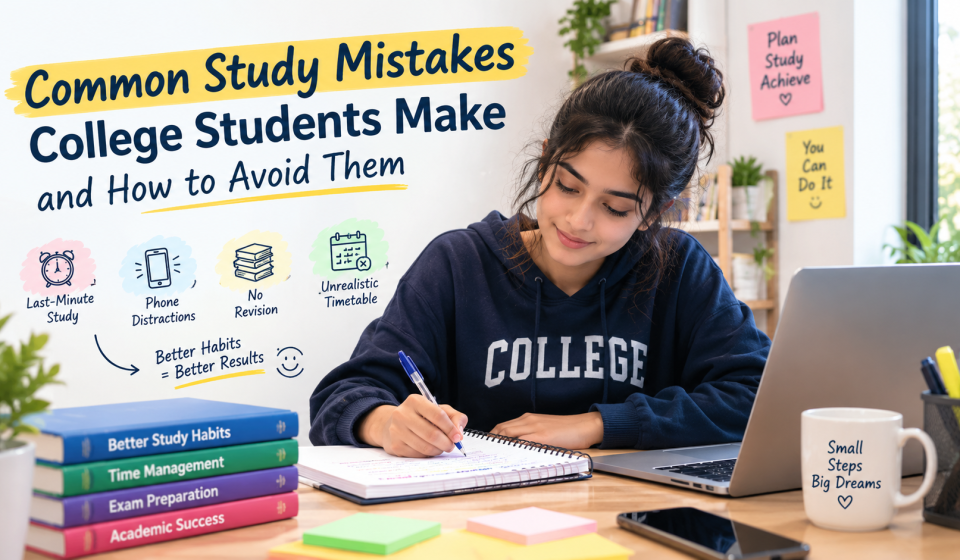

Discover common study mistakes college students make and learn practical tips to improve study habits, manage time, boost concentration, and prepare for exams effectively.
College life brings new opportunities, responsibilities, and challenges. Students must attend lectures, complete assignments, prepare for examinations, participate in activities, and manage their personal lives. With so many responsibilities, developing effective study habits can sometimes become difficult.
Many college students work hard but still struggle to achieve their desired academic results. The problem is not always a lack of intelligence or effort. Often, students make common study mistakes that affect their understanding, concentration, and ability to remember information.
The good news is that these mistakes can be corrected with simple changes in daily routines. By learning how to manage time, take better notes, avoid distractions, and prepare for examinations effectively, students can improve their academic performance without unnecessary stress.
In this article, we will explore the most common study mistakes college students make and practical ways to avoid them.
1. Studying Only Before Examinations
One of the most common mistakes college students make is waiting until the last few days before an examination to begin studying. Many students postpone their preparation because they believe they will have enough time later.
However, studying an entire semester’s syllabus in a few days can become overwhelming. Students may rush through important topics, forget information quickly, and experience unnecessary examination stress.
How to Avoid This Mistake
Develop a regular study routine instead of depending entirely on last-minute preparation.
- Study your lecture topics for 20–30 minutes after college.
- Divide large chapters into smaller sections.
- Revise important concepts every week.
- Start preparing for examinations at least two to three weeks in advance when possible.
- Use weekends to review difficult topics and complete pending work.
Regular study sessions help you understand concepts gradually and reduce the pressure of preparing everything at once.
2. Memorising Without Understanding
Another common mistake is memorising definitions, answers, and textbook paragraphs without understanding their meaning. Students sometimes choose this approach because they believe memorisation is the fastest way to prepare for examinations.
Although memorisation can be useful for certain facts and definitions, it is not enough to develop a strong understanding of a subject. When questions are presented differently from what students have practised, they may struggle to answer them.
How to Avoid This Mistake
Focus on understanding the concept before attempting to memorise it.
- Read the topic carefully and identify its main idea.
- Explain the concept in your own words.
- Connect theoretical concepts with practical examples.
- Ask yourself questions such as “Why does this happen?” and “How does it work?”
- Use diagrams, flowcharts, and real-life examples to understand complex topics.
For example, instead of memorising the definition of a database, understand how databases store and organise information. This approach makes learning more meaningful and helps you answer different types of questions.
3. Creating an Unrealistic Study Timetable
Many students create ambitious study timetables at the beginning of a semester. They may plan to study for six or seven hours every day, complete several chapters in one sitting, and revise every subject regularly.
However, an unrealistic timetable is difficult to maintain alongside college lectures, assignments, commuting, and personal responsibilities. When students fail to follow their schedules, they may feel discouraged and stop planning altogether.
How to Avoid This Mistake
Create a timetable that matches your actual daily routine.
- Identify the time you can realistically dedicate to studying.
- Prioritise difficult and important subjects.
- Set small, achievable daily targets.
- Include breaks between study sessions.
- Leave some flexible time for unexpected assignments or revision.
For example, completing two topics and revising one previous lesson may be more effective than planning to finish five chapters in one day.
Remember that consistency matters more than following a perfect timetable.
4. Studying While Using a Mobile Phone
Mobile phones are useful for educational videos, digital notes, online classes, and research. However, notifications from social media, messaging applications, games, and other platforms can interrupt concentration.
Even a short interruption may make it difficult to return to a complex topic. Constantly switching between studying and checking a phone can also make study sessions less productive.
How to Avoid This Mistake
Make your study environment as distraction-free as possible.
- Keep your phone away from your study table.
- Turn on Do Not Disturb mode during study sessions.
- Disable unnecessary notifications.
- Use your phone only when it is required for learning.
- Set a specific time for checking social media.
You can also try the Pomodoro technique. Study for 25 minutes, take a five-minute break, and repeat the cycle. After four sessions, take a longer break.
Choose a study interval that suits your concentration level. The main goal is to focus on one task at a time.
5. Ignoring Regular Revision
Students often believe that reading a chapter once is enough to remember everything. Unfortunately, information can become difficult to recall when it is not reviewed regularly.
This becomes particularly challenging during examinations when students must remember definitions, formulas, theories, and important concepts from multiple chapters.
How to Avoid This Mistake
Use regular revision and spaced repetition.
Spaced repetition means reviewing information at increasing intervals instead of studying it only once.
For example, you can revise a topic:
- On the same day you learn it.
- Again after two or three days.
- Once more after one week.
- Before the examination.
You should also practise recalling information without looking at your notes. Write down what you remember, answer practice questions, or explain the topic aloud.
These methods help you identify what you understand and what requires additional revision.
6. Taking Incomplete or Unorganised Notes
Taking notes during lectures is an important part of college learning. However, some students write down everything without understanding it, while others record too little information to revise effectively.
Unorganised notes can make examination preparation confusing because important definitions, examples, and explanations become difficult to find.
How to Avoid This Mistake
Create notes that are clear, organised, and easy to revise.
- Use headings and subheadings for different topics.
- Highlight important definitions and formulas.
- Write short explanations instead of copying every sentence.
- Include examples to clarify difficult concepts.
- Keep notes organised by subject and chapter.
You can use notebooks, digital documents, or note-taking applications according to your preference.
After each lecture, spend a few minutes reviewing your notes and correcting anything that is incomplete or unclear. This small habit can save considerable time during examination preparation.
7. Avoiding Difficult Subjects
Every student has subjects they enjoy and others they find challenging. Some students repeatedly study their favourite subjects because they feel confident with them, while postponing difficult topics until the last moment.
Unfortunately, avoiding difficult subjects allows confusion to increase over time. Topics that depend on earlier concepts may become even harder to understand.
How to Avoid This Mistake
Give challenging subjects regular attention rather than avoiding them.
- Identify the exact topic you find difficult.
- Break it into smaller concepts.
- Review the relevant basics before moving forward.
- Practise simple questions before attempting advanced ones.
- Ask your teachers or classmates for clarification.
For example, if you struggle with programming, begin with basic concepts and small code examples before attempting a complete project.
You do not need to master an entire difficult chapter in one sitting. Small improvements made regularly can build confidence and understanding.
8. Studying for Long Hours Without Taking Breaks
Some students believe that studying continuously for several hours proves they are working hard. However, long study sessions without breaks can lead to tiredness, reduced concentration, and difficulty processing information.
The quality of your study session matters more than the number of hours you spend sitting at your desk.
How to Avoid This Mistake
Plan short breaks between focused study sessions.
During breaks, you can stretch, drink water, walk around, or rest your eyes. Avoid spending every break scrolling through social media because this can make it difficult to return to studying.
You should also get sufficient sleep, eat regular meals, and maintain some physical activity.
A balanced routine supports concentration and helps you maintain your study habits over time.
9. Not Practising Questions Before Examinations
Reading textbooks and reviewing notes are useful, but they do not always prepare students to answer examination questions effectively.
Some students understand a topic while reading it but struggle when they have to explain it independently, solve a problem, or write an answer within a limited time.
How to Avoid This Mistake
Include active practice in your preparation.
- Solve previous examination papers when available.
- Practise multiple-choice questions.
- Write answers without looking at your notes.
- Solve numerical problems and practical exercises.
- Test yourself after completing each chapter.
Practising under timed conditions can also help you understand how to manage examination time.
After checking your answers, identify mistakes and revise the relevant concepts. Learning from incorrect answers is an important part of effective preparation.
10. Comparing Your Progress With Other Students
College students often compare their marks, study hours, skills, and achievements with those of their classmates. Although competition can sometimes provide motivation, constant comparison may create unnecessary pressure.
Every student has a different learning speed, educational background, schedule, and set of responsibilities. Someone else’s progress does not determine your ability to succeed.
How to Avoid This Mistake
Focus on your own improvement.
- Set personal academic goals.
- Track the topics you have completed.
- Identify areas where you need more practice.
- Celebrate small achievements.
- Learn useful study techniques from classmates without judging yourself against them.
Instead of asking whether you are ahead of someone else, ask whether you understand more today than you did last week.
Consistent personal progress is a more useful measure of improvement than constant comparison.
11. Depending Too Much on AI and Ready-Made Answers
AI tools and online educational resources can help college students understand difficult concepts, summarise notes, generate practice questions, and explore unfamiliar topics.
However, relying entirely on ready-made answers can become a problem. Students may copy information without understanding it, submit work they cannot explain, or become dependent on tools instead of developing independent problem-solving skills.
How to Avoid This Mistake
Use technology as a learning assistant rather than a replacement for learning.
- Ask AI tools to explain difficult concepts in simple language.
- Request examples and practice questions.
- Attempt assignments independently before checking suggested answers.
- Verify important information using textbooks, lecture notes, or reliable educational sources.
- Explain the final answer in your own words.
For example, if an AI tool provides a programming solution, try to understand each line and modify the code yourself. This approach helps you develop practical skills rather than simply collecting answers.
The objective is to use technology to improve your understanding, not to avoid the learning process.
12. Ignoring Sleep and Personal Well-Being
Some students sacrifice sleep to complete assignments or prepare for examinations. Although staying up late may occasionally be unavoidable, making it a regular habit can negatively affect attention, memory, mood, and academic performance.
Poor sleep and constant stress can also make it more difficult to maintain a consistent study routine.
How to Avoid This Mistake
Treat rest and well-being as essential parts of your academic routine.
- Maintain a reasonably consistent sleep schedule.
- Avoid leaving every assignment until the last minute.
- Take short breaks during long study sessions.
- Eat balanced meals and drink enough water.
- Make time for physical activity and relaxation.
If you feel overwhelmed, divide your workload into smaller tasks and focus on completing one step at a time.
Remember that studying effectively does not mean studying every available minute. A sustainable routine is more helpful than repeatedly exhausting yourself.
How to Build Better Study Habits in College
Avoiding these mistakes becomes easier when you follow a simple and consistent system.
Start by reviewing your daily schedule and identifying the time you can dedicate to studying. Choose two or three achievable tasks each day instead of creating a long list that is difficult to complete.
During study sessions, keep distractions away and focus on understanding the material. After completing a topic, test your knowledge with questions or a short summary. Review previously studied topics regularly so that you do not have to relearn everything before examinations.
At the end of each week, evaluate your progress. Identify the methods that worked, the topics that remain difficult, and the changes you need to make for the following week.
You can follow this simple daily routine:
- Before college: Spend 10 minutes reviewing the previous lesson.
- During lectures: Listen carefully and write organised notes.
- After college: Revise important concepts for 20–30 minutes.
- During study time: Complete assignments and practise questions.
- Before sleeping: Review your progress and plan the next day’s tasks.
You can adjust this routine according to your timetable, subjects, and personal responsibilities. The important thing is to create a realistic system that you can follow consistently.
Conclusion
Common study mistakes can affect college students’ academic performance, but they do not have to become permanent habits. Studying only before examinations, memorising without understanding, ignoring revision, using mobile phones excessively, and avoiding difficult subjects can make learning more stressful than necessary.
The best way to improve is to recognise these mistakes and make small, practical changes. Develop a realistic study timetable, revise regularly, practise examination questions, take appropriate breaks, and use educational technology responsibly.
Most importantly, do not expect yourself to change every habit overnight. Start with one or two improvements and build on them gradually. With consistency, patience, and effective study strategies, you can strengthen your understanding, improve your confidence, and make your college learning experience more productive.
Remember: successful studying is not just about how many hours you spend with your books. It is about how effectively you use that time.
Frequently Asked Questions (FAQs)
1. What are the most common study mistakes college students make?
The most common mistakes include studying at the last minute, memorising without understanding, ignoring revision, using mobile phones during study sessions, avoiding difficult subjects, and following unrealistic study schedules.
2. How can college students improve their study habits?
College students can improve their study habits by following a realistic timetable, revising lessons regularly, practising questions, taking organised notes, avoiding distractions, and setting achievable daily goals.
3. Is studying for long hours better than studying for short periods?
Not necessarily. Focused study sessions with appropriate breaks can be more productive than long sessions without rest. Students should prioritise understanding, concentration, and regular revision rather than simply counting study hours.
4. How can students avoid last-minute exam preparation?
Students should begin preparing early, divide the syllabus into smaller topics, revise weekly, and practise previous examination papers. Completing small study tasks regularly can reduce last-minute pressure.
5. How can students remember what they study for longer?
Students can improve retention through active recall, spaced repetition, self-testing, explaining concepts in their own words, and practising questions. Adequate sleep also supports learning and memory.
6. Should college students use AI tools for studying?
Yes, AI tools can help students understand difficult topics, create practice questions, and organise their revision. However, students should verify information, understand the material, and complete their work honestly instead of blindly copying generated answers.
7. How many hours should a college student study daily?
There is no single ideal number of study hours for every college student. The appropriate amount depends on the course, academic workload, examination schedule, and individual learning needs. Students should choose a realistic routine that allows enough time for learning, revision, rest, and other responsibilities.
8. What is the best way to prepare for college examinations?
The best approach is to start early, understand the syllabus, revise regularly, practise previous papers, test yourself, and focus on topics that need improvement. A consistent preparation plan is generally more manageable than last-minute studying.