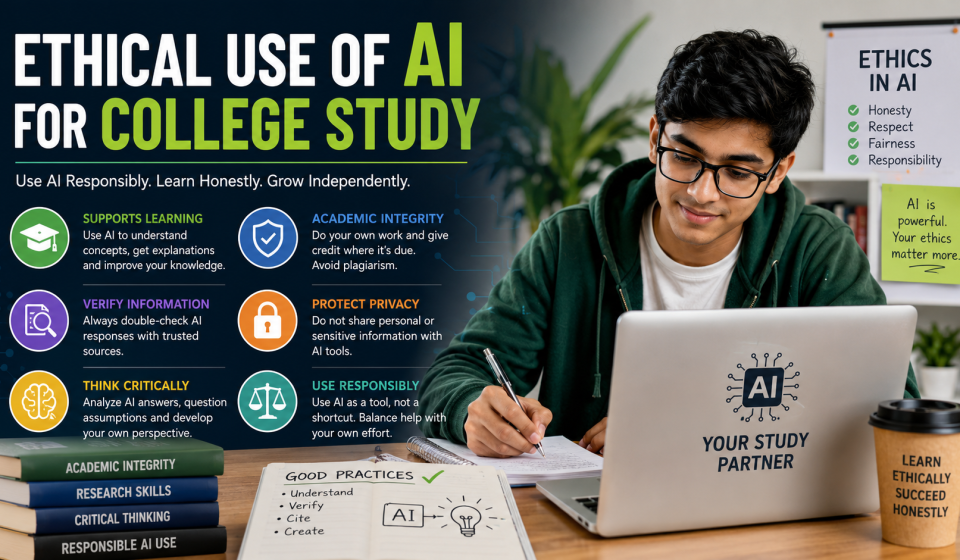

Learn the ethical use of AI for college study with practical tips on responsible learning, academic integrity, plagiarism prevention, research, exam preparation, and using AI tools like ChatGPT to enhance education without compromising honesty.
Artificial intelligence is changing the way college students study, write, research, and prepare for exams. Tools like ChatGPT can explain difficult topics, summarize notes, create practice questions, improve writing, and support time management. However, using AI in college also comes with responsibility.
Ethical AI use means using artificial intelligence to support learning, not replace original thinking. Students should use AI as a study partner, not as a shortcut for cheating. When used correctly, AI can improve academic performance, confidence, and productivity while still protecting honesty and creativity.
What Is Ethical AI Use in College?
Ethical AI use means using AI tools in a fair, honest, and responsible way. For college students, this includes following academic rules, giving credit when required, checking information, and submitting work that reflects their own understanding.
AI should help students learn better. It should not be used to copy answers, fake research, complete exams dishonestly, or submit assignments without personal effort.
Why Ethical AI Use Matters
College education is built on learning, critical thinking, and academic honesty. If students use AI only to get ready-made answers, they may pass assignments but fail to build real knowledge.
Ethical AI use matters because it protects academic integrity, builds trust between students and teachers, improves real understanding, and prepares students for future workplaces where responsible AI skills will be important.
How AI Can Support Better Learning
AI can help students understand complex subjects in simple language. For example, a student can ask AI to explain a difficult theory step by step or give real-life examples.
AI can also help create study schedules, summarize lecture notes, generate flashcards, and prepare practice quizzes. These uses support learning because they encourage revision, understanding, and active recall.
Using AI for Research Responsibly
AI can help students find ideas, organize topics, and understand research concepts. However, students should not depend on AI as the final source of truth.
AI can sometimes make mistakes or provide incomplete information. Students should always verify facts using trusted academic sources such as textbooks, journals, university websites, and official research databases.
Avoiding Plagiarism with AI
Plagiarism means presenting someone else’s work or ideas as your own. AI-generated content can also create plagiarism risks if students copy and submit it without editing, understanding, or proper disclosure.
To avoid plagiarism, students should use AI for brainstorming, outlines, explanations, and feedback. The final assignment should be written in the student’s own words and supported with proper references.
Follow College and Professor Guidelines
Every college may have different rules about AI use. Some professors allow AI for brainstorming and grammar checking, while others may not allow it for assignments or exams.
Before using AI, students should check the course policy. If the rules are unclear, they should ask the professor. Stanford Teaching Commons notes that AI policy should consider academic integrity, student success, and workload balance.
Use AI as a Tutor, Not a Shortcut
The best way to use AI is like a tutor. Instead of asking, “Write my assignment,” students should ask, “Explain this topic,” “Give me feedback on my draft,” or “Ask me quiz questions.”
OpenAI’s Study Mode is designed to guide learners step by step and encourage deeper understanding instead of simply giving final answers.
Protect Personal Data
Students should be careful when sharing personal or sensitive information with AI tools. They should avoid uploading private documents, passwords, personal IDs, confidential college records, or other sensitive details.
Responsible AI use includes understanding privacy. Students should only share information that is safe and necessary for study support.
Check Accuracy Before Using AI Answers
AI tools can sound confident even when they are wrong. This is why students should verify important answers before using them in academic work.
For example, if AI gives a historical date, scientific claim, legal concept, or statistical fact, students should cross-check it with reliable sources. This habit improves research quality and prevents mistakes.
Develop Critical Thinking
AI should not reduce a student’s ability to think independently. Students should question AI responses, compare different viewpoints, and analyze whether the answer makes sense.
A good ethical practice is to ask AI: “What are the limitations of this answer?” or “Give arguments for and against this idea.” This helps students become better thinkers instead of passive users.
AI for Writing Support
AI can be helpful for improving grammar, sentence structure, clarity, and tone. It can also help students create outlines and organize ideas.
However, students should not allow AI to replace their own voice. A strong college assignment should show the student’s understanding, opinion, analysis, and effort.
AI for Exam Preparation
Using AI for exam preparation is ethical when it helps students revise and practice. Students can ask AI to create mock questions, explain answers, make flashcards, or summarize key topics.
Using AI during a closed-book exam or to get unauthorized answers is unethical. The difference is simple: AI is helpful before the exam for learning, but it should not be used during an exam unless clearly allowed.
Benefits of Ethical AI Use
Ethical AI use gives students many benefits. It saves time, improves understanding, supports revision, strengthens writing, and helps students manage academic pressure.
It also prepares students for the future. Many careers now require AI literacy, so learning how to use AI responsibly is a valuable modern skill.
Common Mistakes Students Should Avoid
Students should avoid copying AI answers directly, using AI without permission, trusting every response, ignoring citations, and submitting work they do not understand.
Another mistake is overdependence. If students rely on AI for every task, they may lose confidence in their own thinking. Balance is important.
Source
https://sl1nk.com/ac3cktp
https://l1nq.com/2nh2ic9
Conclusion
Ethical use of AI for college study is about balance. AI can be a powerful learning assistant, but it should never replace honesty, effort, creativity, or critical thinking.
Students should use AI to understand topics, organize notes, prepare for exams, improve writing, and build better study habits. At the same time, they must follow college rules, verify facts, protect privacy, and submit work that reflects their own learning.
When used responsibly, AI can help college students become smarter, more confident, and more prepared for the future.
FAQs
1. What is ethical AI use for college students?
Ethical AI use means using AI honestly and responsibly to support learning, not to cheat, plagiarize, or avoid original thinking.
2. Can students use AI for assignments?
Yes, students can use AI for brainstorming, outlines, explanations, and grammar support if their college or professor allows it. The final work should be their own.
3. Is using AI considered cheating?
Using AI is cheating if it violates course rules, gives unauthorized help, or replaces the student’s own work. It is not cheating when used as an approved study tool.
4. How can students avoid plagiarism with AI?
Students can avoid plagiarism by writing in their own words, citing sources properly, checking college guidelines, and not submitting AI-generated content as original work.
5. Can AI help with exam preparation?
Yes, AI can help create practice questions, flashcards, summaries, and revision plans. It should not be used during exams unless clearly allowed.