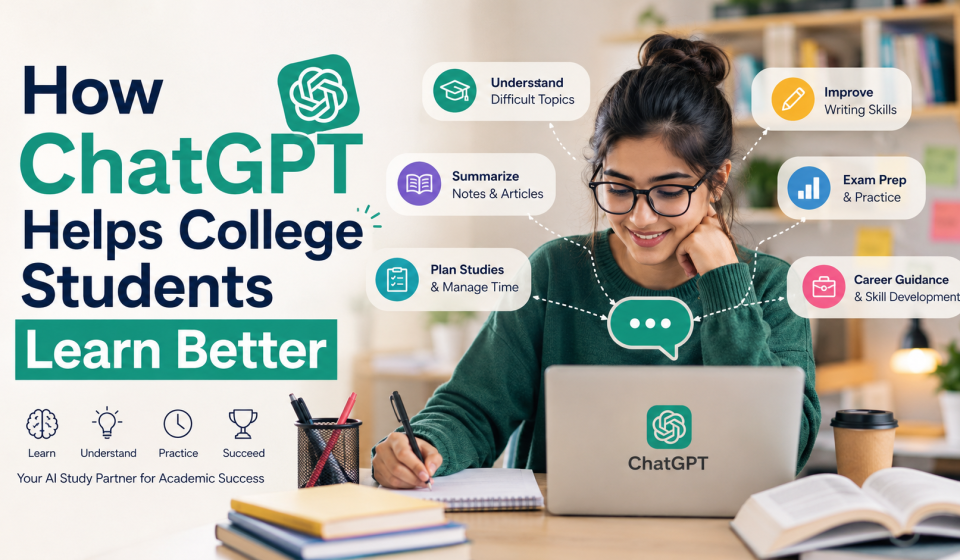

Discover how ChatGPT helps college students learn better through personalized study support, exam preparation, writing assistance, research help, time management, and career guidance. Learn how to use AI responsibly to improve academic performance and develop essential learning skills.
College life is exciting, but it can also be stressful. Students have to manage lectures, assignments, exams, projects, internships, and career planning at the same time. In this busy academic environment, learning smarter is just as important as studying harder. This is where ChatGPT becomes a useful learning assistant for college students.
ChatGPT can help students understand difficult topics, create study plans, summarize notes, prepare for exams, improve writing, practice communication skills, and explore career options. OpenAI’s Study Mode is designed to help learners build deeper understanding by asking questions, guiding thinking, explaining step by step, and checking understanding along the way.
ChatGPT Makes Difficult Topics Easier to Understand
One of the biggest challenges college students face is understanding complex academic topics. Subjects like mathematics, programming, economics, biology, engineering, law, and research methods can feel overwhelming when explained only through textbooks or lectures.
ChatGPT helps by breaking difficult ideas into simple language. A student can ask, “Explain this like I am a beginner,” or “Give me an example from real life.” This makes learning more flexible and less stressful.
Instead of reading the same paragraph again and again, students can ask ChatGPT to explain the concept in different ways. For example, if a student does not understand machine learning, ChatGPT can explain it using examples like recommendation systems, voice assistants, or online shopping suggestions.
Personalized Learning Support
Every student learns differently. Some students understand concepts through examples, some prefer step-by-step explanations, while others learn better through quizzes or summaries. ChatGPT supports personalized learning by adapting responses based on the student’s needs.
OpenAI says Study Mode can understand a learner’s goals and skill level, then work with them toward the answer instead of only giving a final response. This approach can help students become active learners rather than passive readers.
A student can ask ChatGPT to:
Explain a topic in simple words.
Create practice questions.
Check understanding.
Give hints instead of direct answers.
Provide examples related to their subject.
This makes ChatGPT useful for students who want learning support outside classroom hours.
Better Exam Preparation
Exam preparation requires planning, revision, and practice. Many students struggle because they do not know where to start. ChatGPT can help create a clear study plan based on exam dates, subjects, chapters, and difficulty level.
Students can ask ChatGPT to prepare a 7-day, 15-day, or 30-day study schedule. It can divide topics into daily tasks, suggest revision slots, and include mock test practice.
ChatGPT can also generate practice questions, flashcards, short answers, long answers, and multiple-choice questions. This helps students revise actively instead of only reading notes. Active recall is one of the most effective ways to remember information.
Helps Students Improve Writing Skills
College students often need to write essays, reports, assignments, research summaries, presentations, emails, and internship applications. ChatGPT can help students improve the structure, grammar, clarity, and flow of their writing.
Students can use ChatGPT to:
Create an outline.
Improve sentence clarity.
Check grammar.
Make writing more formal.
Summarize research points.
Generate introduction and conclusion ideas.
However, students should use ChatGPT responsibly. It should be used as a writing assistant, not as a tool for copying complete assignments without understanding. The best way is to draft ideas first, use ChatGPT for improvement, and then edit the final version in their own voice.
Supports Research and Note-Making
Research is a major part of college learning. Students often need to read long articles, academic papers, reports, and textbooks. ChatGPT can help summarize large amounts of information into simple notes.
For example, a student can paste a paragraph and ask ChatGPT to summarize it in bullet points. They can also ask for key points, important definitions, comparison tables, or revision notes.
ChatGPT can also help students organize their notes by topic. This saves time and makes revision easier before exams. Instead of scattered notes, students can create structured summaries with headings and subheadings.
Improves Critical Thinking
Many students think ChatGPT only gives answers, but it can also be used to improve critical thinking. Instead of asking for direct answers, students can ask ChatGPT to question them, challenge their ideas, or give different viewpoints.
For example:
“Ask me questions about this topic.”
“Give arguments for and against this idea.”
“Help me analyze this case study.”
“What are the limitations of this theory?”
This helps students think deeper and develop stronger academic reasoning. Study Mode is especially useful because it is built to guide students through thinking rather than simply providing final answers.
Helps with Time Management
Time management is one of the biggest problems for college students. Many students delay assignments, study at the last minute, or feel confused about priorities. ChatGPT can help students plan their academic workload.
Students can ask ChatGPT to create:
Daily study routines.
Weekly assignment plans.
Exam revision timetables.
Productivity checklists.
Goal-setting plans.
A simple study schedule can reduce stress and help students stay consistent. ChatGPT can also suggest break times, revision methods, and ways to avoid distractions.
Career and Skill Development
College is not only about exams. Students also need to prepare for careers. ChatGPT can help with resume writing, interview preparation, internship applications, LinkedIn profiles, and career planning.
OpenAI has noted that ChatGPT Edu can support campus tasks such as personalized tutoring for students and resume review.
Students can ask ChatGPT to:
Improve a resume.
Write a cover letter.
Prepare interview answers.
Practice mock interviews.
Explore career options after graduation.
Learn job-ready skills.
This makes ChatGPT helpful not only for academic success but also for professional growth.
Language Learning and Communication Practice
Many college students want to improve English communication, public speaking, presentation skills, and academic writing. ChatGPT can act like a practice partner.
Students can ask ChatGPT to correct grammar, improve vocabulary, create speaking practice questions, or simulate interview conversations. It can also help students translate difficult academic language into simpler words.
For presentations, ChatGPT can help create a speech outline, slide content, introduction, conclusion, and Q&A preparation. This is especially helpful for students who feel nervous speaking in front of classmates.
Helps Students Learn Anytime, Anywhere
One of the best advantages of ChatGPT is availability. Students can use it when they are studying late at night, preparing before an exam, or revising between classes.
OpenAI describes ChatGPT education tools as powerful AI tools for students, faculty, researchers, and campus administrators, including capabilities for analysis and research.
This flexibility is useful because students may not always have immediate access to teachers, tutors, or classmates. ChatGPT can provide quick support whenever they need help understanding a topic.
Responsible Use of ChatGPT in College
While ChatGPT is helpful, students should use it ethically. It should support learning, not replace learning. Students should avoid copying AI-generated content directly for assignments, exams, or projects.
Responsible use means:
Checking facts from trusted sources.
Understanding the answer before using it.
Using ChatGPT for guidance, not cheating.
Adding personal analysis and original thinking.
Following college academic integrity rules.
ChatGPT is most powerful when students use it as a learning partner, not as a shortcut.
Source
https://l1nq.com/shxcxb8
https://sl1nk.com/ac3cktp
Conclusion
ChatGPT helps college students learn better by making education more personalized, flexible, and interactive. It can explain difficult topics, create study plans, improve writing, support exam preparation, summarize notes, develop critical thinking, and guide career growth.
For modern college students, ChatGPT is not just a question-answer tool. It is a study assistant, writing helper, revision partner, and career guide. When used responsibly, ChatGPT can help students save time, reduce stress, understand concepts deeply, and become more confident learners.
FAQs
1. How does ChatGPT help college students?
ChatGPT helps college students by explaining difficult topics, summarizing notes, creating study plans, generating practice questions, improving writing, and supporting exam preparation.
2. Can ChatGPT improve academic performance?
Yes, ChatGPT can support academic performance when students use it for understanding concepts, revision, practice, and planning. However, students must still study actively and verify important information.
3. Is ChatGPT useful for exam preparation?
Yes, ChatGPT can create revision schedules, mock questions, flashcards, short notes, and practice tests to help students prepare more effectively.
4. Can students use ChatGPT for assignments?
Students can use ChatGPT for brainstorming, outlining, grammar checking, and improving clarity. They should not copy complete answers without understanding or proper academic honesty.
5. Is ChatGPT good for research work?
ChatGPT can help summarize information, organize ideas, create outlines, and explain research topics. Students should always verify research facts with reliable academic sources.