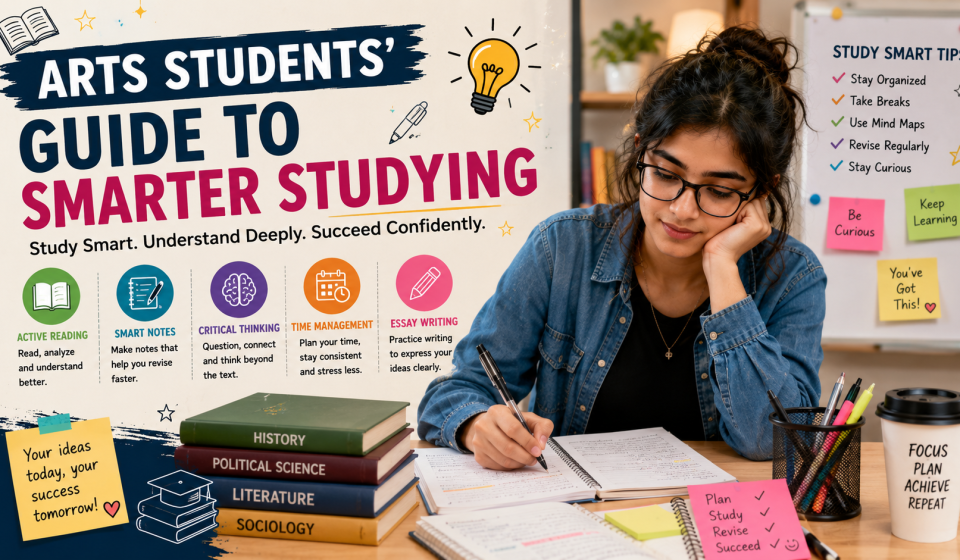

Discover the ultimate Arts Students’ Guide to Smarter Studying with effective study techniques, note-taking methods, essay writing tips, time management strategies, revision hacks, and exam preparation advice to improve academic performance and succeed in college.
Arts students often study subjects that require deep reading, creative thinking, strong writing, interpretation, memory, and analysis. Whether you are studying literature, history, sociology, psychology, political science, philosophy, fine arts, languages, or media studies, success depends on more than just reading textbooks. You need smart study methods that help you understand ideas, connect concepts, express opinions, and remember important information.
Smarter studying means using your time wisely, learning actively, and building strong academic habits. Instead of studying for long hours without direction, arts students can improve performance by using better note-taking methods, revision techniques, research skills, writing strategies, and time management.
Understand Your Subject Requirements
Every arts subject has a different learning style. Literature requires interpretation and critical reading. History needs timelines, causes, events, and consequences. Political science focuses on theories, institutions, and current affairs. Psychology requires concepts, case studies, and research methods. Fine arts may require practice, observation, and creative presentation.
Before starting your study plan, understand what your subject demands. Ask yourself whether the subject needs memorization, analysis, examples, essays, diagrams, or practical work. This helps you choose the right study method instead of using the same approach for every subject.
Create a Realistic Study Schedule
A smart study schedule helps arts students manage reading, writing, revision, assignments, and exam preparation. Many students make the mistake of studying only before exams. This creates stress and reduces understanding.
Create a weekly schedule that includes reading time, note-making, essay practice, revision, and breaks. Keep your study plan realistic. It is better to study consistently for two focused hours daily than to study for eight hours without concentration.
Divide your subjects based on difficulty. Give more time to topics that are lengthy or confusing. Keep lighter topics for days when your energy is low.
Use Active Reading Techniques
Arts students usually have to read long chapters, articles, poems, essays, theories, and research papers. Reading passively is not enough. Active reading helps you understand and remember better.
While reading, highlight only important points. Write short notes in the margin. Ask questions such as: What is the main argument? What evidence is given? What is the author trying to prove? How does this connect to other topics?
After reading, close the book and explain the topic in your own words. This simple method improves memory and understanding.
Make Smart Notes
Good notes are one of the most powerful tools for arts students. Instead of copying full paragraphs from textbooks, write notes in your own words. This helps you process information deeply.
Use headings, subheadings, keywords, bullet points, timelines, comparison tables, and mind maps. For theory-based subjects, include definitions, thinkers, examples, criticism, and applications. For history, use dates, events, causes, results, and important personalities.
Keep your notes simple, clear, and exam-friendly. Notes should help you revise quickly, not confuse you more.
Practice Essay Writing
Essay writing is a major part of arts education. Students often know the topic but struggle to organize their answer. Practicing essays regularly can improve academic performance.
A good essay should have a clear introduction, strong body paragraphs, examples, analysis, and conclusion. Before writing, create a short outline. Decide your main points and arrange them logically.
Practice writing at least one essay every week. Focus on structure, clarity, argument, examples, and language. Over time, your writing speed and quality will improve.
Build Critical Thinking Skills
Arts subjects are not only about memorizing facts. They require interpretation, questioning, comparison, and analysis. Critical thinking helps students understand different viewpoints and create strong arguments.
When studying a topic, do not only ask “What happened?” Ask “Why did it happen?” “What were the effects?” “Who benefited?” “What are the different opinions?” “What is the criticism?”
This habit helps you write better answers and participate confidently in class discussions.
Use Mind Maps for Complex Topics
Mind maps are helpful for arts students because many topics are connected. For example, a political theory may connect with history, society, economics, and philosophy. A literature topic may connect with themes, characters, symbols, and historical context.
Start with the main topic in the center. Add branches for subtopics, examples, thinkers, dates, or arguments. Mind maps make revision easier because they show the full picture on one page.
This method is especially useful before exams when you need to revise large topics quickly.
Revise Regularly
Revision is essential for arts students because many topics are lengthy and theory-based. If you study once and never revise, you may forget important points.
Use spaced revision. Revise a topic after one day, one week, and one month. This helps move information from short-term memory to long-term memory.
During revision, avoid rereading everything. Instead, test yourself. Write short answers, recall key points, explain concepts aloud, or create flashcards.
Connect Theory with Examples
Arts subjects become easier when you connect theory with examples. For example, if you are studying democracy, connect it with real political systems. If you are studying social change, relate it to modern society. If you are studying literature, connect themes with characters and historical background.
Examples make answers stronger and easier to remember. They also show teachers that you understand the topic deeply.
Improve Research Skills
Research is important for arts students, especially for assignments, presentations, and projects. Learn how to find reliable sources such as academic books, journals, university websites, government reports, and trusted publications.
Avoid depending only on random websites. Check the author, publication date, credibility, and references. Good research improves the quality of your assignments and helps you form stronger arguments.
Always note down your sources while studying. This saves time when you need to add references later.
Use Technology Wisely
Digital tools can help arts students study smarter. You can use apps for note-taking, flashcards, time management, grammar checking, reading PDFs, and organizing research.
AI tools can also help explain topics, summarize notes, create outlines, and generate practice questions. However, technology should support your learning, not replace your own thinking. Always verify information and write final answers in your own words.
Participate in Class Discussions
Arts subjects become more meaningful when students discuss ideas. Class discussions help you hear different viewpoints, clarify doubts, and improve communication skills.
Do not be afraid to ask questions or share opinions. Even if your answer is not perfect, participation improves confidence. It also helps you remember topics better because discussion makes learning active.
Prepare for Exams Strategically
Exam preparation should begin early. Start by checking the syllabus, previous question papers, important topics, and marking pattern. Identify repeated questions and high-weightage areas.
Create a revision timetable. Practice writing answers within time limits. For long answers, prepare introductions, key points, examples, and conclusions. For short answers, focus on definitions, keywords, and direct explanation.
During exams, read the question carefully. Answer what is asked, stay focused, and structure your response clearly.
Take Care of Your Mental Energy
Arts students often deal with heavy reading and writing. Mental fatigue can reduce focus and creativity. That is why breaks, sleep, hydration, and healthy routines matter.
Study in focused sessions of 45 to 60 minutes, then take a short break. Avoid studying continuously for hours without rest. A fresh mind understands better and writes more clearly.
Build a Study Group
A good study group can help arts students learn better. Group members can explain topics, share notes, discuss theories, and quiz each other.
However, choose serious study partners. A study group should save time, not waste it. Set clear goals for each session, such as discussing one chapter, revising one theory, or practicing questions.
Source
https://sl1nk.com/9gg2txg
https://sl1nk.com/aqvtx6m
Conclusion
Arts students can study smarter by using active reading, clear notes, regular revision, essay practice, critical thinking, research skills, and better time management. Success in arts subjects is not about memorizing everything. It is about understanding ideas, connecting concepts, forming opinions, and expressing them clearly.
By following smart study methods, arts students can reduce stress, improve confidence, perform better in exams, and develop skills that are useful beyond college. Smarter studying helps students become better thinkers, writers, researchers, and communicators.
FAQs
1. How can arts students study more effectively?
Arts students can study effectively by making clear notes, practicing essays, using mind maps, revising regularly, reading actively, and connecting theories with examples.
2. What is the best study method for arts subjects?
The best method includes active reading, note-making, critical thinking, essay writing practice, and spaced revision. Mind maps and flashcards are also useful.
3. How can arts students improve essay writing?
Arts students can improve essay writing by creating outlines, practicing regularly, using examples, writing clear introductions and conclusions, and organizing points logically.
4. How do arts students remember long answers?
Students can remember long answers by breaking them into headings, keywords, examples, and short points. Regular revision and self-testing also help.
5. Are mind maps useful for arts students?
Yes, mind maps are very useful because they help organize complex theories, timelines, themes, and connected ideas visually.