
College education in 2026 is more advanced, competitive, and technology-driven than ever before. Students are expected to manage lectures, assignments, exams, online learning platforms, internships, projects, and personal responsibilities at the same time. With so much information available, the biggest challenge is not only studying more, but learning better.
Why Learning Techniques Matter for College Students
College subjects often require more than memorization. Students must analyze ideas, solve problems, write research-based answers, and apply knowledge in real situations. Without proper learning techniques, students may spend many hours studying but still struggle to retain information.
Effective learning techniques save time and improve confidence. They help students focus on important topics, organize information, and revise more efficiently. Good learning habits also reduce exam anxiety because students feel prepared throughout the semester, not just before exams.
In 2026, students also have access to digital tools, AI learning assistants, online lectures, and study apps. These resources can be useful, but only when combined with strong learning methods.
Create a Clear Learning Plan
A clear learning plan gives structure to your study routine. Many college students lose time because they start studying without knowing what they need to complete. A plan helps you stay focused and organized.
Start by listing your subjects, assignments, exam dates, and project deadlines. Then divide your study time across the week. Give extra time to difficult subjects and keep short revision blocks for topics you already understand.
Your learning plan should be realistic. Avoid creating a schedule that is too strict or impossible to follow. A simple daily plan with three to five important tasks is more effective than an overloaded timetable.
Use Active Learning
Active learning is one of the most powerful learning techniques for college students. It means engaging with the subject instead of only reading or listening passively.
Active learning includes asking questions, summarizing topics, solving problems, discussing ideas, creating examples, and explaining concepts in your own words. When you actively work with information, your brain processes it more deeply.
For example, after reading a chapter, close the book and write a short summary. Then compare it with your notes. This helps you identify what you understood and what needs more revision.
Practice Spaced Repetition
Spaced repetition is a proven technique for long-term memory. Instead of studying a topic once and forgetting it, you review it multiple times at increasing intervals.
For example, revise a topic after one day, then after three days, then after one week, and again after two weeks. This strengthens memory and reduces the need for last-minute cramming.
Spaced repetition is especially helpful for subjects that require memorization, such as biology, medicine, law, history, languages, formulas, and definitions. Flashcards are a useful tool for this method.
Test Yourself Regularly
Self-testing is more effective than simply re-reading notes. When you test yourself, your brain practices recalling information, which is exactly what you need during exams.
Use quizzes, flashcards, previous exam papers, practice questions, or self-made questions. After studying a topic, write down everything you remember without looking at your notes. Then check your answers and correct mistakes.
Testing yourself also shows which topics are strong and which need more attention. This saves time and improves exam confidence.
Follow the Pomodoro Technique
The Pomodoro Technique is a simple time-management method that improves focus. It usually involves studying for 25 minutes and then taking a 5-minute break. After four sessions, take a longer break of 15 to 30 minutes.
This method is useful because it prevents mental fatigue and makes studying feel manageable. Students who struggle with procrastination can start with one short session instead of forcing themselves to study for hours.
During each Pomodoro session, focus only on one task. Keep your phone away and avoid switching between subjects.
Take Smart Notes
Good notes make revision faster and easier. Instead of copying every word from lectures or textbooks, focus on key ideas, definitions, formulas, examples, diagrams, and explanations.
The Cornell Notes method is a popular system for college students. It divides the page into sections for main notes, keywords, and summary. This structure helps students review quickly before exams.
Mind maps are also useful for visual learners. They help connect related ideas and make complex topics easier to understand. Digital note-taking tools can also help organize notes by subject and topic.
Teach What You Learn
Teaching is one of the best ways to strengthen understanding. When you explain a topic to someone else, you must organize your thoughts clearly. This helps you find gaps in your knowledge.
You can teach a friend, classmate, sibling, or even yourself. If no one is available, pretend you are explaining the topic to a beginner. This technique is often called the Feynman Technique.
If you can explain a concept in simple words, it means you understand it well. If you struggle to explain it, you should revise the topic again.
Use Visual Learning Methods
Visual learning techniques help students understand and remember information better. Charts, diagrams, timelines, tables, mind maps, and flowcharts can make difficult topics easier.
For example, a history student can use timelines, a biology student can use diagrams, and a business student can use comparison tables. Visual tools help organize information in a simple format.
Color-coding notes can also help, but it should be used carefully. Too many colors can become distracting. Use colors only to highlight important ideas, headings, and key terms.
Avoid Multitasking
Many students try to study while checking messages, watching videos, or switching between apps. This reduces concentration and slows learning. Multitasking may feel productive, but it often wastes time.
To learn effectively, focus on one task at a time. If you are reading, only read. If you are solving problems, only solve problems. If you are writing an assignment, only write.
Single-tasking improves understanding, saves time, and reduces mental stress.
Use AI and Digital Tools Wisely
In 2026, AI tools and digital study platforms are becoming common in college learning. Students can use AI tools to summarize notes, explain difficult concepts, create quizzes, organize study plans, and generate practice questions.
However, AI should not replace real learning. Students should use it as a support tool. If you only copy answers from AI without understanding them, it will not help in exams or real-life applications.
Digital tools like calendars, flashcards, task managers, cloud storage, and lecture recordings can also improve productivity. The key is to use technology with discipline.
Join Productive Study Groups
Study groups can help students learn faster when they are focused and organized. A good study group allows students to discuss difficult topics, solve doubts, share notes, and explain concepts to each other.
Before starting a study group session, set a clear goal. For example, decide to revise one chapter, solve practice questions, or prepare for a presentation.
Avoid study groups that become social hangouts. A productive group should support learning, motivation, and accountability.
Revise Consistently
Regular revision is essential for academic success. Many students study topics once and then forget them before exams. Consistent revision helps move information into long-term memory.
Set aside time every week to review old topics. Before exams, focus on summaries, important questions, formulas, diagrams, and practice papers.
Short and regular revision is more effective than long last-minute study sessions. It also reduces exam stress and builds confidence.
Maintain a Healthy Learning Routine
Good learning depends on good health. Lack of sleep, poor diet, dehydration, and stress can affect memory and concentration.
College students should try to sleep well, eat balanced meals, drink enough water, and take short breaks. Exercise, walking, stretching, or meditation can improve focus and mental energy.
A healthy routine supports better learning and helps students stay consistent throughout the semester.
Source
https://l1nq.com/0dqyzq0
https://l1nq.com/ddl05se
Conclusion
The best learning techniques for college students in 2026 are based on smart planning, active learning, regular revision, and focused study habits. Students do not need to study all day to succeed. They need effective methods that help them understand, remember, and apply knowledge.
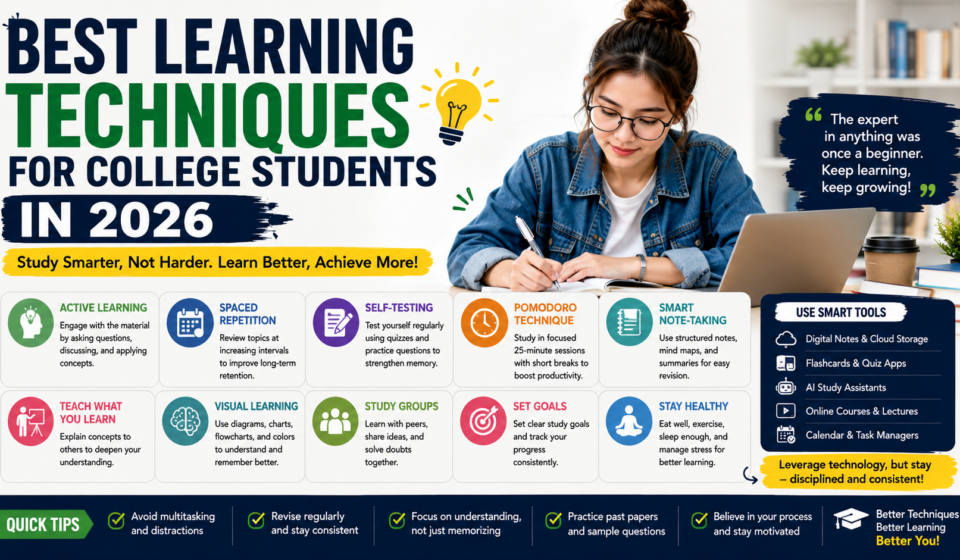
Techniques such as active learning, spaced repetition, self-testing, Pomodoro sessions, smart note-taking, teaching others, visual learning, and responsible use of AI tools can improve academic performance.
With consistency and discipline, college students can learn faster, reduce stress, perform better in exams, and build long-term academic success.
FAQs
1. What are the best learning techniques for college students?
The best techniques include active learning, spaced repetition, self-testing, Pomodoro study sessions, smart note-taking, teaching others, and regular revision.
2. How can college students learn faster?
Students can learn faster by setting clear goals, using active learning, testing themselves, summarizing topics, and avoiding distractions while studying.
3. Is spaced repetition useful for college students?
Yes, spaced repetition is very useful because it helps students remember information for a longer time and reduces last-minute cramming.
4. How many hours should college students study daily?
Most students can benefit from 2 to 4 focused hours daily, depending on their course, workload, and exam schedule. Quality matters more than study hours.
5. Can AI tools help college students learn?
Yes, AI tools can help summarize notes, explain difficult topics, create quizzes, and organize study plans. However, students should use AI responsibly and focus on real understanding.