
Starting college is an exciting new chapter in life. For many students, it is the first time they experience independence, a new academic environment, different teaching styles, and a busy personal schedule. College offers many opportunities, but it also brings challenges.
Why Study Skills Matter for College Freshmen
College freshmen often enter university with different learning backgrounds. Some students may have strong academic habits, while others may struggle with time management, note-taking, or exam preparation. Good study skills help students adjust to college-level learning more smoothly.
Strong study skills are not only about getting good grades. They also help students become independent learners. When freshmen know how to plan, focus, organize, and review effectively, they can handle academic pressure better. These skills also support long-term success in internships, careers, and personal development.
Time Management Skills
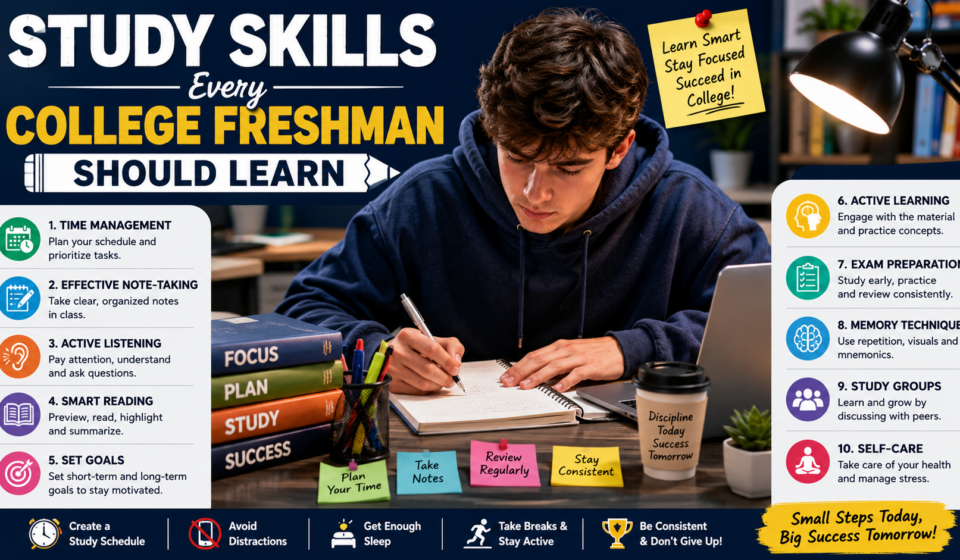
Time management is one of the most important study skills every college freshman should learn. College schedules can be flexible, but that flexibility can become a problem if students do not manage their time properly. Many freshmen underestimate how much time assignments, readings, projects, and exam preparation require.
A good way to manage time is to use a planner, calendar, or digital app. Students should write down class timings, assignment deadlines, exam dates, and study sessions. Breaking large tasks into smaller steps can make them easier to complete. For example, instead of writing “finish research paper,” students can divide it into steps such as choosing a topic, collecting sources, creating an outline, writing the first draft, editing, and final submission.
Managing time well helps students avoid last-minute stress and improves academic performance.
Effective Note-Taking Skills
Taking good notes is essential for college success. Professors may cover a large amount of information in a short time, and students may not find everything in the textbook. Good notes help students remember important points and prepare better for exams.
Freshmen should avoid writing every word the professor says. Instead, they should focus on key ideas, definitions, examples, formulas, and explanations. Using headings, bullet points, symbols, and short summaries can make notes easier to review later.
Popular note-taking methods include the Cornell method, outline method, mapping method, and charting method. Students can experiment with different styles and choose the one that works best for each subject.
Active Listening in Class
Many students attend lectures but do not fully listen. Active listening means paying attention, understanding the main message, asking questions, and connecting new information with what you already know. This skill can make studying much easier after class.
To practice active listening, students should sit where they can focus, avoid phone distractions, and write down questions during the lecture. If something is unclear, they should ask the professor or discuss it after class. Active listening helps students understand concepts better and reduces the need for excessive studying later.
Reading and Understanding Textbooks
College textbooks can be long and difficult to read. Many freshmen try to read every page without a plan, which can become tiring and ineffective. Smart reading skills help students understand information faster.
Before reading a chapter, students should preview the headings, subheadings, summaries, diagrams, and review questions. This gives an idea of what the chapter is about. While reading, they should highlight only important points and write short notes in their own words.
After reading, students should summarize the topic and test themselves. This method improves understanding and memory.
Creating a Study Schedule
A study schedule helps students stay organized and consistent. Without a plan, freshmen may study only before exams, which often leads to stress and poor performance. A weekly study schedule allows students to review regularly and stay prepared.
Students should choose specific times for studying each subject. Short and focused study sessions are usually more effective than long, distracted sessions. For example, studying for 45 minutes with full focus is better than sitting with books for three hours while checking social media.
A good study schedule should also include breaks, meals, exercise, sleep, and relaxation. Balance is important for long-term success.
Avoiding Procrastination
Procrastination is a common problem among college freshmen. Students may delay assignments because they feel overwhelmed, bored, or unsure where to begin. However, waiting until the last minute often creates stress and lowers the quality of work.
To avoid procrastination, students should start tasks early and break them into small steps. The “two-minute rule” can help: if a task takes less than two minutes, do it immediately. For bigger tasks, students can start with just 10 minutes of work. Once they begin, it becomes easier to continue.
Setting deadlines, removing distractions, and rewarding progress can also help students stay motivated.
Active Learning Techniques
Active learning is one of the best ways to study effectively. Instead of only reading or highlighting notes, students should interact with the material. Active learning helps the brain understand and remember information better.
Examples of active learning include explaining concepts aloud, teaching a friend, making flashcards, solving practice problems, creating mind maps, and answering quiz questions. Students can also write summaries in their own words or compare different ideas.
Active learning is especially helpful for subjects that require problem-solving, analysis, or deep understanding.
Exam Preparation Skills
Many freshmen make the mistake of studying only one or two nights before an exam. This method may work sometimes, but it usually increases stress and reduces long-term learning. Good exam preparation starts early.
Students should review notes regularly, identify difficult topics, and practice previous questions if available. Creating a revision plan before exams can help cover all topics without panic. It is also important to understand the exam format, such as multiple-choice questions, essays, practical work, or problem-solving.
Practice tests are very useful because they help students check what they know and what they need to improve.
Memory and Retention Skills
Remembering information is a major part of college learning. Freshmen should learn techniques that improve memory and retention. One effective method is spaced repetition, where students review information at regular intervals instead of cramming everything at once.
Another useful method is retrieval practice. This means trying to remember information without looking at notes. Flashcards, practice questions, and self-quizzing are good examples. Students can also use mnemonics, visual diagrams, and real-life examples to remember difficult concepts.
Good memory skills make exam preparation easier and more effective.
Digital Study Skills
Technology can be a great support for college students. Freshmen can use digital tools for note-taking, scheduling, research, online learning, and collaboration. Apps like digital calendars, task managers, flashcard tools, and cloud storage can help students stay organized.
However, technology can also become a distraction. Social media, games, and constant notifications can reduce focus. Students should use focus mode, website blockers, or app limits during study time.
Digital study skills mean using technology wisely to support learning, not distract from it.
Communication with Professors
Many freshmen feel shy about talking to professors, but communication is an important college skill. Professors can help students understand difficult topics, clarify assignments, and guide them academically.
Students should attend office hours, ask thoughtful questions, and communicate politely through email. If they are struggling, they should ask for help early instead of waiting until the problem becomes serious.
Building positive academic communication can improve confidence and create valuable learning opportunities.
Group Study and Collaboration
Group study can be useful when done properly. Studying with classmates allows students to share ideas, explain concepts, and solve problems together. It can also make learning more interesting.
However, group study should have a clear purpose. Without structure, it can turn into casual chatting. Students should decide the topic, set goals, and keep the group focused. A small group of serious students usually works better than a large group.
Collaboration also teaches teamwork, which is useful in college projects and future careers.
Stress Management and Self-Care
Academic success is not possible without good health. Many freshmen ignore sleep, exercise, and mental well-being because they are busy with college life. This can lead to burnout, anxiety, and poor concentration.
Students should get enough sleep, eat balanced meals, drink water, and take regular breaks. Exercise, meditation, journaling, or talking to friends can help reduce stress. Freshmen should also learn when to rest and when to ask for support.
Healthy students learn better, think clearly, and perform more confidently.
Source
https://l1nq.com/bxrzj42
https://l1nq.com/kl6sdth
Conclusion
College freshmen face many new academic and personal challenges, but the right study skills can make the transition easier. Skills such as time management, note-taking, active listening, smart reading, exam preparation, active learning, and stress management help students become more confident and successful.
Learning these skills early can improve grades, reduce stress, and build a strong foundation for the rest of college life. Freshmen do not need to be perfect from the beginning. They only need to stay consistent, learn from mistakes, and keep improving their study habits. With the right approach, every college freshman can achieve academic success and enjoy a balanced college experience.
FAQs
1. What are the most important study skills for college freshmen?
The most important study skills include time management, note-taking, active listening, textbook reading, exam preparation, active learning, and stress management.
2. How can college freshmen improve their study habits?
Freshmen can improve study habits by creating a schedule, avoiding procrastination, reviewing notes regularly, practicing active learning, and reducing distractions.
3. How many hours should a college freshman study each day?
Study time depends on the course and workload, but most freshmen benefit from 2 to 4 focused study hours per day outside class.
4. What is the best way to take notes in college?
The best note-taking method depends on the student, but the Cornell method, outline method, and mind mapping are useful for many college subjects.
5. How can freshmen avoid procrastination?
Freshmen can avoid procrastination by starting tasks early, breaking big tasks into smaller steps, setting deadlines, and removing distractions.