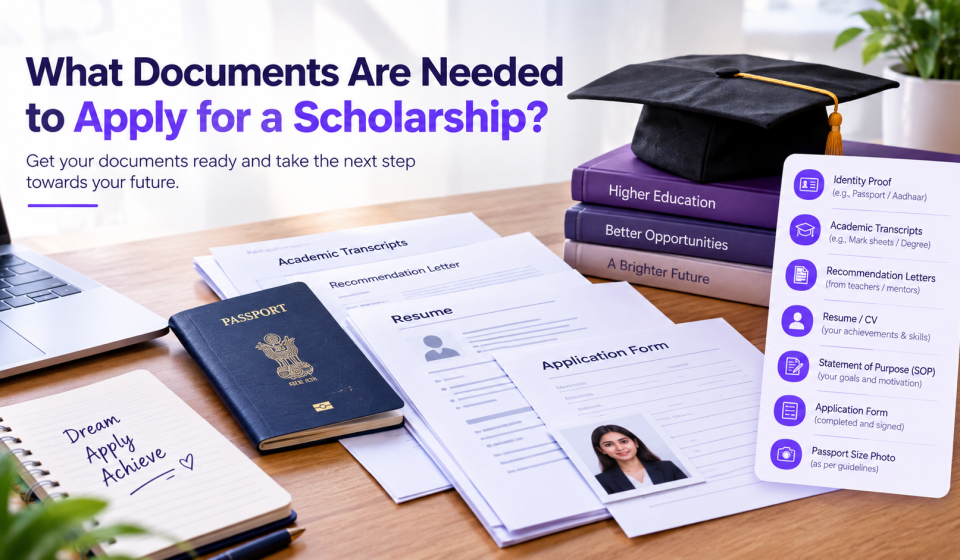

Learn what documents are needed to apply for a scholarship, including transcripts, income proof, recommendation letters, essays, certificates, and identification documents.
Applying for a scholarship can make higher education more affordable, but the application process often requires careful preparation. Along with academic information and personal details, scholarship providers usually ask applicants to submit specific documents that prove their eligibility, financial situation, achievements, and educational goals.
The exact requirements vary depending on the scholarship, institution, country, and organization offering the funding. Some scholarships may require only academic transcripts and identification, while others may ask for income documents, recommendation letters, essays, proof of enrollment, or certificates of achievement.
Knowing what documents are commonly required can help students prepare their applications in advance and avoid missing important deadlines. This guide explains the most common scholarship application documents, why they are needed, and how to organize them effectively.
Academic Transcripts and Mark Sheets
Academic transcripts are among the most commonly requested scholarship documents. They provide a record of your academic performance and help scholarship committees evaluate your educational achievements.
Depending on your education level, you may need to provide:
- High school transcripts
- College or university transcripts
- Semester-wise mark sheets
- Final examination results
- Grade reports
- Academic certificates
Some scholarships require transcripts from all institutions attended, while others may only ask for your most recent academic record.
Make sure the documents are clear and readable. If the scholarship requires official transcripts, request them from your school, college, or university well before the application deadline.
Proof of Enrollment or Admission
Many scholarships are available only to students who are currently enrolled in an educational institution or have received an admission offer.
Applicants may therefore need to provide:
- Admission letter
- Enrollment certificate
- Student identification card
- University acceptance letter
- Registration confirmation
- Proof of current student status
If you are applying for a scholarship before starting your course, an official admission or acceptance letter may be particularly important.
Always check whether the scholarship requires proof of admission before submitting your application.
Identification Documents
Scholarship organizations often need an official identification document to verify the applicant’s identity.
Common examples include:
- Passport
- National identity card
- Government-issued ID
- Birth certificate
- Student ID, where accepted
International students may specifically be asked to provide a valid passport or another recognized identity document.
Check that your name is spelled consistently across your application and identification documents. Differences in spelling can sometimes create verification problems.
Proof of Income or Financial Need
Need-based scholarships commonly require documents showing the applicant’s financial circumstances. These documents help scholarship committees determine whether an applicant meets the financial eligibility requirements.
Depending on the scholarship, you may need:
- Family income certificate
- Salary slips
- Tax documents
- Bank statements
- Government benefit statements
- Financial aid forms
- Proof of household income
- Employer income verification
Students should carefully read the scholarship’s financial requirements because the definition of financial need can differ between organizations.
If the scholarship requires documents from parents or guardians, make sure those documents are collected early.
Personal Statement or Scholarship Essay
Although a personal statement is not always considered a traditional supporting document, it is an important part of many scholarship applications.
A scholarship essay allows you to explain:
- Your educational goals
- Career ambitions
- Personal experiences
- Academic interests
- Leadership experience
- Community involvement
- Financial circumstances
- Why you deserve or qualify for the scholarship
Some scholarships provide a specific essay question, while others allow applicants to write about their goals or achievements.
Keep your essay relevant to the scholarship and follow the required word count. Proofread it carefully before submission.
Letters of Recommendation
Scholarship providers may ask for one or more recommendation letters from people who know your academic, professional, or personal qualities.
Possible recommenders include:
- Teachers
- Professors
- Academic advisors
- Employers
- Internship supervisors
- Community leaders
Choose someone who can provide specific and meaningful information about your abilities and achievements.
Give recommenders enough time to prepare their letters. Ideally, contact them several weeks before the scholarship deadline and provide information about the scholarship and your goals.
Resume or Curriculum Vitae
Some scholarship applications require a resume or CV, particularly scholarships aimed at university students, graduate students, researchers, or professionals.
Your scholarship resume may include:
- Education
- Academic achievements
- Work experience
- Internships
- Volunteer activities
- Leadership roles
- Certifications
- Awards
- Extracurricular activities
- Research experience
- Relevant skills
Keep your resume concise and focused on experiences that demonstrate your qualifications for the scholarship.
Certificates of Awards and Achievements
If you have received academic, sports, cultural, professional, or community awards, you may be able to include certificates as supporting evidence.
Examples include:
- Academic awards
- Competition certificates
- Sports achievements
- Leadership certificates
- Volunteer recognition
- Research awards
- Professional certifications
- Community service awards
Only submit achievements that are relevant or specifically requested. Organizing your certificates clearly can make it easier for the scholarship provider to review them.
Proof of Extracurricular Activities
Some scholarships consider activities outside the classroom. Applicants may need to demonstrate participation in clubs, sports, volunteering, student organizations, community projects, or other activities.
Supporting evidence can include:
- Participation certificates
- Volunteer letters
- Club membership documents
- Leadership certificates
- Event participation records
- Letters from organizations
When possible, provide documents that clearly state your role, activity, and duration of participation.
Research Proposal or Study Plan
Students applying for research-based scholarships, master’s programs, PhD funding, or academic fellowships may be required to submit a research proposal or study plan.
A research proposal typically explains:
- Research topic
- Research objectives
- Background
- Methodology
- Expected outcomes
- Importance of the research
- Relevant references
Requirements vary considerably, so applicants should carefully follow the scholarship provider’s instructions.
English Language or Other Language Test Scores
International scholarships may require proof of language proficiency.
Depending on the program, accepted tests may include:
- IELTS
- TOEFL
- PTE
- Cambridge English examinations
- Other officially recognized language tests
Some universities and scholarship providers may waive language requirements for applicants who completed previous education in a particular language.
Check the scholarship’s official requirements before paying for a test.
Standardized Test Scores
Certain scholarships may request standardized examination results. The required test depends on the scholarship and level of study.
Examples may include:
- SAT
- ACT
- GRE
- GMAT
- Other national or institution-specific examinations
Not every scholarship requires standardized test scores, so applicants should submit them only when requested or relevant.
Passport-Sized Photograph
Some scholarship applications require a recent photograph for identification purposes.
Follow the specified requirements for:
- Photo size
- Background
- File format
- Image quality
- Recentness
Avoid submitting casual photographs when the scholarship specifically requests a formal identification-style photograph.
Medical or Health Documents
Some international scholarship programs may request specific health-related documentation, particularly when students are traveling abroad or applying for government-sponsored programs.
These requirements may include:
- Medical examination certificate
- Vaccination records
- Health declaration
- Medical fitness certificate
Because health-document requirements can vary significantly, applicants should follow the exact instructions provided by the scholarship organization.
Proof of Citizenship or Residency
Certain scholarships are restricted to citizens or residents of particular countries, states, regions, or communities.
Applicants may therefore need to provide:
- Citizenship certificate
- Passport
- Residency certificate
- Permanent residence documentation
- Domicile certificate
- Other official residency evidence
Make sure the document you provide meets the scholarship’s specific eligibility criteria.
Bank or Payment Information
Some scholarship providers may request banking information after an applicant has been selected rather than during the initial application.
This information may be used to transfer scholarship funds.
Applicants should provide financial information only through the scholarship provider’s official and secure application system. Be especially careful if someone requests sensitive banking information through an unofficial email or messaging platform.
Parent or Guardian Documents
For scholarships aimed at school students or financially dependent applicants, documents belonging to parents or guardians may be required.
These could include:
- Parent income certificates
- Employment verification
- Tax documents
- Identification documents
- Financial statements
- Guardian documentation
Read the scholarship instructions carefully to determine exactly whose financial information must be submitted.
How to Prepare Scholarship Documents
Preparing documents before the application deadline can make the process much easier. Start by creating a checklist based on the scholarship’s official requirements.
A useful preparation process is:
1. Read the Official Requirements
Begin with the scholarship provider’s official website or application portal. Make a list of every required document.
2. Create a Digital Folder
Create a dedicated folder for your scholarship application. You can organize it into subfolders such as:
- Academic Records
- Identification
- Financial Documents
- Certificates
- Recommendation Letters
- Essays
- Resume
3. Scan Documents Clearly
Use high-quality scans or digital copies. Make sure every page is readable and that no important information is cut off.
4. Check File Formats
Some applications accept only PDF files, while others may accept JPG, PNG, or DOCX files. Follow the specified format and file-size limits.
5. Use Consistent File Names
Clear names such as Academic_Transcript.pdf or Recommendation_Letter.pdf make documents easier to identify.
6. Check Translation Requirements
If your documents are written in a language different from the scholarship provider’s required language, you may need an official translation.
7. Verify Expiration Dates
Check whether passports, certificates, language scores, or other documents must be valid on the application date.
8. Keep Backup Copies
Save copies of everything you submit. This can be useful if the scholarship provider asks for additional information later.
Common Mistakes to Avoid
Even strong scholarship applicants can lose opportunities because of simple documentation mistakes.
Common problems include:
- Missing required documents
- Submitting the wrong file
- Uploading unreadable scans
- Exceeding file-size limits
- Missing signatures
- Providing expired documents
- Using incorrect file formats
- Failing to translate documents when required
- Submitting documents after the deadline
- Giving inconsistent personal information
Before submitting your application, compare your files with the scholarship’s official checklist.
Do You Need Every Document Listed Above?
No. Not every scholarship requires all of these documents. Requirements depend on the scholarship provider, academic level, country, institution, and type of funding.
For example, a merit-based undergraduate scholarship might primarily request academic transcripts, an admission letter, a personal statement, and recommendation letters. A need-based scholarship may additionally require detailed financial documents.
The safest approach is to follow the official scholarship application instructions rather than submitting unnecessary documents.
Source
https://l1nq.com/ivzgjrq
https://l1nq.com/7pjur3q
Conclusion
Scholarship applications often require more than good grades. Applicants may need to provide academic transcripts, proof of enrollment, identification documents, financial records, recommendation letters, resumes, essays, achievement certificates, and other supporting materials.
The exact requirements vary from one scholarship to another, so carefully reviewing the official application guidelines is essential. Preparing documents early, keeping digital copies organized, checking file requirements, and verifying every detail can make the application process smoother.
A well-organized document package allows you to focus on presenting your academic achievements, goals, and experiences rather than rushing to collect paperwork at the last minute.
FAQs
1. What is the most important document for a scholarship application?
There is no single document that is most important for every scholarship. Academic transcripts, personal statements, recommendation letters, and proof of eligibility are commonly important, depending on the scholarship’s requirements.
2. Do scholarships require income certificates?
Need-based scholarships often require proof of income or financial circumstances. However, merit-based scholarships may not require financial documents.
3. Do I need a recommendation letter for every scholarship?
No. Some scholarships require recommendation letters, while others do not. Always check the individual scholarship requirements.
4. Can I submit photocopies of my documents?
Some scholarships accept scanned copies or photocopies during the initial application, while others may require certified or official documents. Follow the instructions provided by the scholarship organization.
5. Do scholarship documents need to be translated?
If your original documents are not in the language specified by the scholarship provider, an official translation may be required.
6. Should I submit documents that are not requested?
Generally, submit the documents specifically requested by the scholarship provider. Extra documents may not be reviewed and could make your application harder to process.
7. How early should I prepare scholarship documents?
It is best to begin preparing documents several weeks before the deadline, especially if you need transcripts, recommendation letters, official certificates, translations, or financial documents.
8. What format should scholarship documents be in?
PDF is commonly used, but requirements vary. Always check the scholarship application portal for accepted file formats and maximum file sizes.
9. Can international students apply for scholarships?
Yes. Many scholarships are specifically available to international students, although eligibility requirements vary by country, institution, program, and scholarship provider.
10. How can I avoid missing a required document?
Create a checklist from the official scholarship instructions and check every requirement before submitting your application. Keep copies of all uploaded files for your records.