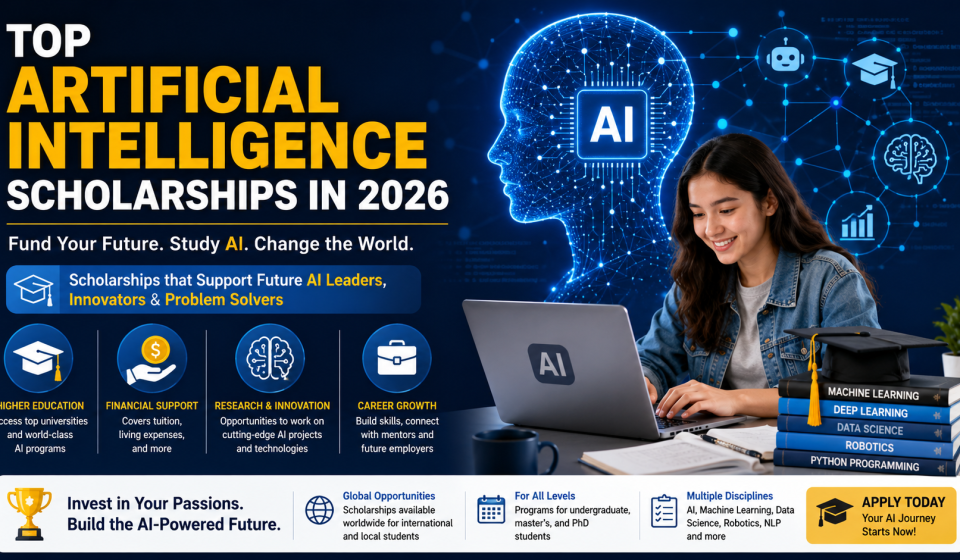

Artificial intelligence is one of the most powerful fields shaping the future of education, business, healthcare, finance, engineering, and technology. As AI becomes more important across industries, students are increasingly choosing artificial intelligence, machine learning, data science, robotics, computer science, and automation as career paths.
Why Artificial Intelligence Scholarships Matter in 2026
AI is no longer limited to technology companies. It is now used in hospitals, banks, schools, factories, agriculture, cybersecurity, marketing, and transportation. Because of this, the demand for skilled AI professionals is growing quickly.
Scholarships make AI education more accessible for students from different financial backgrounds. Many students have strong talent and interest in technology, but they may not be able to afford expensive degree programs. Scholarships help reduce this gap.
AI scholarships also encourage innovation. Students who receive financial support can focus more on learning, research, coding, projects, and internships instead of worrying only about fees.
Types of Artificial Intelligence Scholarships
There are many types of AI scholarships available in 2026. Some are offered by universities, while others come from governments, private organizations, research institutes, and technology companies.
Merit-based scholarships are given to students with strong academic performance. Need-based scholarships support students who require financial help. Research scholarships are designed for students working on AI, machine learning, natural language processing, robotics, or data science projects.
Some scholarships are also created for women in STEM, international students, minority students, and students from developing countries. These programs help create more diversity in the AI industry.
University-Based AI Scholarships
Many universities now offer scholarships for artificial intelligence and related programs. These scholarships may support undergraduate, master’s, or PhD students.
University-based scholarships are often connected to specific courses such as MSc Artificial Intelligence, Data Science, Computer Science, Machine Learning, Robotics, or Business Analytics. Some scholarships cover partial tuition fees, while others offer larger financial support.
For example, Bocconi University lists an Artificial Intelligence Scholarship for its Master of Science in Artificial Intelligence for the 2026–27 academic year, while Canada’s Vector Institute provides an AI scholarship entrance award for eligible master’s students in Ontario.
Fully Funded AI Scholarships
Fully funded scholarships are among the most attractive options for students. These scholarships may cover tuition fees, living expenses, travel costs, health insurance, and sometimes research support.
Fully funded AI scholarships are usually very competitive. Students need a strong academic record, clear career goals, recommendation letters, a well-written personal statement, and sometimes a project portfolio.
Students who want fully funded scholarships should start preparing early. They should research deadlines, eligibility criteria, university requirements, and required documents several months before applying.
Government Scholarships for AI Students
Governments around the world are supporting STEM and AI education because artificial intelligence is important for national development, innovation, and future jobs.
Government scholarships may support students who want to study AI, computer science, engineering, data science, cybersecurity, or robotics. These scholarships can be available for domestic or international students.
Some government-funded programs are not only for AI but also cover broader STEM fields. Students interested in AI should check whether their chosen program is eligible under science, technology, engineering, or computer science categories.
Scholarships for AI and Data Science Students
AI and data science are closely connected. AI systems depend on data, and data science uses machine learning and analytics to find patterns and make predictions. Because of this, many scholarships for data science students are also useful for AI students.
Students can search for scholarships using keywords such as artificial intelligence, machine learning, data science, data analytics, computer science, robotics, automation, and STEM.
Scholarships.com notes that students interested in AI may also qualify for broader scholarships in computer science, engineering, technology, and STEM fields.
Scholarships for Women in AI
Women are still underrepresented in many technology careers, including artificial intelligence and machine learning. To improve gender diversity, many organizations offer scholarships for women in STEM and technology.
These scholarships help female students access education, mentorship, networking, internships, and leadership opportunities. They also encourage more women to become AI engineers, researchers, founders, and technology leaders.
Students applying for women-focused AI scholarships should highlight academic achievements, leadership experience, passion for technology, and future career goals.
AI Scholarships for International Students
International students often face higher tuition fees and living expenses. AI scholarships for international students can make studying abroad more affordable.
Many universities offer scholarships based on academic merit, country of origin, financial need, or field of study. Some scholarships are specifically designed for international master’s or PhD students in AI and technology-related subjects.
Students should check official university pages, scholarship portals, and government websites. They should also verify deadlines carefully because international scholarship deadlines often close early.
Eligibility Criteria for AI Scholarships
Eligibility criteria depend on the scholarship provider. However, most AI scholarships look for students with interest or background in computer science, mathematics, statistics, engineering, data science, or related fields.
Common requirements include academic transcripts, admission letter, resume, statement of purpose, recommendation letters, English language test scores, and proof of financial need. Some scholarships may also ask for coding projects, research proposals, or a portfolio.
Students applying for advanced AI scholarships may need knowledge of Python, machine learning, algorithms, data analysis, mathematics, and programming basics.
How to Apply for Artificial Intelligence Scholarships
The first step is to choose the right AI program and university. After that, students should check whether scholarships are available for that program.
Students should prepare all documents before the deadline. A strong scholarship application should clearly explain why the student wants to study AI, what skills they have, and how the scholarship will help them achieve their goals.
A good statement of purpose can make a major difference. Students should avoid generic writing and focus on their personal journey, academic interest, projects, achievements, and future plans.
Tips to Increase Your Scholarship Chances
Students should apply for more than one scholarship. Depending on only one opportunity can be risky because AI scholarships are competitive.
They should build a strong academic profile, complete AI-related online courses, create projects, participate in coding competitions, and maintain a professional resume. A GitHub profile, research paper, internship, or data science project can improve the application.
Students should also request recommendation letters early. Teachers, professors, or mentors should have enough time to write meaningful recommendations.
Career Benefits of AI Scholarships
Winning an AI scholarship is not only about saving money. It also adds value to a student’s academic and professional profile.
Scholarship recipients may get access to mentorship, research networks, industry events, internships, and career opportunities. Some programs connect students with AI companies, startups, professors, and professional communities.
This can help students build confidence and prepare for high-demand careers in artificial intelligence, machine learning, automation, robotics, natural language processing, and data science.
Future Scope of Artificial Intelligence Education
The future of AI education is strong. As more industries adopt automation and intelligent systems, demand for AI professionals will continue to grow.
Students who study AI can work in many fields, including healthcare AI, financial technology, education technology, cybersecurity, autonomous vehicles, smart cities, agriculture technology, and business analytics.
AI scholarships in 2026 can help students become part of this fast-growing future. With the right education and skills, students can contribute to innovation and solve real-world problems.
Source
https://l1nq.com/hw218gi
https://sl1nk.com/ap5ij6a
Conclusion
Artificial intelligence scholarships in 2026 are excellent opportunities for students who want to build careers in one of the most important technology fields of the future. These scholarships can reduce tuition costs, support research, provide mentorship, and open doors to global education.
Students should explore university scholarships, government scholarships, fully funded programs, STEM scholarships, women in technology scholarships, and international student funding options. The key to success is early preparation, strong documents, practical projects, and clear career goals.
AI is shaping the future, and scholarships can help talented students become future AI professionals, researchers, innovators, and leaders.
FAQs
1. What are artificial intelligence scholarships?
Artificial intelligence scholarships are financial awards for students studying AI, machine learning, data science, robotics, computer science, or related technology fields.
2. Who can apply for AI scholarships in 2026?
Undergraduate, master’s, and PhD students can apply depending on the scholarship. Some programs are for international students, women in STEM, or students with strong academic records.
3. Are there fully funded AI scholarships?
Yes, some scholarships may cover tuition fees, living costs, travel expenses, and research support. However, fully funded scholarships are usually highly competitive.
4. What documents are required for AI scholarship applications?
Common documents include academic transcripts, resume, statement of purpose, recommendation letters, admission proof, financial documents, and sometimes a project portfolio.
5. Do I need coding skills for AI scholarships?
Coding skills are helpful, especially Python, machine learning, data analysis, and programming basics. Advanced scholarships may require stronger technical knowledge..