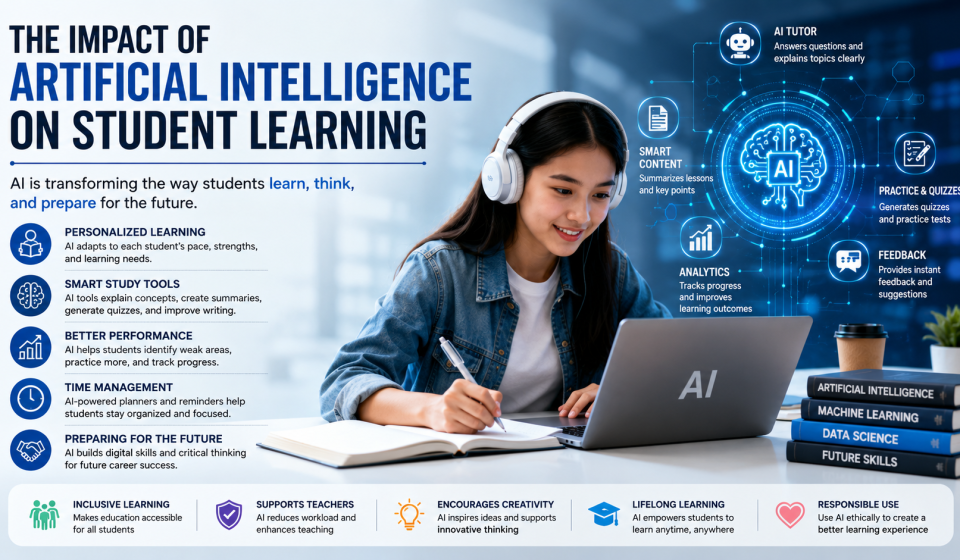

Artificial intelligence is changing the way students learn, study, research, write, and prepare for the future. In the past, students depended mainly on textbooks, teachers, libraries, and classroom lectures. Today, AI tools can explain difficult topics, summarize long chapters, create quizzes, improve writing, translate content, and help students build personalized study plans.
What Is Artificial Intelligence in Education?
Artificial intelligence in education refers to digital tools and systems that can perform tasks usually requiring human intelligence. These tasks include answering questions, analyzing data, giving feedback, recommending lessons, checking grammar, creating summaries, and identifying learning gaps.
For students, AI can work like a personal study assistant. It can help them understand complex subjects, revise faster, and organize their academic work. For teachers, AI can support lesson planning, grading, and student performance tracking.
AI is used in learning apps, writing tools, tutoring platforms, language-learning software, exam preparation tools, and research systems. This makes education more interactive, flexible, and student-centered.
How AI Supports Personalized Learning
One of the biggest benefits of AI in student learning is personalization. Every student learns differently. Some students understand topics quickly, while others need more practice. Some prefer videos, while others learn better through reading, examples, or quizzes.
AI tools can analyze a student’s progress and suggest learning materials based on their needs. If a student is weak in mathematics, grammar, coding, or science concepts, AI can recommend extra practice. If a student already understands a topic, AI can move them to advanced content.
This personalized approach helps students save time and focus on areas that need improvement. It also makes learning more comfortable and less stressful.
AI Makes Difficult Topics Easier to Understand
Many students struggle with difficult subjects because classroom time is limited. Sometimes students feel shy about asking questions repeatedly. AI tools can help by explaining the same topic in different ways.
For example, a student who does not understand a science concept can ask AI for a simple explanation, a real-life example, a diagram idea, or a step-by-step breakdown. This helps students learn at their own speed.
AI can also simplify long academic texts. It can summarize chapters, define difficult words, and explain complex ideas in beginner-friendly language. This is especially helpful for students learning in a second language.
AI Improves Study Planning and Time Management
Time management is a major challenge for students. Many students have to balance classes, assignments, exams, part-time jobs, internships, and personal life. AI tools can help students create better study schedules.
AI-powered planners can suggest daily goals, revision timelines, assignment reminders, and exam preparation strategies. Students can break large tasks into smaller steps and manage deadlines more effectively.
This helps reduce stress and improves productivity. When students have a clear study plan, they are more likely to stay focused and consistent.
AI Enhances Writing and Research Skills
Writing is an important part of student learning. Students need to write essays, reports, research papers, presentations, and project summaries. AI writing tools can help students improve grammar, sentence structure, clarity, and organization.
AI can also help students brainstorm ideas, create outlines, and improve the flow of their writing. For research, AI tools can help summarize sources, identify key points, and organize information.
However, students should not copy AI-generated content directly. They should use AI as a support tool and add their own understanding, analysis, and original thoughts. Academic honesty is very important.
AI Supports Exam Preparation
AI can make exam preparation more effective. Students can use AI tools to generate practice questions, flashcards, mock tests, and revision summaries. This helps them test their knowledge before exams.
AI can also identify weak areas. For example, if a student answers several questions incorrectly from one chapter, AI can suggest reviewing that topic again.
This makes exam preparation more focused. Instead of studying everything randomly, students can spend more time on topics that need improvement.
AI Encourages Self-Paced Learning
Traditional classrooms often follow a fixed speed. Some students may find the pace too fast, while others may find it too slow. AI supports self-paced learning by allowing students to study whenever and wherever they want.
Students can revise lessons at night, practice during free time, or review difficult topics before exams. This flexibility is useful for college students, online learners, and working students.
Self-paced learning also builds independence. Students become more responsible for their own progress and develop lifelong learning habits.
AI Helps Students with Different Learning Needs
AI can also support students with different learning needs. Some tools can convert text to speech, speech to text, translate language, provide captions, and simplify content. These features can help students with disabilities, language barriers, or learning difficulties.
For example, students with reading challenges may benefit from audio-based learning. Students who struggle with note-taking can use AI transcription tools. Students learning a new language can use AI translation and grammar support.
This makes education more inclusive and accessible.
The Risks of Overusing AI
Although AI has many benefits, overusing it can harm student learning. If students depend on AI for every answer, they may stop thinking deeply. They may complete assignments quickly but fail to understand the subject.
This can create a false sense of learning. A student may submit good work with AI support but may not be able to explain the topic in an exam or discussion.
Overuse of AI can also reduce creativity, memory, research skills, and problem-solving ability. Students must remember that AI should support learning, not replace effort.
Academic Integrity and Ethical Concerns
AI has created new challenges for schools and colleges. Some students may use AI to write full assignments, solve exams, or create projects without real learning. This raises concerns about cheating and academic honesty.
Students should follow their institution’s AI policies. If AI is allowed, they should use it responsibly and mention it when required. They should avoid plagiarism and make sure their work reflects their own knowledge.
Ethical AI use means being honest, responsible, and aware of limitations. AI can make mistakes, so students should always verify important information.
The Role of Teachers in an AI-Powered Classroom
AI does not replace teachers. Teachers remain essential for guidance, motivation, emotional support, critical thinking, and real-world understanding. AI can provide information, but teachers help students understand meaning, context, and values.
In an AI-powered classroom, teachers can use technology to make learning more engaging. They can focus more on discussions, problem-solving, mentoring, and personalized support.
The best learning happens when AI and teachers work together. AI provides tools, while teachers provide human connection and wisdom.
Skills Students Need in the Age of AI
As AI becomes common, students need new skills to succeed. They should learn digital literacy, critical thinking, communication, creativity, problem-solving, research skills, and ethical awareness.
Students should also learn how to ask better questions. AI gives better answers when students give clear prompts. This means prompt writing and information evaluation are becoming important skills.
In the future, students who know how to use AI wisely will have an advantage in college and careers.
How Students Can Use AI Responsibly
Students should use AI as a learning partner, not as a shortcut. They can ask AI to explain topics, create practice questions, summarize notes, check grammar, and suggest study plans.
However, they should always rewrite content in their own words, check facts, understand the topic, and follow academic rules. Students should also balance AI use with reading, writing, discussion, and independent thinking.
Responsible AI use helps students become smarter, more confident, and more future-ready.
Source
https://l1nq.com/4ynom1f
https://l1nq.com/i4bqdzx
Conclusion
The impact of artificial intelligence on student learning is both exciting and challenging. AI can personalize education, explain difficult topics, improve writing, support research, help with exam preparation, and make learning more accessible. It gives students powerful tools to study smarter and manage their academic life better.
At the same time, AI must be used carefully. Students should not depend on it completely or use it to avoid real learning. Critical thinking, creativity, honesty, and problem-solving remain essential.
The future of education will not be only about using AI. It will be about using AI wisely. Students who combine technology with discipline, curiosity, and human intelligence will be better prepared for academic success and future careers.
FAQs
1. How does AI help students learn better?
AI helps students by explaining difficult topics, creating study plans, summarizing notes, generating quizzes, improving writing, and offering personalized learning support.
2. Can AI replace teachers?
No, AI cannot replace teachers. AI can support learning, but teachers provide guidance, motivation, emotional support, real-world context, and critical thinking development.
3. Is using AI for studying considered cheating?
Using AI is not cheating if students use it responsibly for learning, revision, and support. However, copying AI-generated answers without understanding or permission may be considered academic dishonesty.
4. What are the risks of AI in education?
The main risks include overdependence, reduced critical thinking, plagiarism, inaccurate information, lack of creativity, and false confidence without real understanding.
5. How can students use AI responsibly?
Students can use AI to understand topics, practice questions, organize notes, and improve writing. They should verify facts, write in their own words, and follow school or college rules.