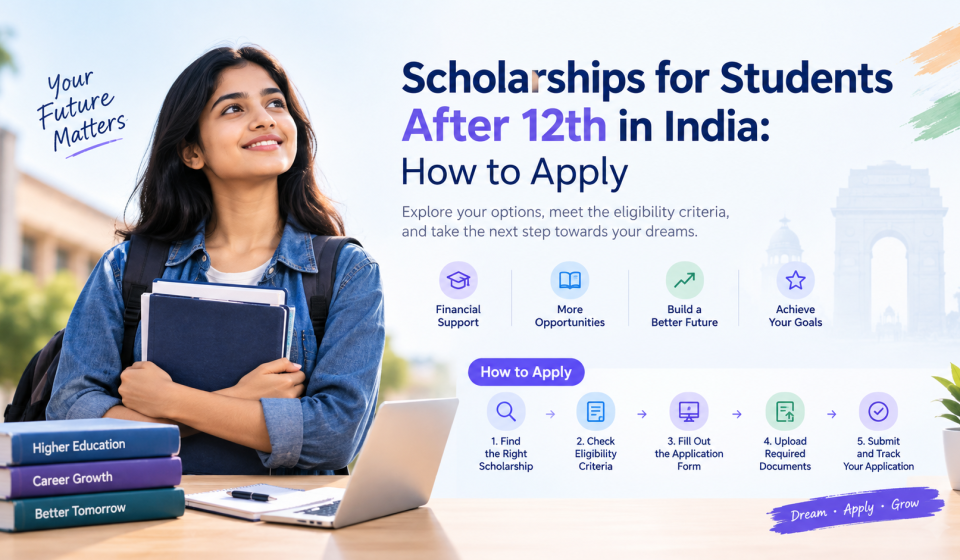

Discover scholarships for students after 12th in India. Learn about eligibility, required documents, application steps, and tips to apply successfully.
Completing Class 12 is an important milestone for students in India. After school, many students plan to pursue undergraduate degrees, professional courses, diplomas, or other higher-education programs. However, tuition fees, accommodation, books, examination fees, and other educational expenses can make higher education difficult for some families.
Scholarships can help reduce this financial burden. There are several scholarships available for students after Class 12, offered by the Central Government, state governments, universities, educational institutions, private organizations, and other foundations.
One of the most important platforms for government scholarships is the National Scholarship Portal (NSP). For the 2026–27 academic year, the NSP portal is open and provides access to multiple scholarship schemes. Students can check scheme-specific eligibility requirements and application deadlines directly through the portal.
This guide explains the different types of scholarships available after Class 12, eligibility requirements, documents generally needed, and how students can apply successfully.
What Are Scholarships for Students After 12th?
Scholarships are financial assistance programs designed to support students in continuing their education. Depending on the scheme, financial assistance may help with tuition fees, maintenance expenses, books, educational materials, accommodation, or other academic costs.
Scholarships may be awarded based on:
- Academic merit
- Family income
- Category or social background
- Disability
- Gender
- Course or field of study
- State or region
- Special circumstances
- Performance in entrance examinations
Some scholarships are merit-based, while others are based primarily on financial need or specific eligibility criteria.
Types of Scholarships Available After Class 12
Students can explore several categories of scholarships after completing Class 12.
1. Central Government Scholarships
The Government of India offers various scholarships for students pursuing higher education. Many of these schemes are available through the National Scholarship Portal.
For example, the PM-USP Central Sector Scheme of Scholarship for College and University Students supports meritorious students from lower-income families pursuing higher studies. The scheme uses Class 12 academic performance as one of its eligibility considerations.
Other schemes listed on NSP include scholarships for specific groups, professional courses, students with disabilities, SC/ST students, OBC/EBC/DNT students, and students from particular regions.
2. State Government Scholarships
Almost every Indian state has scholarship programs for eligible students. These may be intended for students belonging to particular categories, income groups, communities, or educational levels.
Students should check their state government’s official scholarship portal as well as NSP to determine whether a particular scheme is available.
3. Merit-Based Scholarships
Merit scholarships are generally awarded based on academic performance. Students who achieve strong Class 10 or Class 12 results may qualify for scholarships offered by governments, universities, colleges, or private organizations.
For example, the PM-USP Central Sector Scheme considers students who are above the 80th percentile of successful candidates in the relevant stream of their Class XII board examination, subject to other conditions.
4. Need-Based Scholarships
Need-based scholarships focus on the financial circumstances of the student’s family. These programs may have annual family-income limits.
Students should carefully read the income requirements before applying because the income limit can differ significantly from one scholarship to another.
5. Category-Based Scholarships
There are scholarships specifically designed for students from certain categories, including SC, ST, OBC, EBC, DNT, and other eligible groups.
The NSP currently lists schemes such as the Central Sector Scholarship of Top Class Education for SC Students, PM YASASVI Top Class Education in College for OBC, EBC and DNT students, and higher-education scholarships for ST students.
6. Scholarships for Students With Disabilities
Students with disabilities can also find dedicated scholarship opportunities. NSP lists both post-matric and top-class education scholarships for eligible students with disabilities.
Eligibility and documentation requirements can vary, so applicants should carefully review the official scheme guidelines.
Who Can Apply for Scholarships After 12th?
Eligibility depends on the particular scholarship. However, common requirements may include:
- Having passed Class 12 or an equivalent examination
- Taking admission to an eligible undergraduate or professional course
- Meeting minimum academic requirements
- Satisfying family-income criteria where applicable
- Belonging to a specified category, state, or region where required
- Studying at an eligible institution
- Meeting age or course-specific conditions
- Having the required identification and bank-account information
For example, the PM-USP Central Sector Scheme has specific requirements relating to Class XII performance, family income, regular courses, and eligible institutions.
Students should never assume that good Class 12 marks alone guarantee a scholarship. Every scheme has its own conditions.
Documents Required for Scholarship Applications
Before beginning the application process, students should prepare their documents.
Commonly requested documents may include:
- Class 10 marksheet
- Class 12 marksheet
- Aadhaar or other accepted identification
- Admission or college enrollment details
- Income certificate
- Caste/category certificate, if applicable
- Disability certificate or UDID details, if applicable
- Domicile certificate, where required
- Bank account details
- Passport-size photograph
- Previous scholarship details, if applicable
- Fee receipt or institutional documents
- Course and institution information
The exact documents depend on the scholarship. Students should always follow the requirements displayed on the official application portal.
How to Apply for Scholarships After 12th in India
The application process generally involves several steps.
Step 1: Search for Suitable Scholarships
Start by identifying scholarships for which you may qualify. The National Scholarship Portal provides information about various Central Government and other scholarship schemes. Students can check eligibility and scheme-specific details on the portal.
You should also check:
- Your state scholarship portal
- Your college or university website
- Government department websites
- Official scholarship foundations
- Scholarship announcements from your educational institution
Step 2: Check Eligibility Carefully
Read the eligibility requirements before starting the application.
Check your:
- Class 12 marks
- Family income
- Course
- College or university
- Category
- State/domicile
- Year of admission
- Other scholarship benefits
This can help you avoid submitting applications for scholarships for which you are not eligible.
Step 3: Complete One Time Registration on NSP
For scholarships available through NSP, students are required to complete One Time Registration (OTR). The OTR is a unique number associated with the student and is required for applying through the portal.
Students should complete the registration using the official NSP process and keep their OTR information secure.
Step 4: Fill Out the Scholarship Application
After completing the required registration, select the relevant scholarship and fill out the application form.
Enter information carefully, including:
- Personal details
- Academic information
- Bank details
- Course information
- Institution details
- Income information
- Category information, if applicable
Make sure the information matches your official documents.
Step 5: Upload Required Documents
Upload the documents requested by the scholarship scheme.
Check that:
- Documents are readable
- Names and dates are correct
- Certificates are valid
- Uploaded files meet the required format and size
- Bank details are accurate
Incorrect or unclear documentation can lead to verification problems.
Step 6: Submit and Verify the Application
Review the complete application before submitting it.
After submission, the application may go through institutional, district, state, or departmental verification depending on the scheme. Therefore, students should regularly check their application status and respond to any request for correction or additional information.
Step 7: Track Your Scholarship Status
Do not stop after submitting the form. Track the application through the relevant portal.
NSP provides facilities for checking application-related information and tracking scholarship payments.
How to Increase Your Chances of Getting a Scholarship
There is no guaranteed method for receiving a scholarship, but students can improve their application quality by following a few practical steps.
Apply Early
Do not wait until the final day. Some scholarship portals have strict deadlines, and verification may take additional time.
Maintain Accurate Documents
Make sure your certificates, marksheets, income documents, and bank information are accurate and current.
Read the Guidelines
Never rely only on a scholarship’s name or a social-media post. Read the official eligibility conditions and instructions.
Check Your Application Multiple Times
Small mistakes in names, account numbers, marks, course details, or institution information can create unnecessary problems.
Keep Copies of Your Application
Save your application number, OTR details, acknowledgement, uploaded documents, and other important information for future reference.
Monitor Your Email and Portal
Scholarship authorities or institutions may request corrections or verification. Regularly checking the portal can help you respond within the required period.
Common Mistakes Students Should Avoid
Students frequently make avoidable mistakes when applying for scholarships.
Some common mistakes include:
- Applying without checking eligibility
- Missing the deadline
- Entering incorrect academic information
- Providing incorrect bank details
- Uploading unclear documents
- Using unofficial scholarship websites
- Forgetting institutional verification
- Ignoring correction requests
- Assuming scholarship approval is automatic
- Failing to check application status
For the 2026–27 academic year, NSP has published scheme-specific application and verification deadlines, so students should check the official portal rather than relying on old dates.
Where Should Students Look for Scholarships?
The National Scholarship Portal should be one of the first places students check for eligible government scholarships.
Students should also explore:
- State government scholarship portals
- College and university scholarship pages
- Government ministry websites
- AICTE-related scholarship opportunities
- UGC-related schemes
- Private scholarship foundations
- Corporate scholarship programs
- Educational trusts and charitable organizations
Always verify scholarship information through an official source before submitting personal or financial information.
Source
https://l1nq.com/p9ibuq0
https://l1nq.com/v8jih7u
Conclusion
Scholarships for students after 12th in India can make higher education more affordable and accessible. Whether you are planning to study engineering, medicine, commerce, science, arts, management, or another field, it is worth researching the scholarship opportunities available for your course and circumstances.
The National Scholarship Portal provides access to numerous government scholarship schemes, while state governments, universities, colleges, and private organizations offer additional opportunities. For the 2026–27 academic year, students can use NSP to review available schemes, complete the required OTR process, submit applications, and track their scholarship information.
The key is to start early, check eligibility carefully, prepare documents in advance, submit accurate information, and regularly monitor your application. With proper research and timely action, students can identify financial-support opportunities that may help them continue their higher education.
FAQs
1. Can I apply for a scholarship after Class 12?
Yes. Many scholarships are available to students who have completed Class 12 and are entering undergraduate, professional, or other eligible higher-education programs. Eligibility depends on the individual scholarship.
2. Is the National Scholarship Portal free to use?
The scholarship application through the official NSP should be completed according to the portal’s instructions. Students should be cautious of unofficial websites or individuals asking for unnecessary payments.
3. Is OTR required for National Scholarship Portal applications?
Yes. NSP states that One Time Registration (OTR) is required for scholarship applications and provides a unique number for the student’s academic career.
4. Can students from private colleges apply for scholarships?
It depends on the particular scholarship. Some schemes specify which institutions or types of institutions are eligible. Students should check the official scheme guidelines before applying.
5. What documents are usually needed for scholarships?
Common documents include Class 10 and 12 marksheets, identity documents, income certificates, bank details, admission information, category certificates, and other documents depending on the scheme.
6. Can I apply for more than one scholarship?
NSP states that from academic year 2026–27, students may apply for one merit-based scholarship scheme and one or more welfare-based scholarship schemes, subject to the eligibility rules of the relevant schemes.
7. What should I do if I make a mistake in my application?
Check the scholarship portal for correction or modification options and follow the official instructions. If the application has already entered verification, contact the appropriate institution or nodal authority listed for the scheme.
8. When should I apply for a scholarship?
Apply as early as possible after the application window opens. Deadlines vary by scheme, so always check the current official deadline before submitting your application.
9. Are scholarships available for students from low-income families?
Yes. Several scholarships consider family income as part of their eligibility criteria. However, the income limit and other requirements vary between schemes.
10. Where can I check official scholarship information?
The National Scholarship Portal is an important official source for Central Government scholarship schemes. Students should also check the official websites of their state government, university, college, and relevant government departments.