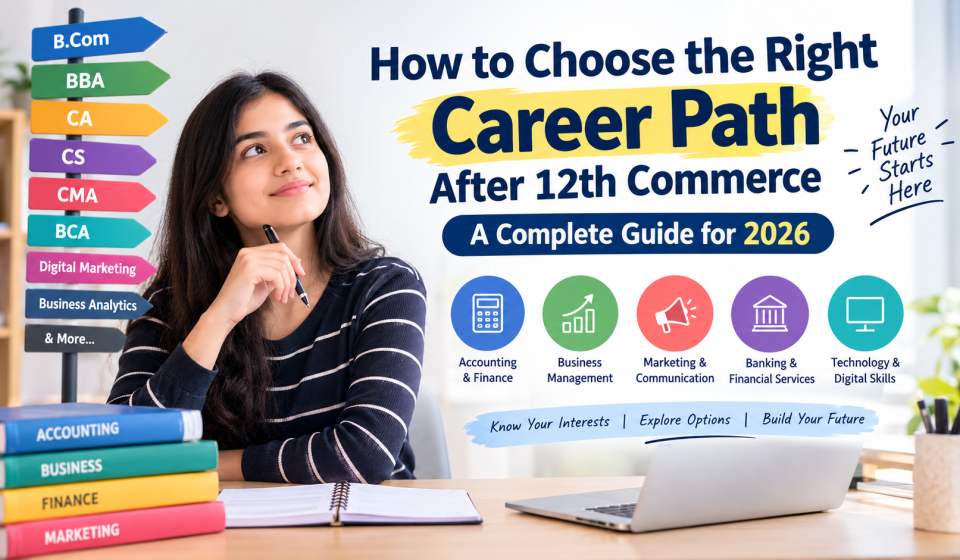

Discover how to choose the right career after 12th Commerce in 2026. Explore the best courses, career options, essential skills, and expert tips for a successful future.
Choosing the right career after completing Class 12 in Commerce is an important decision that can shape your future. In 2026, students have numerous opportunities in accounting, finance, business management, banking, digital marketing, and technology. However, having so many options can make it difficult to decide which career is right for you.
Some students prefer traditional professional courses, while others want to explore modern careers that combine business knowledge with digital skills. The best choice depends on your interests, abilities, financial situation, and long-term goals.
This guide explains how to choose the right career after 12th Commerce, explores popular courses, and shares practical tips to help you make an informed decision.
Why Is Choosing the Right Career Important?
Your career choice influences what you study, which skills you develop, and the professional opportunities you can pursue. Choosing a course simply because your friends are taking it or because it is popular may not lead to long-term satisfaction.
For example, students who enjoy working with numbers might consider accounting or finance. Those who enjoy communication and leadership may prefer business management or marketing. Students interested in computers can investigate technology-related courses, depending on their eligibility.
Understanding your interests before selecting a course can help you make a more confident decision and avoid spending time and money on an unsuitable programme.
Understand Your Interests and Strengths
Before researching courses, take some time to understand your strengths and interests. Ask yourself which subjects you enjoy, what activities motivate you, and what kind of work you would like to do in the future.
Consider these questions:
- Do I enjoy accounting, calculations, and financial information?
- Am I interested in business, management, or entrepreneurship?
- Do I enjoy communication, creativity, and marketing?
- Am I interested in computers, technology, or digital tools?
- Would I prefer a professional qualification or a general degree?
Your answers can help you shortlist suitable careers.
You can also speak with teachers, career counsellors, and professionals to understand the responsibilities and requirements of different jobs. Career aptitude assessments may help you explore your preferences, although they should not determine your decision on their own.
Explore the Best Courses After 12th Commerce in 2026
Commerce students can choose from undergraduate degrees and professional qualifications. Each option offers different learning opportunities and career possibilities.
Bachelor of Commerce (B.Com)
B.Com is a popular undergraduate degree covering accounting, taxation, economics, finance, and business management. It provides a foundation for students interested in banking, accounting, taxation, and financial services.
After completing B.Com, students can pursue further studies, professional qualifications, or entry-level employment, depending on their skills and interests.
Best for: Students interested in accounting, finance, banking, and business.
Bachelor of Business Administration (BBA)
BBA focuses on business operations, marketing, management, human resources, and entrepreneurship. It helps students understand how organisations operate and develop communication, teamwork, and decision-making skills.
Graduates can explore entry-level business roles or pursue postgraduate education, such as an MBA.
Best for: Students interested in management, marketing, leadership, and entrepreneurship.
Chartered Accountancy (CA)
Chartered Accountancy is a professional qualification offered by the Institute of Chartered Accountants of India (ICAI). It focuses on accounting, auditing, taxation, and financial reporting.
The qualification requires dedicated preparation and completion of the prescribed examinations and practical training. Students should review ICAI’s current requirements before enrolling.
Best for: Students who enjoy accounting, financial analysis, and taxation.
Company Secretary (CS)
The Company Secretary qualification focuses on corporate law, regulatory compliance, and corporate governance. Company Secretaries help organisations meet legal obligations and follow appropriate governance practices.
Students interested in business law and corporate regulations can explore this qualification through the Institute of Company Secretaries of India (ICSI).
Best for: Students interested in corporate law, compliance, and company administration.
Cost and Management Accountancy (CMA)
CMA focuses on cost accounting, budgeting, financial planning, and business performance analysis. These skills help organisations manage expenses and make informed financial decisions.
Best for: Students interested in cost management, budgeting, and financial analysis.
Bachelor of Computer Applications (BCA)
BCA focuses on computer applications, programming, databases, and software development. It may be an option for Commerce students who want to enter the technology sector.
However, eligibility requirements vary between universities. Some institutions require Mathematics or specific subjects in Class 12, so check the admission criteria before applying.
Best for: Students interested in programming, software, and technology.
Digital Marketing Courses
Digital marketing involves promoting products and services through search engines, websites, social media, and online advertising.
Students can learn search engine optimisation (SEO), content marketing, social media management, and digital advertising. Practical projects can help them demonstrate their abilities to potential employers.
Best for: Students interested in creativity, communication, online business, and advertising.
Consider Emerging Career Opportunities in 2026
Technology is changing how businesses operate, creating opportunities for people who combine business knowledge with digital skills.
Business Analytics
Business analytics involves examining data to understand sales, customer behaviour, and business performance. Students can begin by learning spreadsheets and data visualisation tools before exploring more advanced skills such as SQL.
Financial Technology
Financial technology, or fintech, combines financial services with digital systems. Digital payments, online banking, and financial applications are examples of this growing field.
Commerce students may explore opportunities in financial operations, customer support, and related business functions.
E-Commerce
E-commerce involves buying and selling products or services online. Career opportunities include online store management, product listing, customer service, digital marketing, and sales operations.
Artificial Intelligence and Digital Business
Businesses increasingly use artificial intelligence tools for tasks such as customer support, reporting, and content creation. Commerce students can learn to use these tools responsibly to improve productivity.
Students interested in technical AI careers may need additional knowledge of programming, mathematics, statistics, and computer science.
Remember that emerging fields do not guarantee employment or high salaries. Research job requirements and develop relevant practical skills before choosing a specialised career.
Compare Courses, Fees, and Eligibility
Before choosing a course, compare its duration, admission requirements, fees, and future opportunities.
Consider the following factors:
- Eligibility: Check the required subjects, minimum marks, and entrance examinations.
- Course fees: Calculate tuition, examination, registration, travel, and other expenses.
- College quality: Research recognition, curriculum, faculty, and practical learning opportunities.
- Career opportunities: Review relevant job advertisements and the qualifications employers expect.
- Further education: Understand whether the course allows you to pursue professional qualifications or postgraduate studies.
Students who need financial assistance can investigate government scholarships, university scholarships, and other legitimate educational funding opportunities.
Always verify admission requirements and scholarship details through official sources before making payments or submitting applications.
Develop Skills Alongside Your Studies
A degree provides academic knowledge, but practical skills can help you prepare for employment.
Communication: Improve your written and verbal communication through presentations, group discussions, and professional email writing.
Computer skills: Learn to use spreadsheets, word processors, presentations, and online collaboration tools.
Financial literacy: Understand basic budgeting, banking, taxation, and financial planning.
Problem-solving: Practise analysing situations, identifying challenges, and developing practical solutions.
Practical experience: Participate in internships, college projects, volunteering, or relevant personal projects.
For example, a student interested in digital marketing could create a sample marketing campaign. Someone interested in finance could practise spreadsheet-based budgeting and financial analysis.
These activities can help you understand your chosen field and demonstrate your skills when applying for internships or entry-level jobs.
Avoid Common Career Selection Mistakes
Students sometimes make career decisions without researching their options properly. Avoid these common mistakes:
- Following friends: Choose a course based on your own interests and goals.
- Focusing only on salary: Consider job responsibilities, learning requirements, and long-term development.
- Ignoring eligibility: Confirm that you meet the institution’s admission requirements.
- Believing unrealistic promises: Be cautious of guaranteed-job claims or unsupported salary promises.
- Neglecting practical skills: Combine academic learning with relevant projects and experience.
Remember that your first course does not determine every aspect of your future. Further education, additional skills, and practical experience can help you explore new opportunities over time.
A Simple Plan to Choose the Right Career
If you are unsure where to begin, follow these steps:
Step 1: Identify your interests, strengths, and preferred working style.
Step 2: Shortlist three to five suitable career options.
Step 3: Research the courses, eligibility criteria, and career opportunities associated with each option.
Step 4: Compare colleges, fees, course content, and practical training.
Step 5: Speak with teachers, counsellors, students, or professionals for guidance.
Step 6: Choose a course that fits your interests, abilities, and financial circumstances.
Step 7: Start developing relevant skills while studying.
This approach can help you make a thoughtful decision instead of choosing a career under pressure.
Source
https://l1nq.com/oeqcx5d
https://l1nq.com/wa7uygt
Conclusion
Choosing the right career path after 12th Commerce in 2026 requires self-awareness, research, and careful planning. Students can explore traditional options such as B.Com, BBA, CA, CS, and CMA, as well as opportunities in technology, digital marketing, business analytics, and e-commerce.
The best career depends on your interests, strengths, financial situation, and professional goals. Compare courses carefully, check eligibility requirements, and research the skills needed for your preferred field.
Most importantly, do not choose a career simply because it is popular or because others recommend it. Focus on finding a path that suits you, and continue developing your knowledge and practical skills.
With informed decisions, consistent effort, and a willingness to learn, you can build a strong foundation for your future after 12th Commerce.
Frequently Asked Questions (FAQs)
1. Which course is best after 12th Commerce in 2026?
B.Com, BBA, CA, CS, and CMA are popular options. The best choice depends on your interests, eligibility, and career goals.
2. Can Commerce students pursue careers in IT?
Yes. Depending on eligibility, Commerce students can explore BCA, digital marketing, e-commerce, and business analytics. Some technical programmes require Mathematics or specific subjects.
3. Is B.Com better than BBA?
Neither is universally better. B.Com generally focuses on accounting, finance, and commerce, while BBA emphasises management, marketing, and business operations.
4. Can I become a Chartered Accountant after 12th Commerce?
Yes. Students can pursue the CA pathway through ICAI, subject to its current registration, examination, and training requirements.
5. Which skills should Commerce students learn in 2026?
Useful skills include communication, spreadsheet management, financial literacy, problem-solving, and digital proficiency. Specialised skills depend on your chosen career.
6. Is Mathematics compulsory for all Commerce courses?
No. Many Commerce courses do not require Mathematics, but some programmes, including certain BCA and Economics degrees, have specific subject requirements.
7. Can I get a job after completing B.Com?
Yes. Graduates may apply for entry-level roles in accounting support, banking operations, administration, sales, and business operations. Opportunities depend on skills, experience, and employer requirements.
8. How can I choose the right career after 12th Commerce?
Identify your interests, compare career options, research course requirements, consider your budget, and seek guidance from experienced people before making your decision.