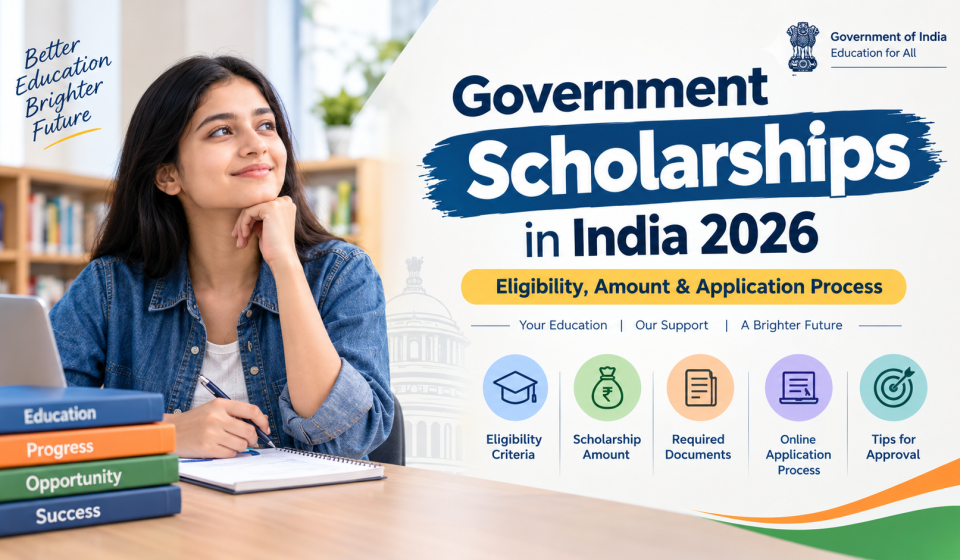

Explore Government Scholarships in India 2026, including eligibility criteria, scholarship amounts, required documents, and the step-by-step online application process.
Education is one of the most important investments in a student’s future, but the cost of school, college, books, accommodation, and other educational expenses can be challenging for many families. To make education more accessible, the Government of India offers various scholarships to eligible students based on academic performance, family income, social category, disability, and other conditions.
Government scholarships in India for 2026 provide financial assistance to students pursuing school education, undergraduate degrees, postgraduate courses, and selected professional programmes. Depending on the scheme, financial support may cover tuition fees, academic expenses, maintenance allowances, or other approved educational costs.
Students can explore scholarship opportunities through the National Scholarship Portal (NSP), government department websites, and state scholarship portals. However, every scholarship has its own eligibility requirements, benefits, and application deadlines.
In this guide, you will learn about the top government scholarships in India in 2026, eligibility criteria, scholarship amounts, required documents, and how to apply online.
What Are Government Scholarships in India?
Government scholarships are financial assistance programmes offered by central and state governments to help eligible students continue their education. These schemes aim to reduce financial barriers and encourage students to complete their studies.
Some scholarships reward academic excellence, while others support students from economically weaker families, reserved categories, minority communities, or families facing particular circumstances.
Government scholarships are generally divided into the following categories:
- Merit-based scholarships: For students who achieve specified academic results.
- Income-based scholarships: For students whose family income falls within the scheme’s prescribed limit.
- Category-based scholarships: For eligible students belonging to SC, ST, OBC, EBC, DNT, minority, or other specified groups.
- Disability scholarships: For eligible students with benchmark disabilities, subject to scheme conditions.
- Professional education scholarships: For students pursuing eligible technical, engineering, and other professional courses.
The amount and selection process depend on the individual scholarship scheme.
Top Government Scholarships in India 2026
Several central government scholarship schemes are available to eligible students during the 2026–27 academic year. The following options are worth exploring.
Central Sector Scheme of Scholarship for College and University Students
The Pradhan Mantri Uchchatar Shiksha Protsahan (PM-USP) Central Sector Scheme of Scholarship for College and University Students supports meritorious students from families with limited financial resources.
The scheme is designed to help students manage part of their educational and day-to-day expenses while pursuing higher education.
Eligibility criteria:
- Students must satisfy the prescribed Class 12 academic-performance requirements.
- They must meet the scheme’s annual family-income limit.
- They must be enrolled in an eligible regular degree course at a recognised institution.
- They must satisfy the scheme’s rules regarding other scholarships and financial assistance.
Scholarship amount: Under the published scheme guidelines, eligible undergraduate students receive ₹12,000 per year for the first three years. Eligible postgraduate students receive ₹20,000 per year. Students in specified five-year professional or integrated courses may receive ₹20,000 per year during the fourth and fifth years.
The applicable amount and conditions should be confirmed in the official guidelines for the relevant academic year.
AICTE Pragati Scholarship Scheme for Girl Students
The Pragati Scholarship Scheme supports eligible girl students pursuing approved technical education programmes.
It aims to encourage women’s participation in technical fields and reduce financial barriers to education.
Eligibility criteria:
- Applicants must be girl students admitted to an eligible technical degree or diploma programme.
- Admission must meet the applicable scheme requirements.
- Family income and the number of eligible beneficiaries in a family must satisfy the prescribed conditions.
- The institution and course must qualify under the scheme.
Scholarship amount: The published Pragati scheme has provided financial assistance of up to ₹50,000 per year, subject to applicable guidelines and eligibility requirements.
Students should check the current notification to confirm the amount, eligible course level, and application dates for 2026–27.
AICTE Saksham Scholarship Scheme
The Saksham Scholarship Scheme provides financial assistance to eligible students with disabilities pursuing approved technical education.
The programme aims to help students access educational opportunities and develop professional skills.
Eligibility criteria:
- Applicants must meet the prescribed disability requirements.
- They must be admitted to an eligible technical degree or diploma programme.
- Family income must fall within the scheme’s specified limit.
- The institution and course must satisfy the applicable conditions.
Scholarship amount: The published scheme has offered financial assistance of up to ₹50,000 per year. Students should verify the applicable amount and conditions in the current official notification.
AICTE Swanath Scholarship Scheme
The Swanath Scholarship Scheme is intended to support eligible technical students facing specified difficult circumstances.
Depending on the applicable scheme rules, eligible beneficiaries may include orphans, students whose parents died due to COVID-19, and children of certain armed forces or central paramilitary forces personnel who died in action.
Eligibility criteria:
- Applicants must belong to a category covered by the scheme.
- They must be enrolled in an eligible technical degree or diploma programme.
- They must satisfy the applicable family-income and admission conditions.
- They must submit the required supporting documents.
Scholarship amount: Published scheme guidelines have provided assistance of up to ₹50,000 per year. The current year’s notification should be consulted before applying.
National Means-cum-Merit Scholarship Scheme
The National Means-cum-Merit Scholarship Scheme supports eligible students from economically weaker families to help prevent school dropouts.
It is intended for students at the prescribed school level who meet the academic, income, and selection requirements.
Eligibility criteria:
- Students must satisfy the prescribed Class 8 examination and selection requirements.
- They must meet the scheme’s family-income limit.
- They must study at an eligible school.
- They must meet the applicable minimum academic-performance requirements.
Scholarship amount: The scheme has provided ₹12,000 per year to selected students, subject to its rules.
Students and parents should consult the official notification for the relevant selection cycle and application dates.
Top Class Education Scheme for SC Students
The Top Class Education Scheme for Scheduled Caste (SC) students supports eligible students pursuing higher education at institutions covered by the scheme.
It aims to reduce the financial burden of studying at designated institutions and help students access quality educational opportunities.
Eligibility criteria:
- Applicants must belong to the Scheduled Caste category.
- They must have secured admission to an eligible institution and course.
- Family income must fall within the prescribed limit.
- They must satisfy the applicable selection and documentation requirements.
Scholarship amount: Financial assistance can include approved tuition and non-refundable fees, along with specified academic or living allowances where applicable. The exact benefits depend on the course, institution, and current scheme guidelines.
Post-Matric Scholarship for Students with Disabilities
This scholarship supports eligible students with disabilities pursuing education after the matriculation level.
It aims to make further education more accessible by providing financial assistance under the applicable scheme.
Eligibility criteria:
- Applicants must satisfy the prescribed disability requirements.
- They must be enrolled in an eligible course.
- They must meet the applicable income and academic conditions.
- They must provide the required disability and educational certificates.
Scholarship amount: Benefits vary according to the course, approved expenses, and applicable allowance categories. Applicants should review the official guidelines to determine the amount available to them.
Government Scholarship Amount in India 2026
The amount of financial assistance depends on the scholarship scheme and the student’s eligibility. Some scholarships offer a fixed annual amount, while others cover specified educational expenses.
Here is a quick overview of selected schemes and their published benefit structures.
| Scholarship Scheme | Published Scholarship Amount or Benefit |
|---|---|
| PM-USP Central Sector Scheme | ₹12,000 per year for the first three undergraduate years; higher amounts for specified later years |
| AICTE Pragati Scholarship | Up to ₹50,000 per year under published scheme guidelines |
| AICTE Saksham Scholarship | Up to ₹50,000 per year under published scheme guidelines |
| AICTE Swanath Scholarship | Up to ₹50,000 per year under published scheme guidelines |
| National Means-cum-Merit Scholarship | ₹12,000 per year under scheme rules |
| Top Class Education Scheme for SC Students | Approved fees and specified additional benefits, subject to eligibility |
| Post-Matric Scholarship for Students with Disabilities | Benefits vary according to course and applicable rules |
Important: This table summarises published scheme benefit structures, not a guarantee of the amount payable in 2026–27. Students must check the latest official notification before applying because eligibility conditions, benefit limits, and implementation rules can change.
Eligibility Criteria for Government Scholarships in India
Before applying for a government scholarship, students should carefully check the eligibility conditions.
1. Academic Qualification
Many scholarships require students to pass a particular examination, achieve a minimum percentage, or meet a specified merit-ranking requirement.
For example, the PM-USP Central Sector Scheme has academic-performance requirements based on Class 12 results.
2. Family Income
Several scholarships are intended for students from economically weaker families. Applicants may need to submit an income certificate issued by the appropriate authority.
The maximum permitted annual family income varies from one scheme to another.
3. Category Requirements
Some schemes are available only to students belonging to specified categories, such as SC, ST, OBC, EBC, DNT, or eligible minority groups.
Students must provide valid supporting certificates when required.
4. Course and Institution
Not every scholarship covers every course or college. Some programmes are restricted to approved technical courses, regular degree programmes, or institutions included in the scheme.
Applicants should verify that their institution and course qualify before submitting an application.
5. Other Conditions
Additional requirements may include domicile, age, disability status, admission year, attendance, academic progress, or restrictions on receiving multiple scholarships.
Always read the scheme guidelines rather than assuming that meeting one condition guarantees eligibility.
Documents Required for Government Scholarships
Students should prepare the necessary documents before beginning an online application.
Commonly required documents include:
- Aadhaar number or other identification details, as permitted by the scheme.
- Recent passport-size photograph, where required.
- Class 10 and Class 12 mark sheets.
- Current admission letter or bonafide student certificate.
- Family income certificate.
- Caste or category certificate, if applicable.
- Domicile or residence certificate, if required.
- Disability certificate, where applicable.
- Bank account details in the student’s name, as required.
- Previous academic marksheets for renewal applications.
- Fee receipt or tuition-fee details, where applicable.
The exact list differs by scholarship. Keep your information consistent across the application form and supporting documents.
How to Apply for Government Scholarships Online in India 2026
The National Scholarship Portal is an important platform for discovering and applying for participating central government scholarship schemes.
Follow these steps to begin your application.
Step 1: Visit the National Scholarship Portal
Open the official National Scholarship Portal at scholarships.gov.in.
Select the student section and review the scholarship schemes available for the 2026–27 academic year.
Step 2: Complete One-Time Registration
The portal requires One-Time Registration (OTR) for scholarship applications.
Follow the official registration instructions and provide the necessary identification details. Keep your OTR number and login credentials secure.
Step 3: Check Your Eligibility
Review the available schemes and select the scholarship that matches your educational level, course, academic performance, and personal eligibility.
Read the scheme guidelines carefully before proceeding.
Step 4: Fill Out the Application Form
Log in using the required credentials and enter your personal, educational, institutional, and bank details accurately.
Check every entry before moving to the next section.
Step 5: Upload Required Documents
Upload the documents requested by the scheme in the prescribed format.
Make sure your certificates are valid, readable, and consistent with the information entered in the form.
Step 6: Submit the Application
Review the complete application and submit it before the official deadline.
Save the application reference number or confirmation for future use.
Step 7: Track Application Status
Monitor the application status through the official portal. Your institution or the relevant authorities may need to verify your details before the application is approved.
After approval, payment processing may take additional time. Students should use the official payment-tracking facilities where available.
Important Scholarship Application Dates for 2026–27
Scholarship deadlines vary by scheme, state, course, and application type.
As of October 2026, the National Scholarship Portal lists several schemes with student application deadlines of 31 October 2026. However, this date does not apply universally to every government scholarship.
For example, the portal lists renewal applications for the PM-USP Central Sector Scheme and the PM-USP Special Scholarship Scheme for Jammu and Kashmir and Ladakh with a closing date of 31 October 2026.
Students should check the relevant scheme’s official page for its current application status, deadline, and verification schedule.
Do not wait until the final day to submit your application. Leave enough time to correct errors or obtain missing certificates.
Tips to Increase Your Chances of Scholarship Approval
Although not every scholarship is competitive in the same way, following these practices can help you avoid common application problems.
1. Choose the correct scheme: Apply only when you meet the eligibility conditions.
2. Submit accurate information: Incorrect income, academic, bank, or identification details may delay verification.
3. Check your documents: Ensure that certificates are valid and meet the scheme’s requirements.
4. Meet the deadline: Late applications may not be accepted.
5. Contact your institution: Ask the scholarship or student-support office about institute verification and any additional requirements.
6. Track your application: Check for defective-application notices, verification updates, or requests for corrections.
7. Avoid fraudulent agents: Use official government websites and never share your password or OTP with unauthorised people.
Source
Conclusion
Government scholarships in India in 2026 can help eligible students manage educational expenses and continue their academic journeys. Programmes such as the PM-USP Central Sector Scheme, AICTE Pragati, AICTE Saksham, AICTE Swanath, and other category-specific scholarships provide different forms of financial assistance.
However, scholarship benefits are not identical for every student. Eligibility depends on factors such as academic performance, family income, course, institution, category, and the scheme’s current rules.
To get started, visit the National Scholarship Portal, complete the required registration, check your eligibility, and prepare your documents before applying. Always verify the latest scholarship amount and deadline through the official scheme guidelines.
With accurate information and timely preparation, students can identify suitable financial assistance opportunities and make informed decisions about their education.
Frequently Asked Questions (FAQs)
1. Which government scholarships are available in India in 2026?
Options include the PM-USP Central Sector Scheme, AICTE Pragati Scholarship, AICTE Saksham Scholarship, AICTE Swanath Scholarship, National Means-cum-Merit Scholarship, and various post-matric and category-specific schemes. Availability depends on eligibility and the current application cycle.
2. How much money can I receive from a government scholarship?
The amount varies by scheme. Some provide fixed annual assistance, while others cover approved tuition fees or provide additional allowances. For example, the PM-USP Central Sector Scheme has published annual rates of ₹12,000 for the first three undergraduate years and ₹20,000 for eligible postgraduate study.
3. How can I apply for a government scholarship online?
Visit the National Scholarship Portal, complete the required One-Time Registration, check your eligibility, fill out the application form, upload the necessary documents, and submit it before the relevant deadline.
4. Can college students apply for government scholarships in 2026?
Yes. Eligible college students can apply for schemes covering undergraduate, postgraduate, technical, and other approved courses. The available options depend on academic results, income, institution, course, and other scheme-specific requirements.
5. Is the National Scholarship Portal free to use?
Students can access the official portal online without paying a scholarship application fee to the government portal itself. If you need assistance through a Common Service Centre, an authorised service charge may apply.
6. What documents are required for a scholarship application?
Common documents include academic marksheets, income certificates, bank details, identification information, admission documents, and category or disability certificates where applicable. Requirements differ between schemes.
7. Can I apply for more than one government scholarship?
The rules depend on the scheme. For the 2026–27 academic year, the National Scholarship Portal states that students may apply for one merit-based scholarship and one or more welfare-based scholarships, subject to eligibility criteria. Always check the relevant scheme rules before applying.
8. How can I check my scholarship application status?
Log in to the official portal and review the available application-status services. You may also need to contact your institution if verification is pending. Payment status can be checked through the official payment-tracking service where supported.
9. What should I do if my scholarship application is rejected?
Review the rejection reason, verify your eligibility and submitted documents, and contact your institution or the relevant scholarship authority if clarification is needed. If corrections or an appeal are permitted, follow the official instructions and deadlines.
10. When is the last date to apply for government scholarships in 2026?
There is no single deadline for every government scholarship. Some schemes listed on the National Scholarship Portal have a student application deadline of 31 October 2026. Check the specific scheme page for the latest date before applying.