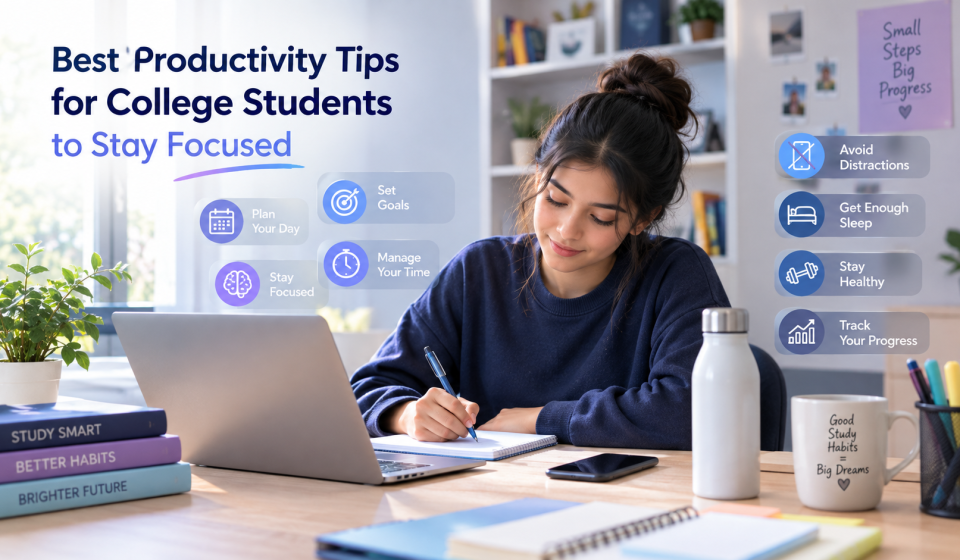

Discover the best productivity tips for college students to stay focused, manage time effectively, avoid distractions, improve study habits, and achieve academic success.
College life can be exciting, but managing lectures, assignments, examinations, projects, and personal responsibilities can sometimes become challenging. Many students struggle to stay focused because of distractions, poor time management, procrastination, and a lack of proper study routines. Being productive does not mean studying for long hours without taking breaks. Instead, it means using your time wisely, staying organized, and developing habits that help you achieve better academic results.
Learning how to manage your time and maintain concentration can make a significant difference in your college experience. With the right productivity strategies, students can complete assignments on time, prepare effectively for examinations, reduce academic stress, and still enjoy their personal lives.
In this article, we will explore the best productivity tips for college students to stay focused, manage their schedules, and improve their overall academic performance.
1. Create a Daily Study Schedule
One of the best ways to improve productivity is to create a daily study schedule. Without a proper plan, students may spend too much time deciding what to study and struggle to complete important tasks.
Start by identifying your daily academic responsibilities, including lectures, assignments, revision sessions, and extracurricular activities. Divide your available time into manageable study periods and assign specific subjects or tasks to each session.
For example, you can dedicate the morning to difficult subjects, the afternoon to assignments, and the evening to reviewing lecture notes.
A well-organized schedule helps you understand your priorities and prevents unnecessary delays. However, make sure your timetable is realistic and includes enough time for meals, rest, and personal activities.
2. Set Clear and Achievable Goals
Setting clear goals gives students a sense of direction and motivation. Instead of studying without a specific objective, decide what you want to accomplish during each study session.
You can divide your goals into three categories:
- Daily goals: Complete homework, read a chapter, or revise lecture notes.
- Weekly goals: Finish assignments, prepare for quizzes, or review multiple subjects.
- Long-term goals: Improve grades, complete projects, or prepare for final examinations.
Make sure your goals are realistic and measurable. For example, instead of writing “study mathematics,” set a goal such as “complete 20 mathematics practice questions.”
Achievable goals make large academic responsibilities feel less overwhelming and help you track your progress.
3. Use the Pomodoro Technique
The Pomodoro Technique is a popular time-management method that helps students maintain concentration while avoiding mental fatigue.
The traditional method involves studying for 25 minutes followed by a five-minute break. After completing four study sessions, take a longer break of approximately 15–30 minutes.
Here is how to use this technique:
- Choose one specific study task.
- Set a timer for 25 minutes.
- Focus completely on the task until the timer ends.
- Take a five-minute break.
- Repeat the process and take a longer break after four sessions.
This method encourages students to work with greater concentration and makes studying feel more manageable.
You can also adjust the study and break periods depending on your attention span and the difficulty of the subject.
4. Eliminate Distractions While Studying
Distractions are one of the biggest obstacles to student productivity. Social media notifications, mobile games, television, and unnecessary conversations can interrupt concentration.
To create a distraction-free study environment, consider these strategies:
- Keep your smartphone away from your study desk.
- Turn off unnecessary notifications.
- Avoid checking social media during study sessions.
- Use website blockers when necessary.
- Inform family members or roommates when you need quiet study time.
If you prefer studying with digital devices, close unnecessary browser tabs and keep only the applications required for your academic work.
Reducing distractions helps you complete tasks faster and understand information more effectively.
5. Organize Your Study Space
Your study environment can directly influence your concentration and productivity. A cluttered desk may make it difficult to find important materials and create unnecessary distractions.
Try to maintain a clean and comfortable study area with everything you need within reach.
Your study space should include:
- A comfortable chair and suitable desk.
- Proper lighting.
- Notebooks, textbooks, and stationery.
- A laptop or computer when required.
- A water bottle.
- Minimal unnecessary decorations.
You do not need an expensive study setup. Even a small, organized corner can become an effective learning environment.
Make it a habit to clean your study area at the end of each day so you can begin your next session without wasting time.
6. Prioritize Important Tasks Using the Eisenhower Matrix
College students often have multiple assignments, examinations, presentations, and personal responsibilities at the same time. Trying to complete everything at once can lead to confusion and stress.
The Eisenhower Matrix is a useful productivity tool that helps you prioritize tasks based on their urgency and importance.
It divides responsibilities into four categories:
- Urgent and important: Assignments due today or upcoming examinations.
- Important but not urgent: Long-term projects and regular revision.
- Urgent but less important: Minor administrative tasks and routine requests.
- Neither urgent nor important: Unnecessary browsing and activities that waste time.
Complete important and urgent tasks first. Schedule important tasks that are not urgent instead of postponing them indefinitely.
This approach helps students focus on activities that contribute most to their academic success.
7. Avoid Multitasking During Study Sessions
Many students believe multitasking helps them complete more work in less time. However, switching between different activities can reduce concentration and make learning less effective.
For example, studying while watching videos, checking messages, and listening to unrelated content can make it harder to understand complex topics.
Instead, practice single-tasking. Focus on one subject or assignment before moving to another.
If you have several responsibilities, organize them into separate time blocks. Give each task your full attention and avoid unnecessary interruptions.
Concentrating on one activity at a time can improve the quality of your work and help you complete academic responsibilities more efficiently.
8. Take Regular Breaks to Refresh Your Mind
Studying continuously for several hours does not necessarily improve academic performance. Your brain needs time to rest and process information.
Taking regular breaks helps prevent mental exhaustion and supports sustained concentration.
During breaks, try activities such as:
- Walking around your room or outside.
- Drinking water.
- Stretching your body.
- Eating a healthy snack.
- Listening to relaxing music.
- Looking away from your computer screen.
Avoid spending your entire break scrolling through social media because it can make it difficult to return to your studies.
Short, refreshing breaks can help you maintain energy throughout the day.
9. Use Digital Productivity Tools
Technology can make college life more organized when used correctly. Several digital applications help students manage assignments, track deadlines, organize notes, and maintain productive routines.
Some useful productivity tools include:
- Notion: Organize notes, assignments, study plans, and personal projects.
- Google Calendar: Schedule classes, examination dates, and important deadlines.
- Todoist: Create task lists and track daily responsibilities.
- Forest: Encourage focused study sessions by limiting phone distractions.
- Google Drive: Store and organize academic documents online.
Choose only the tools that support your study habits. Using too many productivity applications can create additional distractions instead of improving efficiency.
10. Develop a Consistent Morning Routine
Starting your day with a consistent routine can help you feel organized, motivated, and prepared for academic responsibilities.
You do not need to wake up extremely early to become productive. The important thing is to establish a routine that works with your college schedule.
A simple morning routine might include:
- Wake up at a consistent time.
- Drink a glass of water.
- Complete basic personal hygiene.
- Eat a nutritious breakfast.
- Review your daily schedule.
- Identify your three most important tasks.
- Begin your day with a focused activity.
A positive morning routine reduces decision-making and helps you start the day with a clear purpose.
11. Improve Your Sleep Schedule
Sleep plays an important role in memory, concentration, learning, and overall health. Students who regularly stay awake late at night may experience tiredness, reduced attention, and difficulty remembering information.
College students should aim for approximately seven to nine hours of sleep each night, depending on their individual needs.
To improve your sleep schedule:
- Go to bed and wake up at consistent times.
- Avoid excessive caffeine late in the day.
- Reduce screen usage before bedtime.
- Keep your bedroom comfortable and quiet.
- Avoid studying throughout the night whenever possible.
Getting enough sleep helps your brain process information and prepares you for productive study sessions the following day.
12. Practice Active Learning Techniques
Simply reading textbooks repeatedly may not always be the most effective way to remember information. Active learning encourages students to engage with study materials rather than passively reviewing them.
Some useful active learning techniques include:
Active recall: Close your textbook and try to remember important information without looking at your notes.
Spaced repetition: Review information at gradually increasing intervals to strengthen long-term memory.
Mind mapping: Create visual diagrams that connect related ideas and concepts.
Practice testing: Solve sample questions and previous examination papers to evaluate your understanding.
The Feynman Technique: Explain a difficult topic in simple language as if you were teaching someone else.
These methods encourage deeper understanding and help students prepare more effectively for examinations.
13. Stay Physically Active and Eat Healthy Food
Physical health has an important connection with mental performance. Spending the entire day sitting at a desk can lead to tiredness and reduced energy.
Regular physical activity helps improve overall well-being and can support better concentration.
Students can include simple activities such as walking, cycling, stretching, yoga, or light exercise in their daily routines.
Nutrition is equally important. Include balanced meals with vegetables, fruits, whole grains, protein, and healthy fats.
Also, drink enough water throughout the day. Avoid relying heavily on sugary snacks and energy drinks to maintain study energy.
A healthy lifestyle supports both academic productivity and personal well-being.
14. Avoid Procrastination by Starting Small
Procrastination occurs when students delay important tasks even when they understand that completing them is necessary.
Large assignments, difficult subjects, and fear of failure can sometimes make students avoid getting started.
One effective strategy is the five-minute rule. Commit to working on a task for just five minutes. Once you begin, continuing the activity often becomes easier.
You can also break larger assignments into smaller steps.
For example, instead of writing “complete research project,” divide it into:
- Choose the project topic.
- Collect relevant information.
- Prepare an outline.
- Write the introduction.
- Complete the main sections.
- Review and submit the project.
Small steps make difficult responsibilities easier to manage and reduce the tendency to procrastinate.
15. Review Your Progress Every Week
Improving productivity requires understanding what works and what needs to change. Reviewing your progress regularly helps you identify unproductive habits and improve your study routine.
At the end of each week, spend 15–20 minutes evaluating your academic activities.
Ask yourself:
- Did I complete my planned assignments?
- Which subjects required more attention?
- What distracted me the most?
- Did I follow my study schedule?
- Did I take enough breaks?
- What can I improve next week?
You can maintain a simple productivity journal or weekly checklist to track your achievements.
Remember that productivity is not about following a perfect schedule every day. It is about making consistent improvements and developing habits that support your long-term goals.
Source
https://sl1nk.com/14twmxr
https://l1nq.com/r5x5uwd
Conclusion
Developing strong productivity habits is essential for college students who want to stay focused, manage academic responsibilities, and achieve better results. Creating a daily study schedule, setting achievable goals, using time-management techniques, eliminating distractions, and maintaining a healthy lifestyle can make studying more effective.
Students should also remember that productivity is not measured by the number of hours spent studying. It is measured by how effectively they use their time and understand the material.
Start with a few simple changes instead of trying to adopt every productivity technique at once. Stay consistent, review your progress, and adjust your routine whenever necessary.
With patience, discipline, and the right strategies, you can build a productive college experience while maintaining a healthy balance between education and personal life.
Frequently Asked Questions (FAQs)
1. What are the best productivity tips for college students?
The best productivity tips include creating a daily study schedule, setting achievable goals, using the Pomodoro Technique, eliminating distractions, prioritizing important tasks, and maintaining a healthy sleep routine.
2. How can college students stay focused while studying?
Students can improve concentration by studying in a quiet environment, keeping smartphones away, taking regular breaks, setting specific study goals, and focusing on one task at a time.
3. What is the 25-minute study technique?
The 25-minute study technique, also known as the Pomodoro Technique, involves studying for 25 minutes followed by a five-minute break. After four sessions, students take a longer break to refresh their minds.
4. How many hours should a college student study daily?
Study time depends on the student’s academic workload, subjects, and learning requirements. Rather than following a fixed number of hours, students should focus on consistent, distraction-free study sessions and effective learning methods.
5. Which productivity apps are useful for college students?
Popular productivity applications include Notion, Google Calendar, Todoist, Forest, and Google Drive. These tools help students organize assignments, manage schedules, track tasks, and reduce distractions.
6. How can students stop procrastinating?
Students can overcome procrastination by breaking large assignments into smaller tasks, setting deadlines, using the five-minute rule, removing distractions, and rewarding themselves after completing important responsibilities.
7. Does sleep affect student productivity?
Yes. Adequate sleep supports memory, concentration, learning, and mental performance. Maintaining a consistent sleep schedule can help students stay energized and focused during their studies.
8. How can college students balance studying and personal life?
Students can maintain a healthy balance by planning their schedules, prioritizing responsibilities, setting realistic goals, taking regular breaks, exercising, and making time for family, friends, and hobbies.