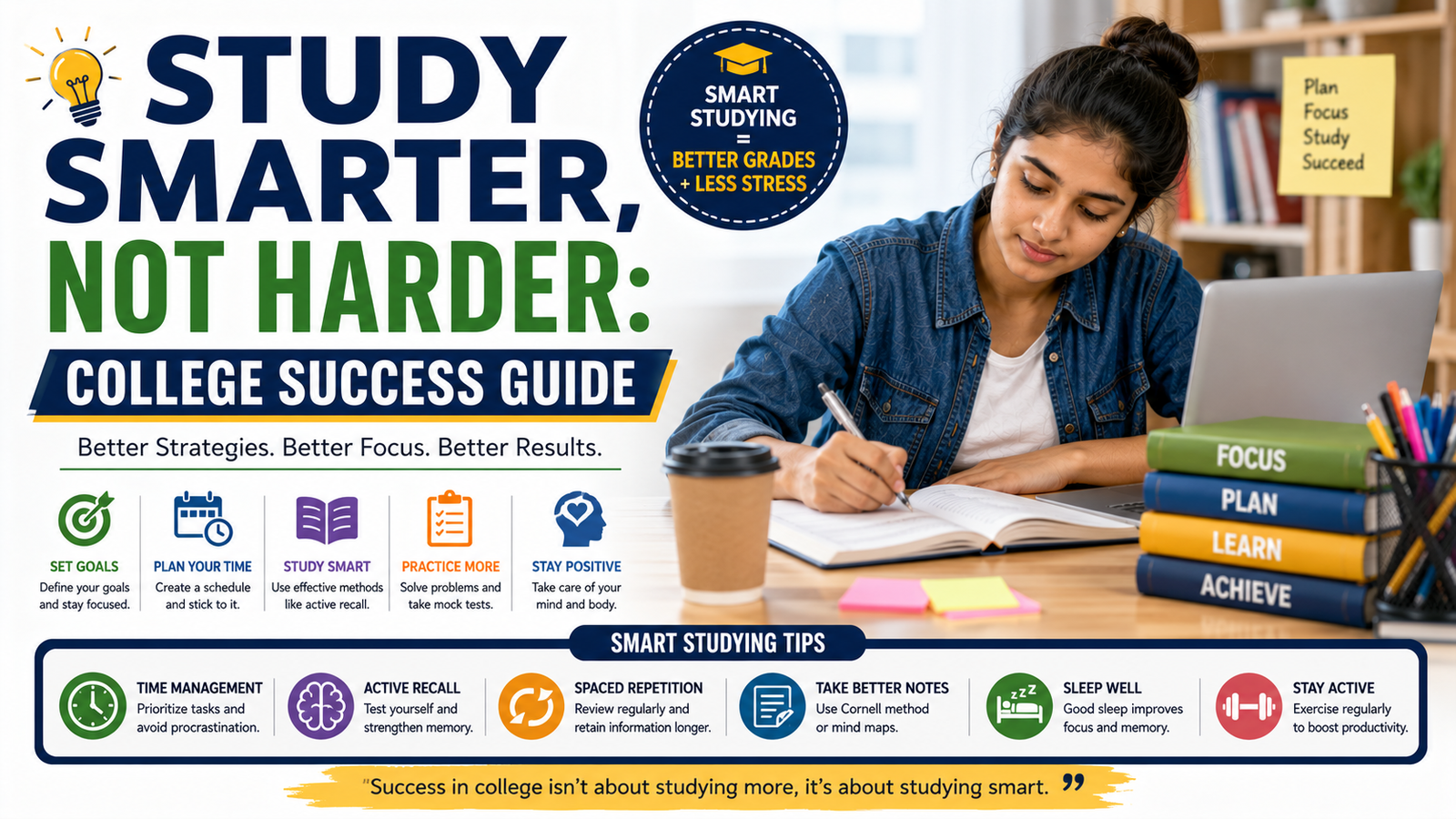

College life is filled with opportunities, challenges, deadlines, exams, assignments, and personal responsibilities. Many students believe success comes from studying for long hours every day, but research shows that studying smarter is far more effective than simply studying harder. Smart studying focuses on efficiency, productivity, memory retention, and proper time management instead of endless hours of stressful learning.
Why Studying Smarter Matters in College
Many students confuse being busy with being productive. Spending hours rereading notes or studying late at night does not always improve understanding or memory.
Smart studying helps students:
- Learn faster
- Retain information longer
- Reduce stress
- Improve academic performance
- Save time
- Maintain better mental health
College success is not about how many hours you study but how effectively you use your time and energy.
Understanding How the Brain Learns
To study smarter, students must understand how learning works.
The brain learns best through:
- Active engagement
- Repetition over time
- Practical application
- Rest and sleep
- Focused attention
Passive studying methods like highlighting textbooks repeatedly often create the illusion of learning without actual retention.
Science-backed learning techniques improve memory by strengthening neural connections in the brain.
Create a Smart Study Schedule
A structured study routine improves consistency and reduces last-minute stress.
Set Realistic Study Goals
Instead of vague goals like “study biology,” create specific goals such as:
- Complete Chapter 3 notes
- Solve 20 math problems
- Revise lecture summaries
Specific goals improve focus and motivation.
Use Time Blocking
Time blocking involves assigning fixed time periods for specific tasks.
Example:
- 8:00–9:00 AM: Mathematics
- 9:15–10:00 AM: Revision
- 4:00–5:00 PM: Assignment work
This method improves organization and productivity.
Study During Peak Energy Hours
Some students focus better in the morning, while others perform better at night. Identify your most productive hours and schedule difficult subjects during those times.
Use Science-Backed Study Techniques
Effective learning depends on using the right strategies.
Active Recall
Active recall involves retrieving information from memory instead of passively rereading notes.
Examples:
- Flashcards
- Practice tests
- Self-quizzing
- Explaining concepts aloud
This method improves long-term retention significantly.
Spaced Repetition
Spaced repetition means reviewing information at intervals over time.
Example:
- Revise after 1 day
- Review after 3 days
- Review again after 1 week
This technique helps prevent forgetting and strengthens memory.
Interleaving Method
Interleaving means mixing different subjects or topics during study sessions.
Instead of studying one subject for four hours straight:
- Study math for one hour
- Switch to science
- Then revise language subjects
This improves problem-solving ability and understanding.
Avoid Common Study Mistakes
Many students unintentionally use ineffective study habits.
Cramming Before Exams
Cramming may help short-term memorization but reduces long-term retention and increases stress.
Multitasking
Studying while checking social media or watching videos reduces concentration and learning efficiency.
Studying Without Breaks
Long study sessions without rest cause mental fatigue and reduced productivity.
The Pomodoro Technique is effective:
- Study for 25 minutes
- Take a 5-minute break
- Repeat the cycle
Improve Focus and Concentration
Concentration is essential for productive studying.
Create a Distraction-Free Environment
An ideal study space should be:
- Quiet
- Organized
- Comfortable
- Well-lit
Keep phones and unnecessary notifications away during study sessions.
Use Focus Tools
Helpful tools include:
- Study timers
- Website blockers
- Noise-canceling headphones
- Productivity apps
These tools help students stay disciplined and focused.
Effective Note-Taking Strategies
Good notes make revision easier and improve understanding.
Cornell Note-Taking Method
This method divides notes into sections:
- Main notes
- Keywords/questions
- Summary
It improves organization and revision efficiency.
Mind Mapping
Mind maps visually connect ideas and improve memory retention.
They are especially useful for:
- Complex subjects
- Brainstorming
- Exam revision
Summarize Information
Writing short summaries after studying helps reinforce understanding.
Time Management Tips for College Students
Poor time management is one of the biggest reasons students struggle academically.
Prioritize Important Tasks
Use priority systems such as:
- Urgent tasks
- Important tasks
- Low-priority tasks
This prevents procrastination and missed deadlines.
Use a Planner or Calendar
Digital planners and apps help students track:
- Assignments
- Exams
- Projects
- Study sessions
Popular tools include:
- Google Calendar
- Notion
- Todoist
Avoid Procrastination
Break large tasks into smaller steps to make them easier to start and complete.
Importance of Sleep for Academic Success
Many students sacrifice sleep to study longer, but lack of sleep reduces learning efficiency.
Sleep helps:
- Consolidate memory
- Improve focus
- Reduce stress
- Increase problem-solving ability
Experts recommend 7–9 hours of sleep daily for optimal brain performance.
Healthy Lifestyle Habits That Improve Studying
Physical health directly affects mental performance.
Eat Brain-Healthy Foods
Foods that support brain function include:
- Nuts
- Fruits
- Vegetables
- Fish
- Whole grains
Stay Hydrated
Even mild dehydration reduces concentration and memory performance.
Exercise Regularly
Physical activity improves blood flow to the brain and reduces anxiety.
Recommended activities:
- Walking
- Yoga
- Gym workouts
- Cycling
Best Technology Tools for Smart Studying
Technology can make studying more efficient when used properly.
Quizlet
Useful for flashcards and active recall practice.
Notion
Helps organize notes, schedules, and assignments.
Forest App
Encourages focus by reducing phone distractions.
Google Drive
Allows students to store and access notes from anywhere.
How to Prepare Effectively for College Exams
Exams become less stressful with proper preparation.
Start Early
Begin preparation weeks before exams instead of waiting until the last moment.
Solve Practice Papers
Practice papers improve:
- Speed
- Accuracy
- Confidence
- Time management
Revise Strategically
Focus more on weak topics while maintaining regular revision of strong subjects.
Building Long-Term Academic Success
Smart studying is not just about passing exams. It helps students build lifelong learning skills.
Benefits of Studying Smarter
- Better grades
- Reduced stress
- Improved confidence
- Stronger memory
- Better work-life balance
- Career readiness
Students who learn effective study strategies in college often perform better professionally as well.
Future of Smart Learning in 2026
Technology and AI are transforming education rapidly.
Future study trends include:
- AI-powered learning apps
- Personalized study plans
- Virtual tutoring
- Interactive online learning
- Smart revision systems
Students who adapt to modern learning methods will gain a major academic advantage.
Source
https://sl1nk.com/fk15m3c
https://l1nq.com/j2fjfzk
Conclusion
College success does not require endless hours of exhausting study sessions. Instead, students achieve better results when they study smarter using effective techniques such as active recall, spaced repetition, time management, and focused learning.
Creating a structured study routine, maintaining healthy habits, avoiding distractions, and using modern productivity tools can dramatically improve academic performance while reducing stress and burnout.
By applying science-backed study methods consistently, college students can learn more efficiently, improve grades, and build the skills necessary for long-term academic and professional success.
FAQs
1. What does studying smarter mean?
Studying smarter means using efficient learning techniques that improve memory, focus, and productivity instead of simply studying for long hours.
2. What is the best study method for college students?
Active recall and spaced repetition are among the most effective science-backed study methods.
3. How many hours should college students study daily?
Most students benefit from 2–5 focused study hours daily depending on course difficulty and workload.
4. Is studying at night effective?
It depends on individual preferences. Some students focus better at night, while others perform best in the morning.
5. How can students improve concentration while studying?
Students can improve focus by removing distractions, creating a study schedule, and using productivity tools.