
Discover the Cornell Note-Taking Method, a powerful study technique that helps students organize notes, improve memory, and boost exam performance through structured learning, active recall, and effective revision strategies.
The Cornell Note-Taking Method is a structured system for organizing notes in a way that improves understanding, retention, and revision. Developed by Walter Pauk at Cornell University in the 1950s, this method is widely used by students, professionals, and lifelong learners because it transforms passive listening into active learning.
Instead of writing notes randomly, the Cornell system divides a page into clear sections that help you record, question, summarize, and review information efficiently. This makes studying faster and more effective, especially during exams.
In this article, you will learn how the Cornell Method works, why it is effective, and how you can use it step-by-step to improve your academic performance.
Structure of the Cornell Note-Taking Method
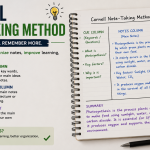
The Cornell system divides a notebook page into three main sections:
1. Notes Column (Right Side – 70% of page)
This is the largest section where you write main lecture points, explanations, diagrams, or key ideas during class or reading.
- Write short sentences
- Use bullet points
- Focus on main ideas, not full sentences
- Leave space for later additions
2. Cue Column (Left Side – 30% of page)
This section is used after the class or study session. You write:
- Keywords
- Questions
- Important cues
- Memory triggers
These cues help you recall the main content quickly during revision.
3. Summary Section (Bottom of the Page)
At the bottom, you write a short summary of the entire page in 2–4 lines.
- Helps reinforce understanding
- Useful for quick revision
- Forces you to process information deeply
How the Cornell Note-Taking Method Works (Step-by-Step)
Step 1: Prepare Your Page
Draw a vertical line (left side) and a horizontal line (bottom) to divide the page into three sections.
Step 2: Take Notes During Lecture
In the right column:
- Write key points from the lecture
- Use abbreviations
- Avoid copying everything
Step 3: Add Cues After Class
After reviewing your notes:
- Add questions in the left column
- Highlight keywords
- Turn headings into questions
Example:
- Notes: “Photosynthesis occurs in chloroplasts”
- Cue: “Where does photosynthesis occur?”
Step 4: Summarize the Content
At the bottom:
- Write a short summary in your own words
- Focus on understanding, not memorization
Step 5: Review Regularly
Cover the notes column and try answering cues from memory. This improves active recall.
Why the Cornell Method Is So Effective
The Cornell system is powerful because it follows how the brain learns naturally.
1. Encourages Active Recall
Instead of re-reading, you test yourself using cues. This strengthens memory.
2. Improves Understanding
Writing summaries forces you to process information deeply.
3. Better Organization
Notes are clean, structured, and easy to revise before exams.
4. Saves Revision Time
You don’t need to go through entire chapters—just cues and summaries are enough.
5. Enhances Focus in Class
You listen actively instead of writing everything blindly.
Benefits of Using the Cornell Note-Taking Method
1. Better Exam Performance
Students who use structured notes tend to perform better in exams due to improved recall.
2. Strong Concept Clarity
You don’t just memorize—you understand topics clearly.
3. Easy Revision System
One page gives you:
- Key points
- Questions
- Summary
This reduces revision stress.
4. Useful for All Subjects
Works for:
- Science
- History
- Business studies
- Law
- Competitive exams
5. Builds Study Discipline
It creates a consistent study habit that improves long-term learning.
When to Use the Cornell Method
The Cornell Method is ideal for:
- Classroom lectures
- Online courses
- Self-study reading
- Exam preparation
- Professional training sessions
It is especially useful when you need to remember large amounts of structured information.
Common Mistakes Students Make
1. Writing Too Much in Notes Column
This defeats the purpose. Only write key ideas.
2. Skipping the Cue Column
Without cues, revision becomes less effective.
3. Not Reviewing Regularly
Cornell notes only work when you actively revise them.
4. Writing Weak Summaries
A summary should capture the entire page in a meaningful way.
Tips to Master the Cornell Note-Taking Method
- Use different colors for headings and cues
- Review notes within 24 hours of class
- Turn every key point into a question
- Keep notes short and simple
- Practice active recall daily
Real-Life Example of Cornell Notes
Topic: Water Cycle
Notes Column:
- Evaporation: water changes into vapor due to heat
- Condensation: vapor cools and forms clouds
- Precipitation: rain, snow falls back to earth
Cue Column:
- What causes evaporation?
- What forms clouds?
- What is precipitation?
Summary:
The water cycle describes how water moves from Earth to atmosphere and back through evaporation, condensation, and precipitation.
Who Should Use Cornell Notes?
- School students
- College students
- UPSC / competitive exam aspirants
- Online learners
- Professionals attending training sessions
Anyone who wants organized, effective learning can benefit.
Source
https://sl1nk.com/ji4ejg6
https://l1nk.dev/hkcrajl
Conclusion
The Cornell Note-Taking Method is one of the most effective study techniques for improving learning efficiency and memory retention. By dividing notes into structured sections—notes, cues, and summaries—it transforms simple writing into an active learning process.
Unlike traditional note-taking, the Cornell system helps you engage with the content, revise faster, and remember more. With consistent practice, it can significantly improve academic performance and make studying less stressful.
If you want a smarter way to study, the Cornell Method is a simple yet powerful tool that can change how you learn forever.
FAQs
1. What is the Cornell Note-Taking Method?
It is a structured note-taking system that divides a page into notes, cues, and summary sections to improve learning and recall.
2. Who invented the Cornell Method?
It was developed by Walter Pauk at Cornell University in the 1950s.
3. Is the Cornell Method good for exams?
Yes, it is highly effective for exam preparation because it improves memory and revision speed.
4. Can I use the Cornell Method for all subjects?
Yes, it works for almost all subjects including science, arts, and competitive exams.
5. Do I need special notebooks for Cornell notes?
No, you can use any notebook or even digital note-taking apps.