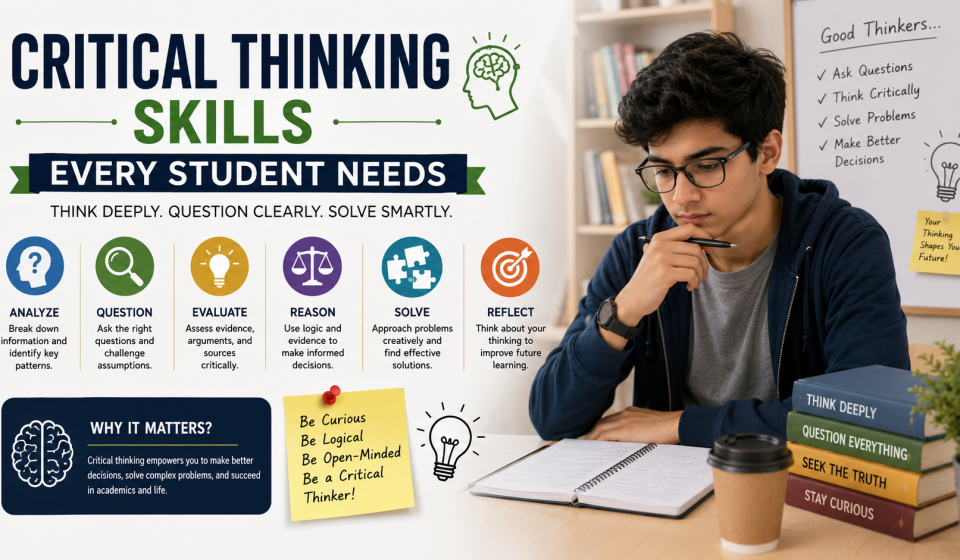

Discover essential critical thinking skills every student needs to succeed in academics and life. Learn how analysis, problem-solving, evaluation, and logical reasoning help students improve decision-making and achieve better academic and career outcomes.
In today’s fast-changing world, information is everywhere. Students are constantly exposed to books, lectures, social media, online articles, and AI-generated content. However, not all information is accurate or useful. This is why critical thinking skills have become one of the most important abilities every student must develop.
Critical thinking is the ability to analyze information logically, evaluate different perspectives, question assumptions, and make informed decisions. It goes beyond memorizing facts—it helps students understand concepts deeply and apply knowledge effectively in real life.
What Is Critical Thinking?
Critical thinking is the process of actively analyzing, questioning, and evaluating information instead of accepting it blindly. It involves reasoning, logic, reflection, and problem-solving.
A student with strong critical thinking skills does not simply accept what a teacher, textbook, or online source says. Instead, they ask questions like:
- Is this information reliable?
- What evidence supports this idea?
- Are there alternative viewpoints?
- What are the consequences of this decision?
In simple terms, critical thinking helps students think smarter, not just harder.
Why Critical Thinking Is Important for Students
Critical thinking is not just an academic skill—it is a life skill. It helps students succeed in education, careers, and personal life.
1. Improves Academic Performance
Students who think critically understand subjects better. Instead of memorizing answers, they learn concepts deeply, which improves exam performance.
2. Enhances Problem-Solving Ability
Real-life problems often do not have simple answers. Critical thinking helps students break down complex problems and find practical solutions.
3. Builds Better Decision-Making Skills
From choosing subjects to selecting careers, students face many decisions. Critical thinking helps them make informed and logical choices.
4. Encourages Independent Thinking
Students learn to think for themselves instead of depending on others’ opinions. This builds confidence and creativity.
5. Prepares for Future Careers
Employers highly value employees who can analyze situations and solve problems effectively. Critical thinking is essential in almost every profession.
Key Critical Thinking Skills Every Student Needs
1. Analysis Skills
Analysis means breaking down complex information into smaller parts to understand it better. Students should learn how to identify key points, main ideas, and supporting details.
2. Evaluation Skills
Evaluation involves judging the credibility and usefulness of information. Students should ask whether a source is reliable or biased.
3. Interpretation Skills
Interpretation helps students understand the meaning of information, data, or arguments. It allows them to make sense of what they read or hear.
4. Inference Skills
Inference means drawing logical conclusions based on available evidence. Students must learn to connect ideas and think beyond obvious facts.
5. Problem-Solving Skills
Problem-solving involves identifying issues, analyzing causes, and finding effective solutions. It is one of the most practical critical thinking skills.
6. Communication Skills
Critical thinkers must express their ideas clearly. Good communication helps students explain their reasoning effectively in writing and speaking.
7. Open-Mindedness
Being open-minded means considering different viewpoints without bias. It helps students understand diverse perspectives and make balanced decisions.
How Students Can Develop Critical Thinking Skills
1. Ask Questions Regularly
Students should develop the habit of asking “why,” “how,” and “what if” questions. This helps deepen understanding.
2. Read Actively
Instead of passively reading, students should highlight important points, take notes, and question the content.
3. Practice Problem-Based Learning
Working on real-world problems improves analytical and reasoning skills. Case studies and projects are very helpful.
4. Engage in Discussions
Group discussions allow students to hear different opinions and defend their own ideas logically.
5. Analyze Different Perspectives
Students should explore multiple viewpoints before forming conclusions.
6. Solve Puzzles and Brain Games
Activities like puzzles, riddles, and logic games help improve reasoning abilities.
7. Reflect on Learning
Reflection helps students understand what they learned and how they can improve.
Role of Teachers in Building Critical Thinking
Teachers play an important role in developing critical thinking skills. Instead of only giving lectures, they can encourage students to:
- Ask questions in class
- Participate in debates
- Work on group projects
- Analyze real-world case studies
- Think independently before answering
Modern education systems are increasingly focusing on interactive learning instead of rote memorization, which supports critical thinking development.
Critical Thinking in Everyday Student Life
Critical thinking is not limited to academics. Students use it daily in many situations:
- Choosing study methods
- Managing time and priorities
- Evaluating online information
- Making career decisions
- Handling peer pressure
For example, when a student sees a trending news post on social media, critical thinking helps them question its authenticity instead of believing it immediately.
Common Barriers to Critical Thinking
1. Rote Learning
Memorizing without understanding limits thinking ability.
2. Bias
Personal opinions can prevent students from seeing the full picture.
3. Lack of Curiosity
Without curiosity, students do not explore deeper knowledge.
4. Overdependence on Technology
Relying too much on search engines or AI can reduce independent thinking.
5. Fear of Being Wrong
Students often avoid expressing ideas due to fear of mistakes.
How to Overcome These Barriers
- Focus on understanding instead of memorizing
- Challenge personal assumptions
- Stay curious and ask questions
- Use technology as a tool, not a replacement for thinking
- Accept mistakes as part of learning
Benefits of Strong Critical Thinking Skills
Students who develop strong critical thinking skills enjoy many benefits:
- Better academic results
- Improved confidence
- Stronger communication skills
- Smarter decision-making
- Higher career success
- Greater creativity and innovation
These benefits last throughout life and help students succeed in every field.
Source
https://sl1nk.com/ikmjkew
https://l1nq.com/pjjxtlo
Conclusion
Critical thinking is one of the most valuable skills every student needs in today’s world. It helps students move beyond memorization and develop deep understanding, logical reasoning, and independent decision-making abilities.
From academics to career growth, critical thinking plays a major role in shaping success. Students who learn to question, analyze, and evaluate information are better prepared for real-life challenges.
By practicing curiosity, active learning, and open-minded thinking, every student can strengthen this essential skill and build a smarter future.
FAQs
1. What are critical thinking skills for students?
Critical thinking skills are abilities that help students analyze, evaluate, and understand information logically instead of accepting it blindly.
2. Why are critical thinking skills important?
They help students improve academic performance, solve problems effectively, and make better decisions in life and career.
3. How can students improve critical thinking?
Students can improve by asking questions, reading actively, participating in discussions, and solving real-world problems.
4. Is critical thinking useful in exams?
Yes, it helps students understand concepts deeply and apply knowledge, leading to better exam performance.
5. Can critical thinking be learned?
Yes, critical thinking is a skill that can be developed through practice, learning, and experience.