
College life in 2026 is more fast-paced than ever. Students are balancing classroom lectures, online learning platforms, assignments, internships, competitive exams, part-time work, and personal responsibilities. With so much pressure, simply studying for long hours is not enough. College students need smart study techniques that improve focus, memory, understanding, and exam performance.
Why Study Techniques Matter for College Students
Many students believe that success depends only on how many hours they study. However, effective learning depends more on how students study. A student who studies with proper techniques for two focused hours may learn more than someone who studies passively for five hours.
Good study techniques help students organize information, improve memory, understand concepts deeply, and prepare better for exams. They also reduce confusion and make learning less stressful. In college, where subjects are often complex and workloads are heavy, using the right study method can make a major difference.
Active Recall for Better Memory
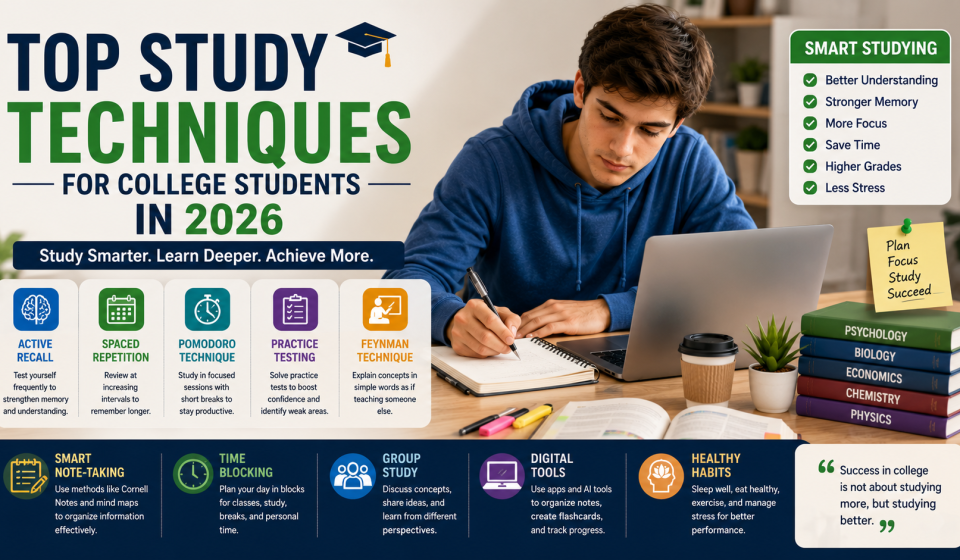
Active recall is one of the most effective study techniques for college students. It means testing yourself on what you have learned instead of simply reading the same notes again. For example, after studying a topic, close your book and try to write down or explain the main points from memory.
This technique strengthens memory because it forces the brain to retrieve information. The more often students recall information, the easier it becomes to remember during exams.
Students can use active recall through flashcards, practice questions, oral explanations, blank-page summaries, and self-quizzing. Instead of asking, “Did I read this?” students should ask, “Can I explain this without looking?”
Spaced Repetition for Long-Term Learning
Spaced repetition is a smart revision method where students review topics at planned intervals. Instead of studying a topic once and forgetting it, they revise it after one day, three days, one week, and again before exams.
This technique helps move information from short-term memory to long-term memory. It is especially useful for subjects that require memorization, such as biology, medicine, law, history, languages, and business studies.
Students can create a revision calendar or use flashcard apps to schedule reviews. In 2026, many digital learning tools also offer automatic spaced repetition features, making revision easier and more personalized.
The Pomodoro Technique for Focus
The Pomodoro Technique is a popular time-management method that helps students stay focused. In this method, students study for a fixed period, such as 25 or 50 minutes, and then take a short break.
This technique works because the brain focuses better when study time is divided into manageable sessions. Long, unbroken study sessions can lead to boredom and mental fatigue.
During each Pomodoro session, students should remove distractions, keep their phone away, and focus on one task only. After completing a few sessions, they can take a longer break. This method is helpful for students who struggle with procrastination or lack of concentration.
Practice Testing for Exam Success
Practice testing is one of the best ways to prepare for college exams. It helps students understand question patterns, improve speed, and identify weak areas. Instead of only reading notes, students should regularly solve practice questions, mock tests, and past exam papers.
Practice testing also improves confidence. When students are familiar with exam-style questions, they feel less nervous during the actual exam.
After each practice test, students should review their mistakes carefully. Mistakes show what needs improvement. This makes future study sessions more focused and productive.
The Feynman Technique for Deep Understanding
The Feynman Technique is a simple study method that helps students understand concepts deeply. In this method, students choose a topic and explain it in simple words as if teaching it to a beginner.
If they cannot explain the topic clearly, it means they need to study it again. This method helps students find gaps in their understanding and improve clarity.
The Feynman Technique is useful for subjects like science, economics, psychology, mathematics, engineering, and theory-based courses. It also helps students write better exam answers because they understand the topic instead of memorizing it blindly.
Smart Note-Taking Methods
Good notes are important for effective studying. However, copying everything from a lecture is not the best approach. Students should focus on writing key ideas, examples, definitions, diagrams, and summaries.
The Cornell Note-Taking Method is useful for college students. It divides notes into sections for main ideas, details, and summaries. Mind maps are also helpful for visual learners because they show connections between concepts.
Students should review their notes soon after class. This helps strengthen memory and makes exam revision easier.
Digital Tools for Organized Studying
In 2026, digital tools are a major part of college study routines. Students can use apps for notes, task management, flashcards, time tracking, online courses, and AI-based explanations.
Digital tools can help students organize study material, create schedules, generate quizzes, summarize long notes, and track progress. However, technology should support learning, not replace it. Students should avoid copying AI-generated answers without understanding the topic.
Used wisely, digital tools can save time and improve productivity.
Time Blocking for Better Planning
Time blocking is a technique where students divide their day into fixed blocks for specific tasks. For example, one block may be for reading, another for assignments, another for revision, and another for rest.
This method helps students avoid wasting time and reduces procrastination. It gives structure to the day and makes large tasks feel manageable.
A good time-blocking schedule should include study sessions, breaks, meals, exercise, sleep, and personal time. Balanced planning helps students stay consistent without feeling burned out.
Group Study and Peer Teaching
Group study can be useful when it is focused and organized. Studying with classmates allows students to discuss ideas, solve problems, share notes, and learn from different perspectives.
Peer teaching is especially powerful. When students explain a concept to others, they improve their own understanding. However, group study should not become a distraction. Students should set clear goals before each session and stay on topic.
This technique works well for exam revision, problem-solving, presentations, and difficult subjects.
Avoiding Multitasking While Studying
Many students try to study while checking messages, watching videos, or browsing social media. This reduces concentration and weakens learning. The brain performs better when it focuses on one task at a time.
Students should create a distraction-free study environment. They can keep their phone away, use website blockers, and choose a quiet place to study.
Single-tasking improves focus, saves time, and helps students remember information better.
Healthy Habits That Support Studying
Study techniques work best when students take care of their health. Sleep, exercise, hydration, nutrition, and mental well-being all affect learning. A tired or stressed brain cannot study effectively.
Students should avoid sacrificing sleep before exams. Good sleep helps the brain organize and store information. Regular exercise improves energy and mood, while healthy food supports concentration.
A balanced lifestyle is an important part of academic success.
How to Build a Successful Study Routine
A successful study routine should combine multiple techniques. Students can use active recall for memory, spaced repetition for revision, Pomodoro sessions for focus, practice testing for exam preparation, and digital tools for organization.
The key is consistency. Students do not need to study all day. Even two to four focused hours daily can be effective if they use the right methods.
A good routine should be flexible, realistic, and based on personal goals.
Source
https://l1nq.com/68ns5ui
https://l1nq.com/xcn282t
Conclusion
The top study techniques for college students in 2026 are designed to make learning smarter, faster, and less stressful. Active recall, spaced repetition, the Pomodoro Technique, practice testing, the Feynman Technique, smart note-taking, time blocking, and digital tools can help students improve academic performance.
College success is not only about hard work. It is about using the right strategies consistently. When students study with focus, revise regularly, test themselves, and maintain healthy habits, they can achieve better grades and build long-term confidence.
FAQs
1. What is the best study technique for college students?
Active recall is one of the best study techniques because it helps students remember information by testing themselves instead of only rereading notes.
2. How can college students study better in 2026?
Students can study better by using active recall, spaced repetition, practice testing, digital tools, time blocking, and focused study sessions.
3. What is the Pomodoro Technique?
The Pomodoro Technique is a focus method where students study for a set time, such as 25 or 50 minutes, and then take a short break.
4. Is group study helpful for college students?
Yes, group study is helpful when it is organized and focused on discussion, revision, and problem-solving.
5. How many hours should college students study daily?
Most students can benefit from 2 to 4 focused study hours daily, depending on their course, workload, and exam schedule.