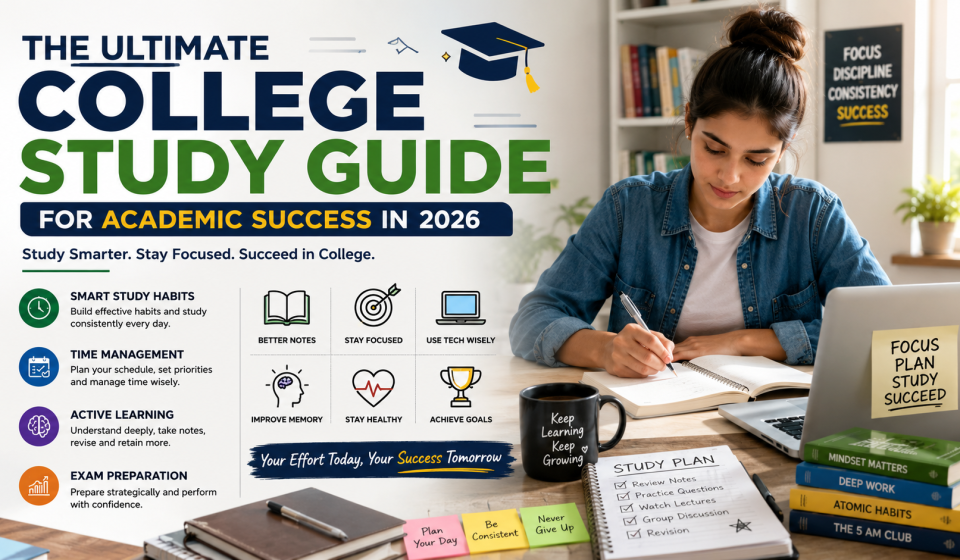

College life is exciting, challenging, and full of opportunities. Students enter college with dreams of building a successful future, but academic success does not happen by chance. It requires smart planning, consistent study habits, time management, focus, and the ability to use modern learning tools effectively. In 2026, college students have more resources than ever before, including online classes, AI tools, digital note-taking apps, recorded lectures, academic platforms, and productivity systems. However, success still depends on discipline and the right study strategy.
Why Smart Study Habits Matter in College
College education is different from school because students have more freedom and responsibility. Professors may not remind you every day about assignments, exams, or reading tasks. This means you must become independent and organized.
Smart study habits help students stay ahead of deadlines, understand difficult topics, and perform better in exams. Good study habits also reduce last-minute pressure. When students study regularly, they remember information better and feel more prepared.
In 2026, distractions are everywhere. Social media, streaming platforms, mobile games, and constant notifications can affect focus. That is why developing strong study habits is more important than ever.
Create a Realistic Study Schedule
A study schedule is one of the most powerful tools for college success. Many students fail not because they are weak academically, but because they do not manage their time properly.
Start by listing all your classes, assignments, exams, project deadlines, and personal responsibilities. Then divide your study time into daily and weekly blocks. Avoid creating an unrealistic timetable that is too strict. Instead, create a flexible schedule that you can actually follow.
Use time blocks for specific subjects. For example, you can study math for one hour, revise lecture notes for 30 minutes, and work on assignments for another hour. Keep short breaks between study sessions to refresh your mind.
Use Active Learning Instead of Passive Reading
Passive reading means simply reading textbooks or notes without fully engaging with the material. This method is often less effective because students may forget what they read.
Active learning means interacting with the content. You can ask questions, summarize concepts in your own words, make flashcards, solve practice problems, teach the topic to someone else, or create mind maps.
When you actively study, your brain processes information more deeply. This improves memory and understanding. For difficult subjects, active learning is much more useful than reading the same chapter again and again.
Take Better Notes During Lectures
Good notes are essential for academic success. In college, lectures often contain important explanations that may not be fully covered in textbooks. Students should learn how to take clear and organized notes.
One effective method is the Cornell note-taking system. In this method, you divide the page into sections for main notes, key points, and summaries. Another method is mind mapping, which helps connect ideas visually.
Digital note-taking apps can also help students organize subjects, add images, record lectures, and search notes easily. However, avoid copying everything word for word. Focus on main ideas, definitions, examples, and professor explanations.
Improve Focus and Avoid Distractions
Focus is one of the biggest challenges for college students. A simple 30-minute study session can become unproductive if you keep checking your phone.
To improve focus, keep your phone away or use focus mode. Choose a quiet study space such as a library, study room, or clean desk at home. Use the Pomodoro technique by studying for 25 minutes and taking a 5-minute break.
Avoid multitasking. Studying while watching videos or chatting with friends reduces concentration. When you focus on one task at a time, you complete work faster and understand better.
Use Technology and AI Tools Wisely
In 2026, technology plays a major role in college education. Students can use AI tools for research support, grammar checking, summarizing notes, creating study plans, and understanding difficult concepts.
However, technology should support learning, not replace it. Students should avoid copying AI-generated answers without understanding them. Use AI tools to clarify topics, generate practice questions, organize ideas, and improve writing.
Other useful digital tools include calendar apps, task managers, flashcard apps, cloud storage, citation tools, and online learning platforms. When used correctly, technology can save time and improve productivity.
Practice Regular Revision
Revision is the key to long-term memory. Many students study only before exams, but this creates stress and weak understanding. Regular revision helps information stay fresh in your mind.
Use spaced repetition, which means reviewing topics at increasing time intervals. For example, revise a topic after one day, then after three days, then after one week. This method is very effective for remembering facts, formulas, vocabulary, and definitions.
Before exams, revise summaries, flashcards, important questions, and previous papers. Do not wait until the last night to study everything.
Prepare for Exams Strategically
Exam preparation should begin early. First, understand the exam format. Check whether the exam includes multiple-choice questions, essays, case studies, numerical problems, or practical tasks.
Make a list of important topics based on lectures, assignments, past papers, and professor hints. Focus more on high-weightage topics but do not completely ignore smaller sections.
Practice writing answers within a time limit. For technical subjects, solve problems regularly. For theory subjects, prepare structured answers with introductions, main points, examples, and conclusions.
Build Healthy Study-Life Balance
Academic success is important, but health is equally important. Many students ignore sleep, food, exercise, and mental well-being during college. This can affect concentration, memory, and motivation.
Try to sleep 7 to 8 hours daily. Eat balanced meals, drink enough water, and include physical activity in your routine. Even a short walk can refresh your mind.
Also, take time for hobbies, friends, and relaxation. A balanced lifestyle helps students stay motivated and avoid burnout.
Join Study Groups and Ask for Help
Studying alone is useful, but group study can also be powerful when done correctly. A good study group helps students discuss difficult topics, share notes, solve problems, and stay accountable.
Choose serious study partners who are focused on learning. Avoid groups that become social gatherings instead of study sessions.
If you do not understand a topic, ask for help early. Talk to professors, teaching assistants, classmates, or tutors. Asking questions is not a weakness. It shows that you are serious about learning.
Track Your Academic Progress
Successful students regularly track their performance. Keep a record of grades, assignment scores, test results, and feedback from professors. This helps you understand your strengths and weaknesses.
If your performance is low in one subject, give it more attention. If you are doing well in another subject, maintain your consistency.
Progress tracking also keeps you motivated. Small improvements over time can lead to big academic success.
Source
https://sl1nk.com/oov4d5r
https://l1nq.com/mlji61l
Conclusion
The ultimate college study guide for academic success in 2026 is based on smart planning, active learning, regular revision, focus, and balance. Students do not need to study all day to succeed. They need to study with purpose and consistency.
By creating a realistic study schedule, taking better notes, avoiding distractions, using technology wisely, and maintaining a healthy lifestyle, college students can improve their academic performance and reduce stress. Success in college is not about perfection. It is about building habits that help you grow every day.
With the right mindset and study strategy, every student can achieve better grades, stronger confidence, and long-term academic success.
FAQs
1. What is the best study method for college students?
The best study method is active learning. This includes summarizing, practicing questions, teaching others, making flashcards, and revising regularly.
2. How many hours should a college student study daily?
Most students should study 2 to 4 focused hours daily outside class, depending on their course, workload, and exam schedule.
3. How can I stay focused while studying?
Keep your phone away, study in a quiet place, use the Pomodoro technique, avoid multitasking, and set clear goals for each study session.
4. Are AI tools useful for college students?
Yes, AI tools can help with research, summaries, grammar, study planning, and concept explanation. However, students should use them ethically and understand the material themselves.
5.How can I prepare for college exams without stress?
Start early, revise regularly, practice past papers, make short notes, sleep well, and avoid last-minute cramming.