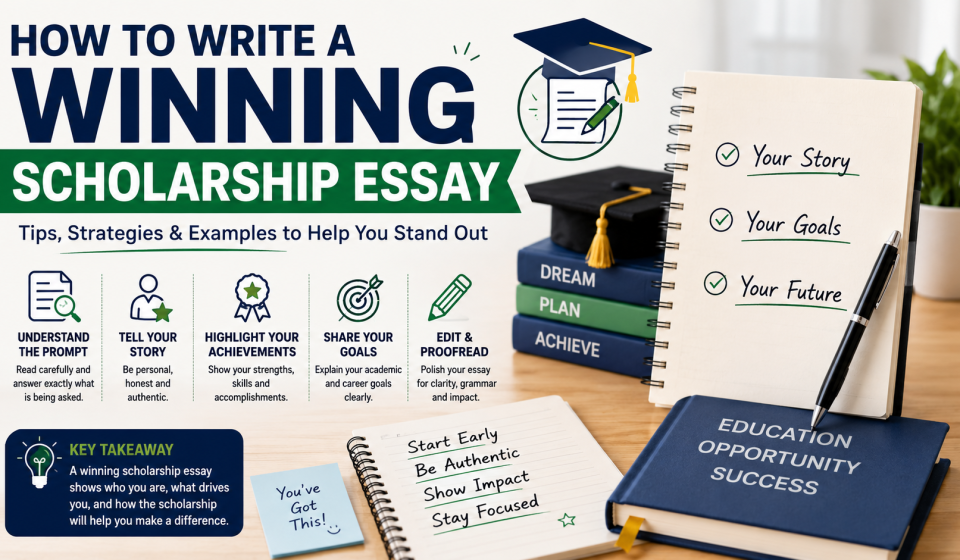

A scholarship essay is one of the most important parts of a scholarship application. While grades, certificates, and recommendation letters show your academic record, the essay shows your personality, goals, challenges, values, and motivation. It gives the selection committee a chance to understand who you are beyond marks and documents.
Why a Scholarship Essay Matters
A scholarship essay helps judges understand your story. Many applicants may have good grades, but not every student can clearly explain their purpose, struggles, and dreams. Your essay is your opportunity to stand out.
A strong essay can show leadership, determination, financial need, academic passion, community involvement, and future vision. It helps the committee see why investing in your education is meaningful.
Scholarship providers often want to support students who are serious, responsible, and motivated. Your essay should prove that you are not only asking for financial help but also ready to use the opportunity wisely.
Understand the Essay Prompt Carefully
Before writing, read the essay prompt several times. Many students make the mistake of writing a good essay that does not answer the actual question. Scholarship prompts may ask about your goals, challenges, leadership experience, community service, academic interests, or financial need.
Underline the main keywords in the prompt. If the question asks about leadership, focus on leadership examples. If it asks about your career goals, explain your academic path and future plans.
Following the prompt shows that you can understand instructions and communicate clearly. This creates a strong first impression.
Research the Scholarship Provider
A winning essay should match the values of the scholarship provider. Before writing, learn about the organization, university, foundation, or company offering the scholarship.
Check what type of students they support. Do they value leadership, innovation, social service, academic excellence, financial need, or research? Once you understand their mission, you can connect your essay to their goals naturally.
For example, if a scholarship supports community service, highlight your volunteering experience and desire to help others. If it supports science students, explain your interest in research and innovation.
Start With a Strong Introduction
The introduction should catch the reader’s attention from the beginning. Avoid starting with boring lines like “My name is…” or “I am applying for this scholarship because…” Instead, begin with a personal story, a meaningful experience, or a powerful statement.
For example, you can start by describing a challenge you faced, a moment that inspired your career goal, or a lesson that changed your mindset.
A strong opening makes the reader want to continue. It also helps your essay feel personal and memorable.
Tell Your Personal Story
Your scholarship essay should not sound like a resume. Instead of only listing achievements, explain the story behind them. Show how your experiences shaped your goals and character.
Talk about challenges you overcame, lessons you learned, and moments that motivated you. Be honest and specific. A personal story is more powerful than general statements.
For example, instead of saying, “I am hardworking,” describe a time when you balanced school, family responsibilities, and exam preparation. This shows your hard work through real experience.
Highlight Your Achievements Clearly
While your essay should be personal, it should also show your strengths. Mention academic achievements, leadership roles, awards, projects, internships, volunteer work, sports, or creative activities.
Do not simply list everything. Choose achievements that support your main message. If your essay is about leadership, focus on leadership examples. If it is about financial hardship, show how you continued working hard despite challenges.
Always explain why the achievement matters. Show how it helped you grow and prepared you for future success.
Explain Your Goals and Future Plans
Scholarship committees want to know how the scholarship will help you. Clearly explain your academic and career goals. Mention what course you want to study, what skills you want to build, and what impact you hope to create in the future.
Your goals should sound realistic and meaningful. Avoid vague statements like “I want to be successful.” Instead, explain what success means to you.
For example, you might say that you want to become a healthcare professional to serve rural communities or study engineering to develop sustainable technology.
Show Why You Deserve the Scholarship
A winning essay should answer one important question: Why should the committee choose you?
Explain your dedication, achievements, financial need, leadership qualities, or community impact. Show that you will use the scholarship responsibly and make the most of the opportunity.
Avoid sounding arrogant or desperate. Be confident but respectful. Focus on your potential, effort, and commitment to your education.
Keep the Essay Well-Structured
A clear structure makes your essay easier to read. Use a simple format: introduction, body paragraphs, and conclusion.
The introduction should introduce your main idea. The body should explain your story, achievements, challenges, and goals. The conclusion should connect everything and leave a strong final impression.
Each paragraph should focus on one main point. Avoid jumping from one idea to another without connection. Good structure helps your essay feel professional and organized.
Use Clear and Simple Language
You do not need complicated words to impress judges. Clear, honest, and natural writing is more effective. Use simple language that explains your thoughts well.
Avoid slang, informal expressions, and repeated phrases. Also avoid copying essay samples from the internet. Scholarship committees read many essays, so copied or generic writing can be easily noticed.
Write in your own voice. Your essay should sound like you, not like a machine or template.
Edit and Proofread Carefully
After writing your first draft, do not submit it immediately. Take time to revise. Check grammar, spelling, sentence flow, word limit, and clarity.
Read your essay aloud to find awkward sentences. Remove unnecessary words and make your message stronger. Ask a teacher, mentor, or trusted friend to review it.
A polished essay shows effort and professionalism. Even a strong story can lose impact if the essay has many mistakes.
Common Scholarship Essay Mistakes to Avoid
Many students make avoidable mistakes while writing scholarship essays. These include ignoring the prompt, writing too generally, using the same essay for every scholarship, exaggerating achievements, and submitting without proofreading.
Another mistake is focusing only on financial need without showing goals or potential. It is important to explain both your need and your commitment to success.
Also avoid writing a sad story only to gain sympathy. Challenges are important, but your essay should also show strength, growth, and determination.
Source
https://l1nq.com/upk6xle
https://l1nq.com/3t9z9wz
Conclusion
Writing a winning scholarship essay takes planning, honesty, and careful editing. Your essay should tell your story, answer the prompt, highlight your achievements, and explain your future goals. It should show the scholarship committee why you are a deserving candidate and how the scholarship will help you move forward.
A strong scholarship essay does not need to be perfect or overly complicated. It needs to be clear, personal, meaningful, and well-organized. With the right structure and genuine storytelling, you can create an essay that stands out and increases your chances of winning financial support for your education.
FAQs
1. What should I include in a scholarship essay?
A scholarship essay should include your personal story, academic goals, achievements, challenges, financial need if relevant, and how the scholarship will help your future.
2. How do I start a scholarship essay?
Start with a strong personal story, meaningful experience, or powerful statement that connects to the essay prompt and makes the reader interested.
3. How long should a scholarship essay be?
Scholarship essay length depends on the application guidelines. Many essays range from 500 to 1,000 words, but always follow the required word limit.
4. Can I use the same essay for multiple scholarships?
You can use a basic structure, but you should customize each essay for the specific scholarship prompt and provider.
5. What makes a scholarship essay stand out?
A scholarship essay stands out when it is personal, honest, specific, well-structured, and clearly connected to the student’s goals and the scholarship’s purpose.