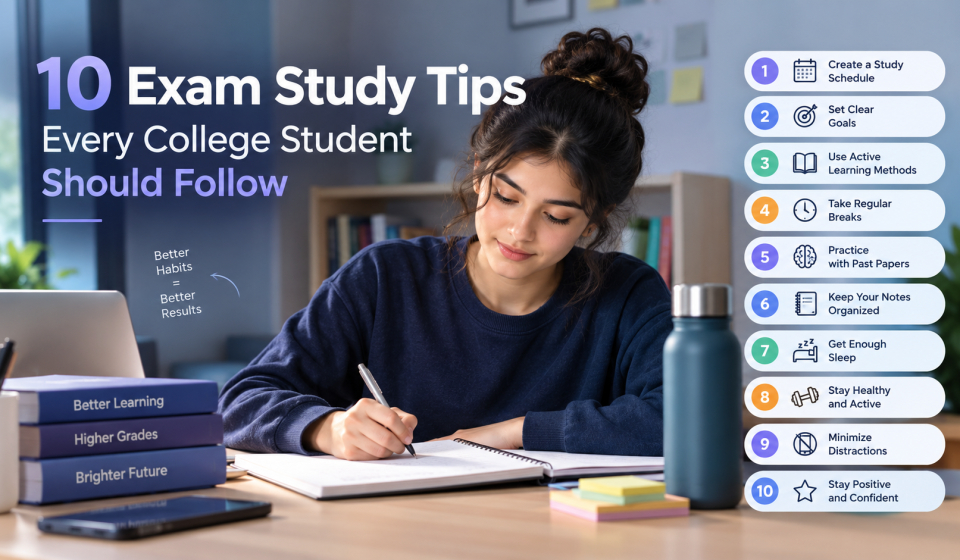

Discover 10 effective exam study tips every college student should follow to study smarter, stay focused, manage time, reduce stress, and achieve better exam results.
College exams can be challenging, especially when you have multiple subjects, assignments, projects, and personal responsibilities to manage at the same time. Studying effectively is not simply about spending long hours with your books. It is about using the right strategies, organizing your time, and focusing on understanding rather than memorizing everything at the last minute.
A good study routine can help you feel more confident, remember information for longer, and perform better during exams. Whether you are preparing for semester exams, final examinations, or important college tests, developing effective study habits can make a significant difference.
In this article, we will explore 10 practical exam study tips every college student should follow to prepare smarter, stay organized, and approach exams with greater confidence.
Create a Realistic Study Schedule
One of the most effective ways to prepare for college exams is to create a study schedule. Instead of deciding what to study each day at the last minute, plan your study sessions in advance.
Start by listing all your subjects and identifying the topics you need to cover. Then divide your available time between these subjects according to their difficulty and importance.
For example, if you have four subjects and find one particularly difficult, you can dedicate more study time to that subject. Include short breaks in your schedule so that you do not become mentally exhausted.
A realistic schedule should be flexible. If you miss one study session, adjust your plan instead of abandoning it completely.
Start Studying Early
Avoid waiting until a few days before the exam to begin studying. Last-minute preparation can increase stress and make it difficult to remember large amounts of information.
Starting early gives you enough time to understand difficult concepts, revise important topics, and practice questions. It also allows you to identify areas where you need additional help.
Even studying for one or two hours each day several weeks before an exam can be more effective than studying for many hours during the final night.
Early preparation also gives your brain more opportunities to review information, which can improve long-term retention.
Understand Concepts Instead of Just Memorizing
Memorization can be useful for certain subjects, but understanding concepts is generally a more effective approach to learning.
Instead of simply reading a definition repeatedly, ask yourself why the concept works and how it relates to other topics. Try explaining the subject in your own words.
For example, if you are studying science, focus on understanding the process rather than memorizing every sentence from your textbook. If you are studying economics or business, connect theories with practical examples.
When you understand a topic, you are more likely to remember it and apply it to different types of exam questions.
Use Active Learning Techniques
Simply reading your notes again and again may not be enough. Active learning requires you to interact with the information you are studying.
Some useful active learning techniques include:
- Writing summaries in your own words
- Creating flashcards
- Making mind maps
- Solving practice problems
- Explaining concepts aloud
- Asking yourself questions
- Teaching the topic to someone else
One particularly useful technique is the practice testing method. Close your textbook and try to recall what you have learned. This helps you identify which topics you understand and which ones require more revision.
Active learning can make study sessions more engaging and productive.
Practice With Previous Exam Papers
Previous exam papers can be extremely useful when preparing for college examinations. They can help you understand the format of the exam and the types of questions that may be asked.
Try solving previous papers without looking at your notes. Set a timer to create an exam-like environment.
After completing the paper, check your answers and identify your mistakes. Pay attention to topics that repeatedly appear in previous examinations, but do not assume that a particular question will definitely appear again.
Practice papers can also help improve your time-management skills. You will learn how much time to spend on different sections and how to avoid spending too long on one difficult question.
Take Regular Breaks
Studying continuously for several hours may seem productive, but long periods without breaks can reduce concentration and cause mental fatigue.
Instead, divide your study time into manageable sessions. For example, you might study for 45–50 minutes and then take a short break.
During breaks, step away from your study materials. Stretch, drink water, walk around, or simply rest your mind.
Try to avoid spending your entire break scrolling through social media because it can make it harder to return to your studies.
Regular breaks can help you maintain concentration and make longer study sessions more manageable.
Remove Distractions While Studying
Distractions can significantly reduce the effectiveness of your study time. Smartphones, social media, television, gaming, and unnecessary notifications can interrupt your concentration.
Before beginning a study session, create an environment that supports focused learning.
You can:
- Put your phone on silent or Do Not Disturb mode.
- Keep unnecessary browser tabs closed.
- Study in a quiet location.
- Turn off unnecessary notifications.
- Keep only the materials you need nearby.
- Use website-blocking tools if necessary.
If you need your phone or computer for studying, try to use them only for academic purposes during your study session.
A distraction-free environment allows you to accomplish more in less time.
Focus on Difficult Subjects First
Not every subject will require the same amount of effort. Some topics may be easy to understand, while others may require several hours of practice.
Consider studying your most difficult subjects when your concentration is highest. For many students, this may be in the morning, but it depends on your individual routine.
For example, if mathematics requires more concentration than another subject, dedicate your most productive study period to mathematics.
Once you complete a difficult topic, you may feel more confident and motivated to continue with easier subjects.
However, do not completely ignore subjects that seem easy. Make sure every subject receives enough revision time.
Take Care of Your Sleep, Food, and Health
Effective exam preparation is not only about studying. Your physical wellbeing can also influence your concentration and energy levels.
Avoid making all-night study sessions a regular habit. Lack of sleep can leave you tired and make it harder to focus and remember information.
Try to maintain a consistent sleep schedule, especially during the days leading up to an exam.
Eating balanced meals and staying hydrated can also support your energy throughout the day. Light physical activity, such as walking or stretching, can provide a useful break from studying.
Remember that sacrificing your basic needs for extra study hours is not always productive. A rested student can often study more effectively than an exhausted one.
10. Revise Strategically Before the Exam
Revision is one of the most important parts of exam preparation. However, effective revision does not mean reading your entire textbook from beginning to end repeatedly.
Instead, focus on important concepts, formulas, definitions, difficult topics, previous mistakes, and areas where you have struggled.
Create a short revision checklist for each subject. You can also use flashcards, summary notes, diagrams, and practice questions to review information quickly.
During the final days before the exam, avoid trying to learn everything from scratch. Your goal should be to strengthen what you already know and address remaining weaknesses.
A final revision session can help improve confidence and reduce exam-day anxiety.
How to Make Your Study Sessions More Effective
Following study tips is useful, but consistency is even more important. Try to establish a routine that works with your college schedule.
Before every study session, decide exactly what you want to accomplish. Instead of saying, “I will study biology,” set a specific goal such as, “I will complete Chapter 4 and answer 20 practice questions.”
Specific goals make it easier to measure your progress.
You can also keep a simple study tracker. Record the subjects you studied, topics completed, and areas that need additional revision.
Do not compare your study routine with other students. Some students may study for several hours, while others may learn effectively in shorter sessions. The goal is to discover the method that helps you learn and retain information most effectively.
Common Exam Study Mistakes to Avoid
Even hardworking students can make mistakes during exam preparation. Some common problems include:
- Starting preparation too late
- Studying without a schedule
- Relying entirely on memorization
- Ignoring difficult topics
- Spending too much time making notes
- Studying continuously without breaks
- Checking social media frequently
- Avoiding practice questions
- Sleeping too little
- Trying to learn everything the night before
Avoiding these mistakes can make your preparation more organized and less stressful.
How to Stay Motivated During Exam Preparation
Maintaining motivation throughout exam preparation can be difficult. When you have many chapters to complete, the workload may feel overwhelming.
Break large tasks into smaller goals. Completing one chapter, solving a set of questions, or revising one topic can give you a sense of progress.
You can also reward yourself after completing important study goals. For example, take a short break, listen to music, go for a walk, or spend some time doing an activity you enjoy.
Most importantly, remember why you are studying. Your exams are an opportunity to demonstrate what you have learned and develop skills that can benefit your academic and professional future.
Source
https://l1nq.com/hmz7zc6
https://sl1nk.com/cjnp39a
Conclusion
Preparing for college exams does not have to mean studying for endless hours or staying awake all night. Effective preparation comes from planning ahead, studying actively, practicing regularly, and taking care of your wellbeing.
Creating a realistic study schedule, starting early, understanding concepts, practicing previous exam papers, eliminating distractions, taking breaks, and revising strategically can make your preparation much more effective.
Every student has a different learning style, so experiment with different techniques and develop a routine that works for you. With consistent effort and smart study habits, you can approach your college exams with greater confidence and improve your chances of achieving better results.
Frequently Asked Questions (FAQs)
1. How early should college students start studying for exams?
Ideally, students should begin preparing several weeks before their exams. Starting early provides enough time to understand difficult topics, practice questions, and revise the material multiple times.
2. How many hours should a college student study each day?
There is no fixed number of hours that works for everyone. The quality of your study sessions is more important than the number of hours. Focused sessions with clear goals can be more productive than long periods of distracted studying.
3. What is the best study technique for college exams?
Active learning techniques such as practice testing, flashcards, self-questioning, summarizing, and explaining concepts in your own words can be highly effective.
4. Should I study difficult subjects first?
Studying difficult subjects during your most productive hours can be helpful. However, you should still divide your time appropriately among all subjects.
5. Are previous exam papers useful?
Yes. Previous exam papers can help you understand the exam format, practice answering questions, improve time management, and identify areas that need more revision.
6. Is studying all night before an exam effective?
All-night study sessions are generally not a good long-term strategy. Getting adequate sleep can help you stay focused and mentally prepared for the examination.
7. How can I avoid distractions while studying?
Keep your phone away or use Do Not Disturb mode, study in a quiet location, turn off unnecessary notifications, and use website-blocking tools when necessary.
8. How can I remember what I study for longer?
Active recall and spaced revision can help strengthen memory. Instead of repeatedly reading the same material, test yourself and review information at increasing intervals.
9. Should I take breaks while studying?
Yes. Short, regular breaks can help reduce mental fatigue and maintain concentration during longer study sessions.
10. What should I do on the day before an exam?
Focus on light revision rather than trying to learn everything from the beginning. Review key concepts, formulas, summaries, and difficult areas, prepare your exam materials, and get enough sleep.