
Discover the best revision techniques for college exams, including active recall, spaced repetition, flashcards, mind maps, past papers, and study strategies to improve memory, boost confidence, and achieve academic success.
College exams can feel stressful, especially when students have many subjects, long chapters, assignments, and deadlines to manage. Many students spend hours reading textbooks again and again, but still forget important points during exams. The problem is not always lack of effort. Often, students need better revision techniques.
Revision is not just rereading notes. It is the process of reviewing, recalling, testing, and strengthening what you have already learned. Good revision methods help students remember information longer, understand concepts clearly, write better answers, and feel more confident before exams.
Why Revision Techniques Matter for College Students
College-level subjects often require deep understanding, critical thinking, problem-solving, and strong memory. Without proper revision, students may forget topics quickly or struggle to connect ideas during exams.
Effective revision techniques help students organize information, identify weak areas, improve focus, and reduce last-minute pressure. When students revise actively, they are more likely to perform well because they are not just reading information; they are practicing how to use it.
Create a Revision Timetable
A revision timetable is the first step toward exam success. It helps students divide subjects, topics, and chapters into manageable study sessions. Without a timetable, students may waste time deciding what to study next.
Start by listing all subjects and exam dates. Then divide topics based on difficulty and importance. Give more time to challenging subjects and less time to topics you already understand. Keep short revision slots every day instead of waiting until the last week.
A good timetable should include study time, breaks, practice tests, and final review sessions.
Use Active Recall
Active recall is one of the most powerful revision techniques. Instead of reading notes repeatedly, students should close their books and try to remember the information from memory.
For example, after studying a chapter, write down everything you remember without looking. Then check your notes and fill in the missing points. This method strengthens memory because your brain works harder to retrieve information.
Students can use active recall by answering questions, explaining concepts aloud, using flashcards, or writing summaries from memory.
Practice Spaced Repetition
Spaced repetition means revising information at increasing time intervals. Instead of studying a topic once and forgetting it, students review it several times over days or weeks.
For example, revise a topic on day one, then again after two days, then after one week, and again before the exam. This technique helps move information from short-term memory to long-term memory.
Spaced repetition is especially useful for subjects that require memorization, such as definitions, formulas, dates, vocabulary, theories, and key concepts.
Make Summary Notes
Summary notes help students revise quickly before exams. Instead of reading full chapters again, create short notes that include only the most important points.
Use headings, bullet points, keywords, formulas, definitions, examples, and diagrams. Keep your summary notes simple and easy to scan. For theory subjects, include key arguments, thinkers, dates, and case studies. For science or math subjects, include formulas, steps, and solved examples.
Good summary notes save time and reduce stress during the final days before exams.
Use Mind Maps
Mind maps are useful for organizing connected ideas. They help students see the relationship between topics, subtopics, examples, and concepts.
Start with the main topic in the center of the page. Add branches for definitions, causes, effects, theories, examples, and important details. Use short keywords instead of long sentences.
Mind maps work well for subjects like history, literature, political science, psychology, business studies, biology, and economics. They are also helpful for revising long chapters quickly.
Practice Past Exam Papers
Past papers are one of the best tools for college exam preparation. They help students understand question patterns, repeated topics, marking style, and exam difficulty.
Practicing past papers also improves time management. Many students know the answers but fail to complete the paper on time. By solving past papers under exam conditions, students learn how to write faster and manage time better.
After completing a paper, check your answers and identify weak areas. Then revise those topics again.
Take Mock Tests
Mock tests help students prepare mentally and academically for real exams. A mock test creates exam-like pressure, which helps students build confidence.
Choose a quiet place, set a timer, and solve questions without using notes. After the test, review your performance honestly. Notice where you lost marks, which questions took too much time, and which topics need more revision.
Regular mock tests reduce exam fear and improve accuracy.
Use Flashcards
Flashcards are simple but powerful revision tools. They are useful for memorizing definitions, formulas, dates, vocabulary, theories, and short facts.
Write a question on one side of the card and the answer on the other side. Test yourself regularly. Keep difficult flashcards in a separate pile and revise them more often.
Digital flashcard apps can also help students use spaced repetition automatically.
Teach the Topic to Someone Else
Teaching is an excellent revision technique because it forces students to explain ideas clearly. If you can teach a topic in simple words, it means you understand it well.
You can teach a friend, family member, study group, or even yourself. Explain the topic without looking at your notes. If you get stuck, review that part again.
This technique works well for both theory-based and practical subjects.
Use the Blurting Method
The blurting method is a revision technique where students write everything they remember about a topic on a blank page. After writing, they compare it with their notes and correct missing or wrong information.
This method is useful because it shows what you actually remember, not what only looks familiar while reading. It helps identify weak areas quickly.
Use blurting for chapters, definitions, theories, processes, timelines, and essay topics.
Revise with Practice Questions
Practice questions help students apply knowledge. Reading notes may make students feel prepared, but questions reveal whether they can actually use the information.
After revising a topic, solve short questions, long questions, multiple-choice questions, numerical problems, or case studies depending on your subject.
Practice questions also help improve answer structure and confidence.
Use the Feynman Technique
The Feynman Technique means explaining a concept in very simple language. Choose a topic, explain it like you are teaching a beginner, identify gaps, review the topic, and explain it again.
This method is helpful for difficult concepts because it removes confusion. If you cannot explain something simply, you may need to understand it better.
College students can use this technique for science concepts, economic theories, philosophical ideas, legal principles, and technical subjects.
Create Exam Answer Outlines
For theory exams, answer structure matters. Students should practice creating answer outlines before writing full answers.
An answer outline includes introduction, key points, examples, explanation, and conclusion. This helps students organize thoughts quickly during exams.
For essay-based subjects, preparing outlines for important topics can save time and improve answer quality.
Revise Diagrams, Charts, and Tables
Visual revision helps students remember information faster. Diagrams, charts, and tables make complex topics easier to understand.
Use comparison tables for similar theories, timelines for history, flowcharts for processes, and diagrams for science topics. Visual tools help students revise large information in a short time.
Study in Focused Sessions
Revision works best when students study with full concentration. Instead of sitting for long hours without focus, use short, focused sessions.
Study for 45 to 60 minutes, then take a short break. During each session, focus on one topic or task. Avoid checking your phone or switching between subjects too often.
Focused revision saves time and improves memory.
Avoid Last-Minute Cramming
Last-minute cramming may help students remember a few facts temporarily, but it often increases stress and confusion. It is better to revise regularly over time.
If exams are close, focus on high-priority topics, summary notes, past papers, and weak areas. Avoid trying to learn everything new at the last moment.
A calm and organized revision approach is more effective than panic studying.
Revise with a Study Group
Study groups can be useful when members stay focused. Students can quiz each other, explain difficult concepts, share notes, and discuss important questions.
However, group study should have a clear purpose. Decide what topic you will revise before starting. Avoid turning study sessions into casual conversations.
A good study group can improve motivation and understanding.
Take Care of Sleep and Health
Revision is not only about books. Sleep, nutrition, hydration, and exercise also affect memory and concentration.
Students should avoid sacrificing sleep before exams. A tired brain finds it harder to recall information. Eat healthy meals, drink water, take short walks, and rest properly.
A healthy body supports a sharp mind.
Source
https://sl1nk.com/b3tqsca
https://sl1nk.com/ag6egcl
Conclusion
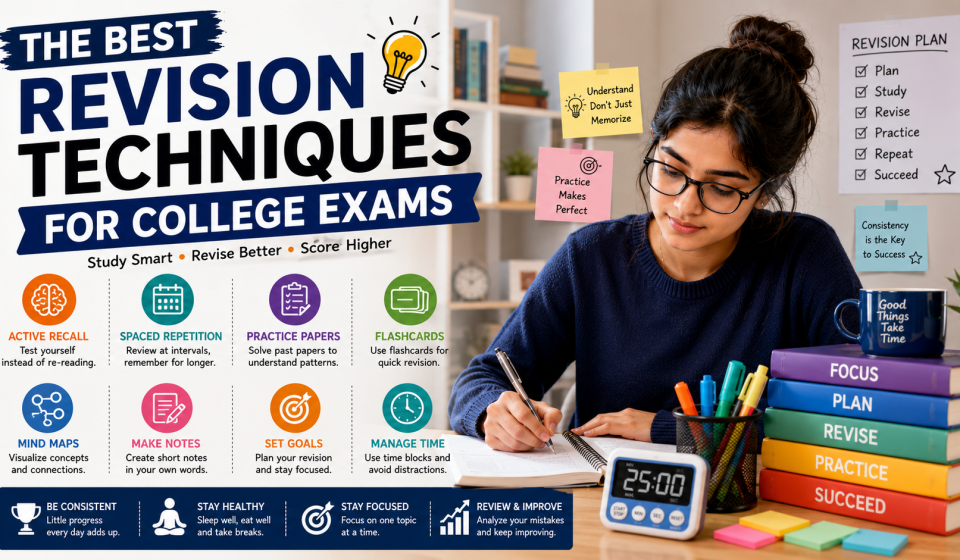
The best revision techniques for college exams are active, organized, and consistent. Students should use methods like active recall, spaced repetition, summary notes, mind maps, past papers, mock tests, flashcards, the Feynman Technique, and practice questions.
Effective revision helps students remember better, reduce exam stress, improve confidence, and perform well in college exams. Instead of simply rereading notes, students should test themselves, review weak areas, and practice writing answers.
With the right revision strategy and regular effort, every college student can prepare smarter and achieve better academic results.
FAQs
1. What is the best revision technique for college exams?
Active recall is one of the best revision techniques because it helps students remember information by testing themselves instead of only rereading notes.
2. How early should college students start revising?
Students should start revising at least a few weeks before exams. Regular revision throughout the semester is even better.
3. Is spaced repetition useful for exams?
Yes, spaced repetition helps students remember information longer by reviewing topics at planned intervals.
4. How can students revise faster?
Students can revise faster by using summary notes, mind maps, flashcards, practice questions, and past papers.
5. Are past papers important for college exams?
Yes, past papers help students understand question patterns, repeated topics, time management, and exam style.