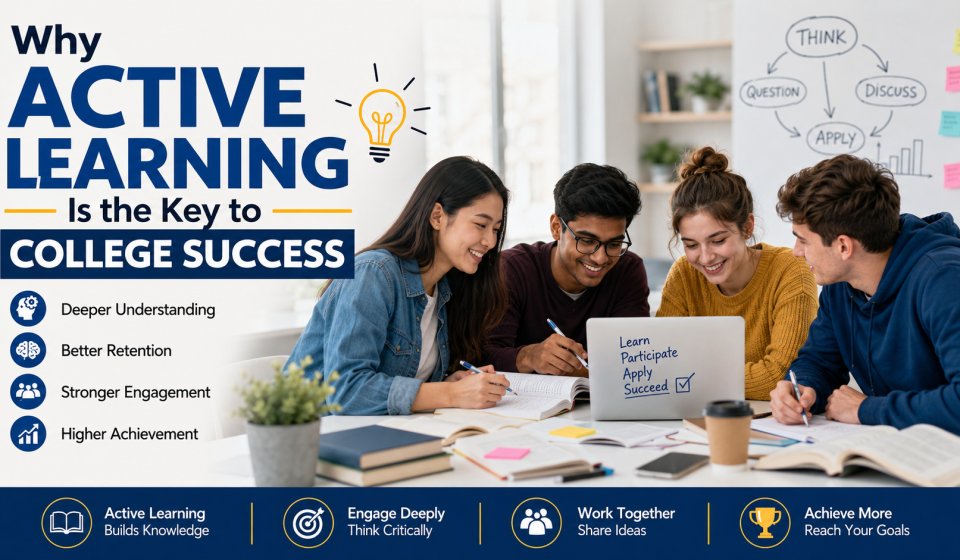

College life is very different from school life. Students are expected to understand complex concepts, manage their own time, complete assignments, prepare for exams, and build skills for future careers. In this situation, simply reading textbooks or listening to lectures is not enough. Students need a better way to learn, remember, and apply knowledge. This is where active learning becomes important.
What Is Active Learning?
Active learning is a study approach that requires students to be mentally involved in what they are learning. Instead of just reading or memorizing, students interact with the material. They ask themselves questions, solve examples, explain topics, join discussions, and connect new information with previous knowledge.
For example, reading a chapter silently is passive learning. But reading the chapter and then writing a short summary in your own words is active learning. Watching a lecture is passive learning. But pausing the lecture to answer questions, make flashcards, or explain the topic to a friend is active learning.
Active learning can happen inside the classroom and outside the classroom. In class, it may include group discussions, case studies, presentations, debates, quizzes, or problem-solving activities. Outside class, it may include self-testing, mind mapping, practice papers, teaching someone else, or creating study notes.
Why Active Learning Matters in College
College subjects are often more detailed and advanced than school subjects. Students cannot depend only on memorization. They must understand concepts, compare ideas, solve problems, and apply knowledge in practical situations. Active learning supports all these goals.
When students actively participate in learning, they are more likely to remember information for a longer time. This happens because active learning forces the brain to work with the material. The student is not just seeing words; they are thinking about meaning, structure, and application.
Active learning also improves confidence. When students practice questions, discuss ideas, and explain concepts, they become more comfortable with the subject. This confidence helps during exams, presentations, interviews, and future professional tasks.
Active Learning Improves Understanding
One of the biggest benefits of active learning is better understanding. Many students believe they understand a topic because they have read it many times. But when they try to explain it or solve a question, they realize there are gaps in their knowledge.
Active learning helps identify these gaps early. For example, if a student studies economics and tries to explain demand and supply using a real market example, they will quickly know whether they truly understand the concept. If they cannot explain it clearly, they can review the topic again.
This process makes learning stronger. Students do not just memorize definitions; they understand how ideas work. This is especially useful in subjects like science, business, engineering, law, medicine, mathematics, and social sciences.
Active Learning Boosts Memory and Retention
Many college students forget what they studied after a few days. This is common when they use passive study methods. Active learning improves retention because it involves repeated recall and application.
Self-testing is one of the best active learning methods. Instead of only reading notes, students can close the book and try to answer questions from memory. This strengthens the brain’s ability to retrieve information later.
Flashcards, quizzes, practice problems, summaries, and teaching others are also helpful. These methods train the mind to remember important points. When exam time comes, students can recall information more easily because they have already practiced using it.
Active Learning Makes Classes More Engaging
College lectures can sometimes feel long or difficult. Students may lose focus if they only sit and listen. Active learning makes classes more interesting because students become part of the learning process.
When students ask questions, participate in group activities, or share opinions, they stay more alert. They also feel more connected to the subject. This improves motivation and reduces boredom.
Engaging in class also helps students build better relationships with professors and classmates. Students who participate actively are more likely to get guidance, feedback, and academic support.
Active Learning Builds Critical Thinking Skills
College success is not only about getting good marks. It is also about developing the ability to think clearly and solve problems. Active learning helps students build critical thinking skills.
When students discuss case studies, compare viewpoints, analyze data, or solve real-world problems, they learn how to think beyond simple memorization. They learn to ask why, how, and what if. These questions are important for deeper learning.
Critical thinking is also valuable for career growth. Employers want graduates who can solve problems, make decisions, communicate ideas, and adapt to new situations. Active learning prepares students for these skills.
Active Learning Helps in Exam Preparation
Exams are a major part of college life. Many students study hard but still perform poorly because they do not practice active recall or application. Active learning can make exam preparation more effective.
Instead of reading the same notes again and again, students should solve past papers, attempt mock tests, explain topics aloud, and write answers in their own words. These methods prepare the brain for real exam conditions.
Active learning also helps students manage exam stress. When students practice regularly, they feel more prepared. They know what they understand and what needs revision. This reduces last-minute panic.
Best Active Learning Strategies for College Students
College students can use many simple active learning techniques. One effective method is summarizing. After studying a topic, write the main points in your own words. This helps you check your understanding.
Another useful technique is self-questioning. Ask yourself questions like: What is the main idea? Why is it important? How can I apply it? What example can explain it?
Group study can also be powerful when used correctly. Students can discuss topics, quiz each other, and explain difficult concepts. However, group study should stay focused on learning, not casual chatting.
Mind maps are helpful for visual learners. They show connections between ideas and make complex topics easier to remember. Practice questions are also important, especially for subjects that involve calculations, analysis, or written answers.
Teaching someone else is one of the strongest active learning methods. If you can explain a topic clearly to another person, it means you understand it well.
How Technology Supports Active Learning
Technology has made active learning easier for college students. Students can use educational apps, online quizzes, digital flashcards, video lectures, note-taking tools, and AI-based study assistants to improve learning.
Online platforms allow students to practice questions, watch explanations, join discussion forums, and track progress. Digital tools also help students organize notes, set reminders, and revise regularly.
However, technology should be used wisely. Simply watching videos for hours is still passive learning. Students should pause videos, take notes, answer questions, and test themselves after learning.
Active Learning Encourages Independent Learning
College students must become independent learners. Professors can guide students, but they cannot do the learning for them. Active learning teaches students how to take responsibility for their education.
When students plan study sessions, ask questions, review mistakes, and practice regularly, they become more independent. This habit helps not only in college but also in professional life.
Independent learners are better prepared for future challenges. They know how to learn new skills, research information, and improve themselves continuously.
Common Mistakes Students Should Avoid
Some students think active learning means studying more hours. But active learning is not about studying longer; it is about studying better. Quality matters more than quantity.
Another mistake is depending only on highlighting. Highlighting can be useful, but it should not be the main study method. Students must also summarize, question, and test themselves.
Some students avoid difficult questions because they feel uncomfortable. But difficult questions are useful because they show where improvement is needed. Mistakes are part of learning.
Students should also avoid multitasking. Active learning requires focus. Studying while checking social media or watching entertainment reduces concentration and memory.
How to Start Active Learning Today
Students can begin active learning with small steps. After every lecture, spend 10 minutes reviewing the main points. Write a short summary. Create two or three questions from the topic. Try to answer them without looking at the notes.
During study sessions, use a mix of reading, writing, speaking, and testing. This keeps the brain engaged. Students can also make a weekly revision plan to practice old topics regularly.
The key is consistency. Active learning works best when students use it daily, not only before exams.
Source
https://sl1nk.com/k0pznba
https://l1nq.com/1dcvfug
Conclusion
Active learning is one of the most effective ways to achieve college success. It helps students understand concepts deeply, remember information longer, stay engaged in class, and perform better in exams. More importantly, it builds important life skills such as critical thinking, communication, problem-solving, and independent learning.
College students who use active learning do not just study harder; they study smarter. By asking questions, practicing regularly, explaining ideas, solving problems, and applying knowledge, students can improve both academic performance and personal confidence.
In today’s competitive academic world, passive learning is not enough. Active learning is the key to becoming a successful, confident, and future-ready college student.
FAQs
1. What is active learning in college?
Active learning is a study method where students actively participate in learning through questioning, discussion, problem-solving, summarizing, self-testing, and applying concepts.
2. Why is active learning important for college students?
Active learning helps college students understand topics better, remember information longer, improve exam performance, and develop critical thinking skills.
3. What are examples of active learning strategies?
Examples include self-quizzing, group discussions, flashcards, mind maps, practice questions, teaching others, case studies, and writing summaries.
4. Is active learning better than passive learning?
Yes, active learning is usually more effective because it requires students to think, recall, and apply information instead of only reading or listening.
5. How can students use active learning for exams?
Students can solve past papers, take mock tests, explain topics aloud, make flashcards, and practice writing answers from memory.