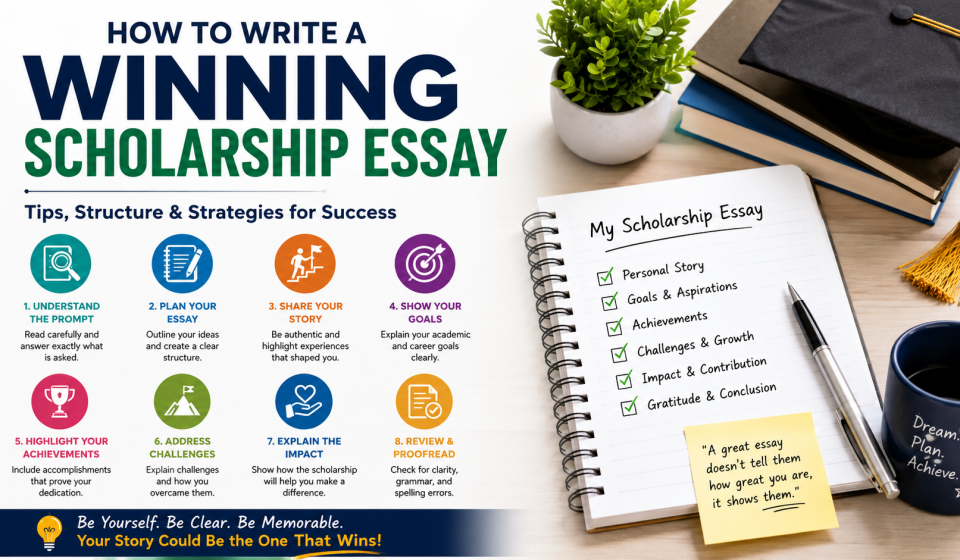

A scholarship essay can be one of the most important parts of a student’s scholarship application. Grades, certificates, and achievements show what you have done, but an essay shows who you are. It gives scholarship committees a chance to understand your story, goals, challenges, personality, and motivation. A strong essay can make your application stand out even when many other students have similar academic records.
Understand the Scholarship Essay Prompt
Before writing anything, read the essay prompt carefully. Many students make the mistake of writing a general essay without answering the exact question. Scholarship committees usually ask prompts such as why you deserve the scholarship, what your career goals are, how you overcame a challenge, or how education will help you make a difference.
Underline the main keywords in the prompt. If the question asks about leadership, focus on leadership examples. If it asks about financial need, explain your situation respectfully and clearly. Your essay should directly answer the prompt from beginning to end.
Research the Scholarship Provider
A winning scholarship essay should match the values of the organization offering the scholarship. Before writing, research the scholarship provider, their mission, goals, and the type of students they support.
For example, if the scholarship focuses on community service, include your volunteer work or social impact. If it supports future leaders, highlight leadership qualities and responsibility. If it supports STEM students, explain your interest in science, technology, engineering, or mathematics.
This helps your essay feel more relevant and connected to the scholarship’s purpose.
Start with a Strong Introduction
Your introduction is your first chance to impress the reader. Avoid starting with common lines like “My name is…” or “I am applying for this scholarship because…” Instead, begin with a short personal story, meaningful moment, challenge, or powerful statement.
A strong introduction should make the reader curious and interested. For example, you can start with a moment when you realized the value of education, a challenge that shaped your goals, or an experience that inspired your career path.
The introduction should be emotional but focused. It should lead naturally into the rest of your essay.
Tell Your Personal Story
Scholarship committees read many essays, so your personal story is what makes yours unique. Do not only list your achievements; explain the journey behind them. Share your experiences, struggles, lessons, and growth.
For example, instead of saying, “I am hardworking,” describe a time when you balanced studies with responsibilities at home or worked hard to improve your grades. Instead of saying, “I am passionate about medicine,” explain what inspired you to choose healthcare and how you plan to help people in the future.
Your story should be real, specific, and meaningful.
Show Your Goals Clearly
A scholarship provider wants to know how the scholarship will help you succeed. Your essay should explain your academic goals, career goals, and long-term vision. Be specific about what you want to study, why it matters to you, and how you plan to use your education.
For example, instead of writing, “I want to become successful,” write about the field you want to enter, the skills you want to gain, and the impact you hope to create. Clear goals show that you are serious, focused, and ready to use the scholarship wisely.
Highlight Your Achievements Without Bragging
Achievements are important, but they should be presented naturally. Mention academic success, awards, leadership roles, projects, internships, volunteer work, or extracurricular activities that support your essay theme.
Avoid sounding arrogant. Instead of simply listing accomplishments, explain what you learned from them. For example, if you led a student club, describe how it taught you teamwork, communication, and problem-solving.
The best scholarship essays show both achievement and humility.
Explain Challenges and Growth
Many scholarship essays ask about challenges or obstacles. When writing about difficulties, avoid focusing only on problems. Instead, explain how you responded, what you learned, and how the experience made you stronger.
Challenges can include financial hardship, family responsibilities, academic struggles, health issues, limited resources, or personal setbacks. Be honest, but stay positive. The goal is not to make the reader feel sorry for you, but to show resilience, determination, and maturity.
Connect the Scholarship to Your Future
A winning essay clearly explains why the scholarship matters. Scholarship committees want to know how their support will help you move forward.
Explain how the scholarship will reduce financial pressure, allow you to focus on studies, support your college expenses, or help you access better opportunities. Also connect it to your future contribution. For example, you may explain how your education will help you serve your community, support your family, or contribute to your chosen field.
This makes the scholarship feel like an investment in your future.
Use Simple and Clear Language
Many students think a scholarship essay must sound very advanced. In reality, clear and simple writing is more powerful. Use natural language, short sentences, and strong examples.
Avoid unnecessary complicated words, repeated phrases, and confusing sentences. Your essay should sound professional but still personal. The reader should feel like they are listening to a real student with real goals.
Good writing is not about showing off vocabulary; it is about communicating your message clearly.
Keep the Essay Well Structured
A scholarship essay should have a clear structure. Start with an engaging introduction, continue with body paragraphs that explain your story and goals, and end with a strong conclusion.
Each paragraph should focus on one main idea. Use smooth transitions so the essay flows naturally. Avoid jumping from one topic to another without connection.
A well-structured essay is easier to read and more convincing.
Avoid Common Scholarship Essay Mistakes
Some mistakes can weaken your scholarship essay. Avoid copying sample essays from the internet, using generic statements, ignoring the prompt, writing too much about problems without solutions, or submitting the essay without proofreading.
Also avoid repeating information that is already clear from your application form. Use the essay to add depth, personality, and meaning to your application.
Originality is very important. Your essay should sound like you, not like a template.
Proofread and Edit Carefully
Even a strong essay can lose impact if it has spelling, grammar, or punctuation mistakes. After writing your first draft, take time to revise it. Check if your essay answers the prompt, flows smoothly, and includes specific examples.
Read it aloud to find awkward sentences. Ask a teacher, mentor, friend, or family member to review it and give honest feedback. Editing helps make your essay more polished and professional.
Do not wait until the last day to write your scholarship essay. Good essays need time.
End with a Powerful Conclusion
Your conclusion should leave a strong final impression. Do not simply repeat everything you already wrote. Instead, summarize your main message and show confidence about your future.
End by reminding the reader why the scholarship matters to you and how you will use the opportunity responsibly. A good conclusion should feel hopeful, focused, and memorable.
Source
https://sl1nk.com/3icq2y0
https://sl1nk.com/0yirtxs
Conclusion
Writing a winning scholarship essay requires honesty, planning, and clear storytelling. A strong essay answers the prompt, shares a personal journey, explains future goals, and connects the scholarship to the student’s dreams. It should be specific, well-structured, and written in a natural voice.
Scholarship committees want to support students who are motivated, responsible, and ready to make the most of the opportunity. By sharing your real story, showing your strengths, and explaining your goals clearly, you can create an essay that stands out and improves your chances of winning a scholarship.
FAQs
1. What should I include in a scholarship essay?
You should include your personal story, academic goals, career plans, achievements, challenges, and how the scholarship will help your future.
2. How do I start a scholarship essay?
Start with a strong introduction such as a personal story, meaningful experience, challenge, or moment that inspired your educational goals.
3. How long should a scholarship essay be?
The length depends on the scholarship requirements, but many essays are between 500 and 1000 words. Always follow the given word limit.
4. What makes a scholarship essay stand out?
A scholarship essay stands out when it is personal, specific, honest, well-structured, and directly answers the prompt.
5. Can I mention financial problems in my scholarship essay?
Yes, you can mention financial problems if relevant, but focus on how you are working toward your goals and how the scholarship will help.