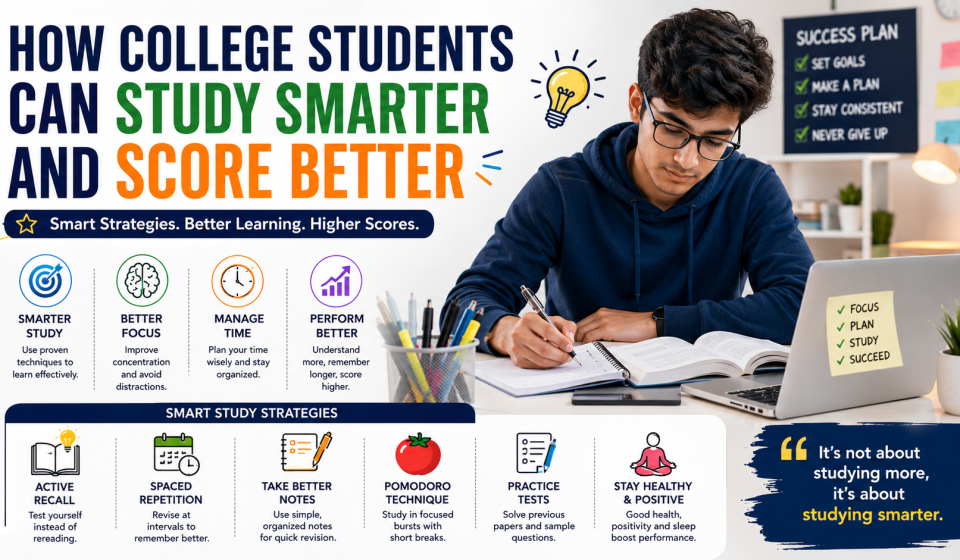

College life is full of opportunities, but it also comes with pressure. Students have to attend lectures, complete assignments, prepare for exams, manage projects, participate in activities, and sometimes handle part-time jobs. In such a busy routine, studying longer is not always the best solution. The real secret is learning how to study smarter.
Why Smart Study Matters for College Students
Many college students work hard but still do not get the results they expect. This often happens because they follow old study habits like rereading notes repeatedly, memorizing without understanding, or studying only before exams.
Smart study helps students save time and improve performance. It allows them to focus on important topics, organize their learning, and reduce exam stress. When students study with a proper method, they can improve both confidence and academic results.
In today’s competitive education system, smart study is not optional. It is necessary for success.
Create a Realistic Study Plan
A good study plan is the foundation of smart learning. Without a plan, students may feel confused about what to study and when to study. A proper schedule helps divide subjects, topics, assignments, and revision time.
Students should create a weekly study plan instead of planning only one day at a time. Difficult subjects should be studied when the mind is fresh. Easy topics can be revised later in the day.
The plan should be realistic. Studying for 10 hours every day may sound impressive, but it is difficult to maintain. A consistent 3 to 4 hours of focused study can be more useful than long distracted study sessions.
Use Active Recall
Active recall is one of the most effective study techniques. Instead of reading the same page again and again, students should test themselves on what they remember.
After studying a topic, close the book and try to explain it in your own words. Write down key points without looking at notes. Ask yourself questions and answer them from memory.
This technique strengthens the brain’s ability to remember information. It is useful for theory subjects, formulas, definitions, case studies, and exam preparation.
Practice Spaced Repetition
Many students forget what they study because they revise only once. Spaced repetition solves this problem by reviewing information at regular intervals.
For example, revise a topic on the same day, then after two days, after one week, and again before the exam. This method helps transfer knowledge from short-term memory to long-term memory.
Students can use flashcards, revision notebooks, or study apps for spaced repetition. It is especially useful for subjects that require memorization.
Take Better Notes
Smart note-taking helps students understand and revise quickly. Copying every word from a lecture is not useful. Instead, students should write important points, examples, formulas, definitions, and summaries.
The Cornell Note-Taking Method is a popular system. It divides the page into notes, keywords, and summary sections. Mind maps and bullet points are also helpful for organizing information.
Good notes should be simple, clear, and easy to review before exams.
Focus on Understanding, Not Memorizing
Memorization may help for short answers, but real success comes from understanding. College exams often test concepts, applications, and problem-solving skills.
Students should ask why and how while studying. They should connect new topics with real-life examples. When a concept is understood deeply, it becomes easier to remember and explain.
Understanding also helps students write better answers in exams because they can explain ideas in their own words.
Use the Pomodoro Technique
The Pomodoro Technique is useful for students who struggle with focus. In this method, students study for 25 minutes and take a 5-minute break. After four sessions, they take a longer break.
This technique keeps the mind fresh and prevents tiredness. It also makes large study tasks feel smaller and easier.
Students can use a timer or mobile app to follow this method. During each session, they should avoid checking messages or social media.
Solve Previous Question Papers
Previous question papers are powerful tools for scoring better. They help students understand the exam pattern, important topics, question style, and time management.
Students should solve papers under exam-like conditions. This improves speed and confidence. After solving, they should check mistakes and revise weak areas.
Practicing papers regularly helps students reduce fear and perform better in the actual exam.
Study in a Distraction-Free Environment
A proper study environment can improve concentration. Students should choose a clean, quiet, and comfortable place to study. The study table should have only necessary books, notes, stationery, and water.
Phones are one of the biggest distractions. Students should keep phones away or use focus mode while studying. Social media notifications can break concentration and reduce productivity.
A distraction-free environment helps students complete more work in less time.
Use Technology Wisely
Technology can be a great support for smart study. Students can use educational videos, online courses, digital notes, flashcard apps, AI tools, and productivity apps.
AI tools can help explain difficult concepts, summarize notes, create quizzes, and prepare study plans. However, students should not depend completely on technology. The goal should be learning, not copying.
Technology is helpful only when used with discipline.
Revise Regularly
Revision is essential for scoring better. Studying a topic once is not enough. Regular revision keeps information fresh in the mind.
Students should revise daily, weekly, and before exams. Short revision sessions are better than last-minute cramming. Revision can include reading notes, solving questions, using flashcards, or explaining topics aloud.
A good revision habit reduces exam stress and improves confidence.
Take Care of Health
Good academic performance depends on good health. Students should not ignore sleep, food, exercise, and mental well-being.
Lack of sleep affects memory and concentration. Eating unhealthy food and sitting for long hours can reduce energy. Students should sleep properly, drink enough water, eat balanced meals, and take short walks.
A healthy body supports a sharp mind.
Stay Consistent and Motivated
Consistency is more important than perfection. Students do not need to study all day. They need to study regularly with focus.
Motivation may change, but discipline builds success. Setting small goals, tracking progress, and rewarding yourself after completing tasks can help maintain motivation.
Students should remember that improvement takes time. Small daily efforts create big academic results.
Source
https://l1nq.com/efmif5i
https://l1nq.com/3yszzhm
Conclusion
College students can score better by studying smarter, not just harder. Smart study includes planning, active recall, spaced repetition, better notes, regular revision, practice tests, and a distraction-free environment.
Students should focus on understanding concepts, using technology wisely, and maintaining good health. A balanced routine helps reduce stress and improve academic performance.
By following the right study methods consistently, college students can improve their grades, build confidence, and achieve long-term success.
FAQs
1. What does studying smarter mean?
Studying smarter means using effective techniques like planning, active recall, revision, and practice testing to learn better in less time.
2. How many hours should a college student study daily?
Most college students can benefit from 3 to 4 focused hours of study daily, depending on their subjects and exam schedule.
3. What is the best study technique for scoring better?
Active recall, spaced repetition, and solving previous question papers are among the best techniques for scoring better.
4. How can students avoid distractions while studying?
Students can keep phones away, use focus mode, study in a quiet place, and set clear goals for each study session.
5. Is group study useful for college students?
Yes, group study can be useful when students discuss topics seriously, solve doubts, and stay focused on learning.